
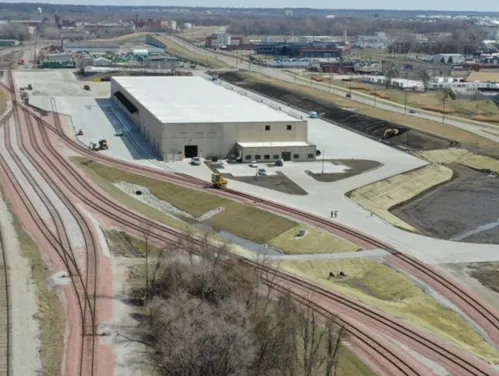
Getting Started: Rail Planning, Design, and Site Evaluation
Processes for getting started vary widely based on the railroad carrier. Yet regardless of railroad size or service, beginning the discussion with the railroad is essential before project work begins. Each railroad will have specific requirements for constructing rail that will connect with their line. Land development and railroad access sites may already be designated for rail use and more information can be available by visiting the railroad, Iowa Economic Development Authority (IEDA) and public utilities and local jurisdictions. See the railroad’s website or find contact information for each of the railroads in the railroad profile section of this toolkit.
Once a site has been determined, communication with the railroad representative is essential to identify service, rates, billing requirements, and equipment availability for the proposed location and railroad. A Memorandum of Understanding may be required to document the plan for the proposed facility. If the site involves signal facilities, an engineering consultant will need to prepare a plan to expedite the signal planning process.
Processes for getting started vary widely based on the railroad carrier. Yet, regardless of railroad size or service, beginning the discussion with the railroad is absolutely essential before project work begins. Final documentation depends on the rail carrier and the site owner. The process for Class I and shortline railroads can differ. Typical documents include:
- A detailed construction drawing of the proposed track layout and other facility features that will become part of an Industrial Track Agreement.
- Additional legal documents, payments, and insurance will be required for the project. Once the track design is finalized, typically an Industrial Track Agreement will be finalized.
Building a new site
Considerations include:
Site location and facility description.
Company information and ownership.
Rail service contracts or lease agreements.
Current rail operating status.
Commodities and equipment types to be handled.
Loading and unloading information.
Service frequency expectations and freight volumes.
Safety considerations.
Three basic track layouts for connecting to a serving railroad.
- Basic stub-in or spur: This is an ordinary spur that connects to the serving railroad at one end. With this configuration, cars may need to be pushed and pulled, and will have a limited number of cars that can be handled at a time.
- Runaround or siding: A section of track that usually parallels the serving railroad and can accommodate traffic from either direction.
- Loop track: A track designed to support continuous train movement for faster loading/unloading of unit trains. Class I railroads may require loop-type tracks if the business wants to connect to one of the railroad’s main lines.
Existing Industrial Parks
If the site is already rail served, communication with the railroad is still essential as newer locomotives may require larger track curvature due to axle placement. Jumbo hopper cars also require heavier track structures to handle increasing loading weights. Railroads may require the following documentation:
- Industrial Track Agreement
- Track Agreement Audit
- Engineered drawings and current track condition
- General location map
- Material safety data sheet (if hazardous materials will be handled)
Track Construction
Track construction is the final step in the process and can only begin after the Industrial Track Agreement is completed. In some cases, the railroad will perform the work. In other cases, the facility owner contracts with professional track development and construction companies to complete the work. The railroad can assist in identifying qualified engineering and construction firms.
- Slope (also known as grade): Even very small slopes (e.g., 1 percent) can be important to a railroad for train operations. Also, from a safety standpoint, many railroads will require zero slope between the spur and the serving line. This is to keep errant rail cars from coasting toward the serving line. Site evaluation should include examining any elevation differences between the site and the serving railroad. Significant earthwork to correct slopes can be expensive.
- Track curvature: Trains cannot turn as sharply as trucks. It is not uncommon to see a turning radius of 600 feet or more for a train compared to 60 feet for a truck. Space requirements for such large turns need to be included in a site evaluation.
- Nearby obstacles: Turnouts for rail spurs or sidings cannot be located too close to rail curves, road crossings, bridges, tunnels, or other turnouts. For many railroads, the minimum distance to any of these obstacles is 200 feet.