Iowa's Rail Network
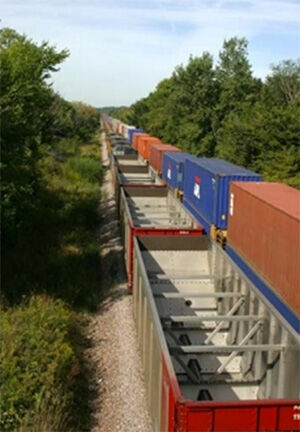
Iowa has a robust and thriving rail transportation system that has 17 operating railroads and 3,801 miles of mainline track. Stretched end to end, that length is equivalent to the distance from Iowa to Ireland. This system is a critical component of Iowa’s agriculture and manufacturing economies and allows Iowa businesses to send or receive shipments around the world through connections with the multimodal transportation system.
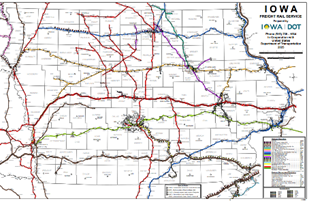
Iowa has an extensive rail system shown on the 2025 Freight Rail Service Map (2.8 MB) .pdf for the safe and eco-friendly transport of large volumes of freight. The information on the Freight Railroad Profiles shows the overview of each operating railroad in Iowa, including total miles of freight railroad owned and operated by each railroad, lines owned/leased and operated under contract, trackage, and/or haulage rights, transloading/intermodal locations, and interchanges.
Although rail accounts for about three percent of the freight network’s mileage, it carries roughly nine percent of Iowa’s freight tonnage. The rail network performs an important role in moving bulk commodities produced and consumed in the state to and from local, regional, and national processors, livestock feeders, and river terminals, as well as ports for international export. The rail network’s ability to haul large volumes over long distances at low costs will continue to be a major factor in moving freight and improving the economy of Iowa.
Benefits of Using Rail
For rail freight improvements, the benefits involve increased transportation competition resulting in lower cost to shippers, less highway congestion and damage, and reduced environmental and energy impacts. By their nature, grade crossing improvement projects and other rail-related improvements also increase transportation safety.
The transport of hazardous materials is regulated by the FRA and the Pipeline and Hazardous Materials Safety Administration (PHMSA). Class I railroads have additional resources and personnel that can be dispatched quickly to supplement local response to hazardous materials rail incidents outside of public emergency response.
Positive Train Control (PTC)
PTC is a set of technologies that prevent the most serious human error incidents. It is designed to prevent train-to-train collisions or derailments caused by excessive speed, unauthorized train movement onto sections of track where maintenance activities are taking place, and movement of a train through a track switch left in the wrong position. These technologies are designed to automatically stop a train before certain accidents.
Remote Control Locomotives (RCL)
For more than 20 years, freight railroads have successfully used RCL technology — also known as Remote Control Operations (RCO) — to enhance the safety and efficiency of locomotive operations within railyards. Widely accepted throughout the industry, RCL has proven to be as safe or safer than conventional methods in facilitating yard operations. All RCO employees are FRA-certified and receive specialized training in remote operations.
Based on existing technologies and transportation modes, rail is considered the most fuel-efficient approach to transport goods over land. According to the American Association of Railroads (AAR), not only can one train move nearly 500 tons on a gallon of fuel, one train can carry the freight of hundreds of trucks. Additionally, AAR indicates freight railroads are, on average, three to four times more fuel efficient than trucks and moving freight by rail instead of trucks is expected to translate to a reduction in greenhouse gas (GHG) emissions by up to 75%. The efficiency is reflected in the 2020 national data, where freight rail only represented 6.0% of the GHG emissions related to freight transportation, while transporting almost 29.0% of the total freight.
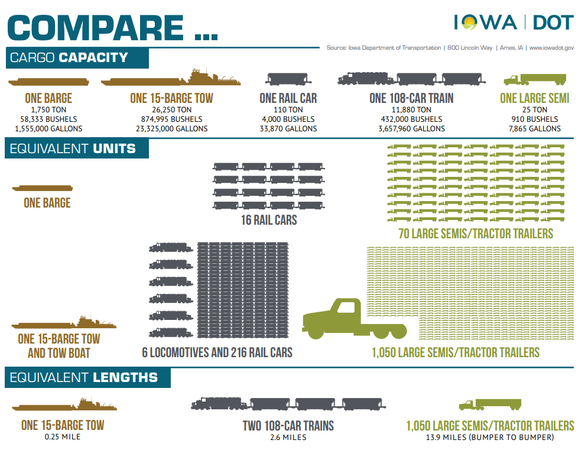
The efficiency of rail relative to truck is not new. A 2022 study from Texas A&M Transportation Institute comparing domestic freight transportation modes highlighted that while freight trucks have been improving in terms of metric tons of GHG emissions produced per ton-mile transported from 2005 (171.9 metric tons GHG per ton-mile) to 2019 (140.7 metric tons GHG per ton-mile), it is still significantly more environmentally damaging than rail, which only produced 21.6 metric tons of GHG per ton-mile transported in 2019.
- Efficiency of Freight Rail can be seen on the Transportation Mode Comparison Chart.
Rail has particular cost advantages when shipping sizable quantities or commodities in bulk where the large capacity of a rail car (or multiple cars) offers economies of scale. Shippers moving oversize or overweight truckloads may be able to use rail to avoid or reduce issues with highway clearances and permitting. Rail is often a very effective way to move large equipment, pipe, and other dimensional cargo. The serving railroad can provide details and the process to ship over-dimensional loads by rail.
According to the Federal Highway Administration (FHWA) Freight Analysis Framework (FAF), freight tonnage moving in the U.S. will increase by nearly 27% between 2022 and 2050. This will prove to be a sizable challenge for the overall freight transportation system. This growth will be reflected in Iowa and will not uniform across modes. Iowa’s transportation system facilitated the movement of over 624 million tons of freight with an estimated value of $377 billion in 2022. These figures are expected to grow to over 1 billion tons with a value of over $745 billion in 2050. Additionally, Iowa is a net exporting state, meaning the state produces and exports more goods than it imports. This is true both in terms of tonnage and value. The gap between Iowa’s imports and exports is projected to grow wider from 42 million tons in 2022 to 120 million tons in 2050.
Commodities
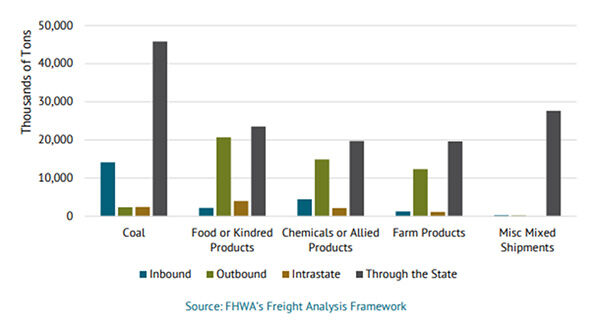
Iowa rail movements in 2022 totaled 273.6 million tons and carried over 6.0 million carload units. Rail movements through Iowa account for 66% of the weight and 84% of the carloads of all rail movements in the state. The five commodity categories included on the chart below show – coal, food or kindred products, chemicals or allied products, farm products, and misc. mixed shipments account for 80% of the total commodity movements by weight and 69% by carloads.
Alternative Access to Railroads
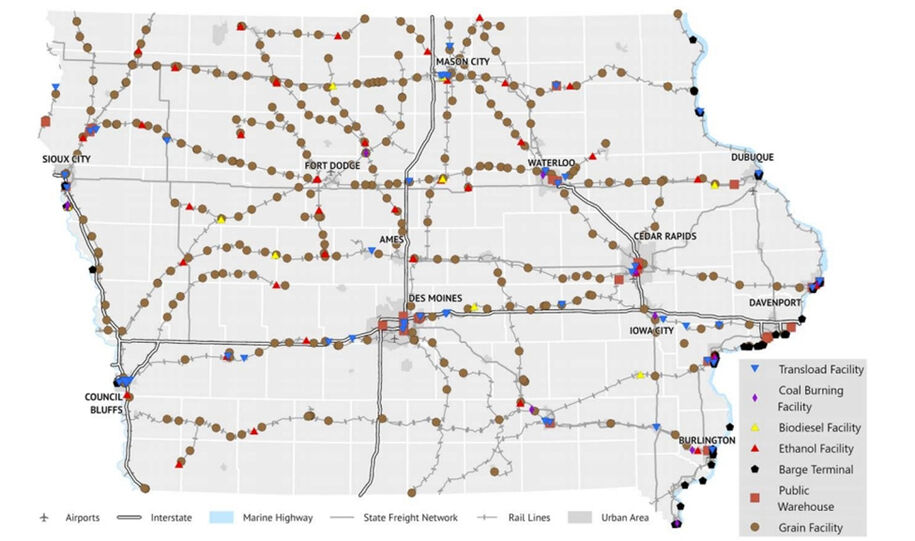
Transloading refers to the transfer of freight shipments, typically bulk, from the vehicle/container of one mode to that of another at a terminal interchange point. Types of transload facilities include the following. Iowa Transloading Facilities (Map) Figure 3.6 from Iowa State Rail Plan. For a complete list of Rail-Served Freight Facilities, refer to the Resource section of the rail toolkit
Types of Transloading
- Team track: A simple siding or spur track where rail cars are placed and available for use to load and unload freight. Once the cars are loaded, the railroad is notified to pick them up. Team tracks can be owned by a railroad or rail customer.
- Cross-dock: Locations where cargo is unloaded from an incoming truck or rail car and is reloaded directly into outbound trucks, trailers, containers, or rail cars. A cross-dock typically allows level loading between modes.
- Barge terminals: Locations where commodities are transferred from barges to trucks and/or rail cars. These terminals are a staple of industries moving bulk products by inland waterways.
- Biorefineries: Production facilities for renewable fuels made with corn and the byproducts of corn production. These locations typically receive raw materials by truck and ship finished biodiesel/ethanol by truck and/or rail. The opportunity to shift from one mode to another qualifies these locations as transloads.
- Coal-burning facility: Power plants that burn coal to generate energy. These facilities typically receive large amounts of coal via railroad or waterway.
- Grain elevators: Facilities that collect grain from farmers by tractor and trailer or truck. The grain is then stored and shipped to market via truck and/or rail. Iowa has a vast network of grain elevators to handle the large production of corn and soybeans each year before being transported elsewhere. As is the case with biorefineries, the multiple transportation options qualify these locations as transloads.
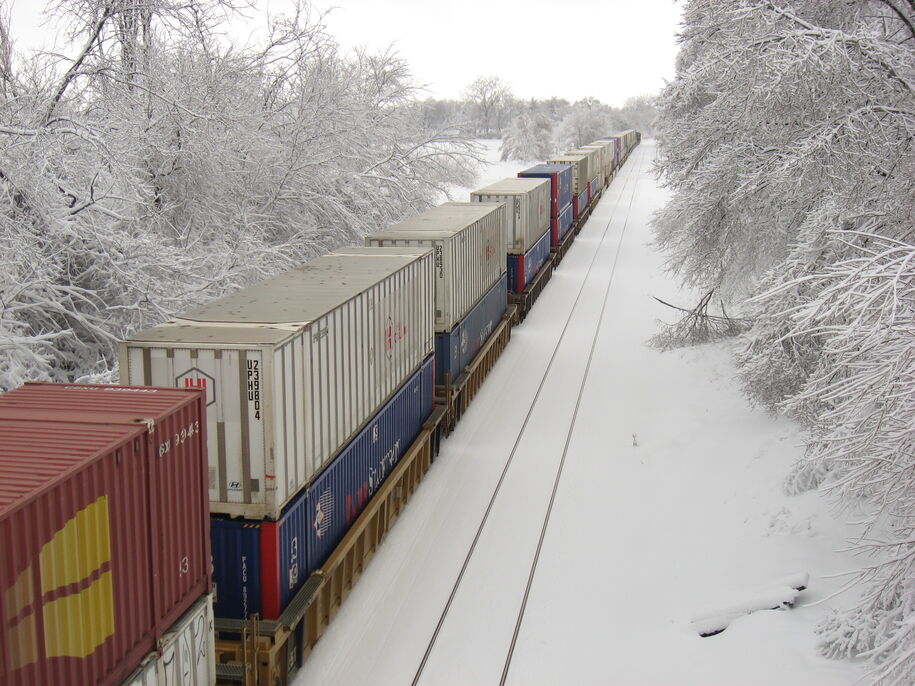
Intermodal refers to the transfer of freight using an intermodal container or trailer through multiple modes of transportation (rail, barge, and/or truck) without the handling of the freight itself when changing modes. This method improves security and transportation speed while reducing the damage and loss of goods. Container transfer facilities handle rail-to-truck and truck-to-rail transfers in sealed units such as trailer-on-flatcar (TOFC) or container-on-flatcar (COFC).
A warehouse is a commercial building for storing goods, including raw materials, packing materials, spare parts, components, and finished goods associated with agriculture, manufacturing, and production. Warehouses are used by manufacturers, importers, exporters, wholesalers, and transport businesses, and some warehouses include transloading capabilities to offer short- and long-term storage and handling of goods.
Overview of Government Assistance Programs
The federal, state, and local governments all have business assistance or funding programs that can assist you in various ways. Iowa DOT may help sponsor applications for federal funding through programs such as Better Utilizing Investments to Leverage Development (BUILD)and the Consolidated Rail Infrastructure and Safety Program (CRISI) program, among others. Iowa Economic Development Authority’s (IEDA) mission is to strengthen economic and community vitality by building partnerships and leveraging resources to make Iowa the choice for people and business. Through its two main divisions – business development and community development – IEDA administers several state and federal programs to meet its goals of assisting individuals, communities, and businesses. IEDA aids in the attraction of new industries along the state’s rail lines. Such investments ensure that these railroads can continue to serve their shippers, thus helping to retain businesses and employment and prevent the diversion of freight from rail to truck and the consequent maintenance impacts to the state highway system.
Railroad Revolving Loan and Grant (RRLG) Program
The RRLG Program offers financial aid to enhance rail facilities for the creation of jobs, economic growth, and improved rail transportation in Iowa. Funding availability for the program varies based on loan repayments and state appropriations. The Iowa Transportation Commission is responsible for approving projects. RRLG money is available to railroads, businesses, local governments, economic development agencies, and non-profit groups.
RRLG Fact Sheet summarizes the accomplishments over time, from 2006-2025, the program has aided with.
The program assists in three categories.
- Targeted Job Creation: Rail projects that offer direct job opportunities are eligible for loans and grants. Grant funding is subject to the applicant's commitment to job creation and retention, while loans can be used to supplement grants if the project's cost exceeds the available grant funding. Both grants and loans require a local contribution.
- Rail Network Improvement: Rail projects that enhance existing rail lines or industrial access and do not create new jobs fall under this category. Loans are the only available funding option. These loans will be provided at a 0% interest rate for ten years. However, a matching contribution of 20% is required for loan requests.
- Rail Port Planning and Development: Funding is available for planning studies that provide information regarding the location, design, or funding needs for a rail port facility. These studies assist decision-makers in evaluating rail development options that promote industrial and business advancement while supporting economic growth. Grants of up to $100,000 are available with a 20% matching contribution required
Grade Crossing Safety Program
This state-funded program has provided funding since 1973 for a portion of the maintenance costs for traffic control devices including flashing light signals, flashing light signals with cantilever assemblies, and flashing light signals with automatic gate arms. These devices are activated by the approach or presence of a train. The program amount is $700,000 annually.
Highway-Railroad Grade Crossing Surface Repair Program
This state-funded program is designed to assist city and county highway authorities and railroads to promote safety through surface replacement at public highway railroad grade crossings. This program is funded through an annual allocation of $900,000 from Iowa’s Road Use Tax Fund.
Iowa Clean Air Attainment Program (ICAAP)
Fixing America’s Surface Transportation Act (FAST Act), the current Federal Transportation Reauthorization Act, continued the Congestion Mitigation Air Quality Improvement (CMAQ) program to provide a flexible funding source to State and local governments for transportation projects and programs to help meet the requirements of the Clean Air Act. Funding is available to reduce congestion and improve air quality for areas that do not meet the National Ambient Air Quality Standards for ozone, carbon monoxide, or particulate matter (nonattainment areas) and for former nonattainment areas that are now in compliance (maintenance areas). Indicative of the Congressional intent for creating the CMAQ Program, the Iowa DOT Commission established ICAAP in 1995. Iowa DOT administers the ICAAP on a statewide competitive application basis and awards federal funds to projects with the highest potential for reducing transportation-related congestion and air pollution.
Revitalize Iowa’s Sound Economy Program (RISE)
Projects funded by the RISE program promote economic development in Iowa through the establishment, construction, and improvement of roads and streets. The RISE program is targeted toward value-adding activities that feed new dollars into the economy and provide maximum economic impact to the state on primary or secondary roads, and city streets open for public use. While all counties and incorporated cities in Iowa are eligible to apply, funding is generally limited to industrial, manufacturing, warehousing, distribution, and professional office developments, with few exceptions.
Projects seeking competitive federal discretionary grant funding under many of the available programs are typically subjected to a rigorous benefit-cost analysis (BCA) to quantify specific public benefits needed to justify the investment, in addition to narrative description of project merits. Additional funding opportunities can be found on the Iowa DOT grant and program list.
Better Utilizing Investments to Leverage Development (BUILD) Grant Program
The U.S. Department of Transportation's (USDOT) Better Utilizing Investments to Leverage Development (BUILD) grant program provides grants for surface transportation infrastructure projects with significant local or regional impact. The eligibility requirements of BUILD allow project sponsors, including state and local governments, counties, Tribal governments, transit agencies, and port authorities, to pursue multi-modal and multi-jurisdictional projects that are more difficult to fund through other grant programs.
Consolidated Rail Infrastructure & Safety Improvements (CRISI) Grant Program
The Consolidated Rail Infrastructure & Safety Improvements (CRISI) Grant Program funds projects that improve the safety, efficiency, and reliability of intercity passenger rail, freight rail, and rail infrastructure. Learn more about this grant opportunity on the DOT Competitive Grants Dashboard’s Consolidated Rail Infrastructure & Safety Improvements Program page.
Carbon Reduction Program (CRP)
The Carbon Reduction Program (CRP) was authorized by the Infrastructure Investment and Jobs Act that was enacted in November of 2021. This program is codified in 23 U.S.C. 175, and it provides funding for projects designed to reduce emissions of carbon dioxide from on-road highway sources.
Highway-Railroad Grade Crossing Safety Program
The Federal Highway Safety Improvement Program (formerly Section 130 funds). These funds are primarily used to install or upgrade crossing signals. Other low-cost improvements may be funded such as crossbuck or yield signs, medians, or incentives for crossing closures. Funding is based on a benefit/cost calculation that considers a number of factors, including highway and train traffic, accident history, and project cost. Iowa DOT anticipates spending approximately $5.2 million per year through this program.
Railroad Rehabilitation and Improvement Financing Program (RRIF)
The RRIF program was established by the Transportation Equity Act for the 21st Century (TEA-21) and amended by the Safe Accountable, Flexible and Efficient Transportation Equity Act: a Legacy for Users (SAFETEA-LU), the Rail Safety Improvement Act of 2008, and the Fixing America’s Surface Transportation (FAST) Act. Under this program the Department of Transportation is authorized to provide direct loans and loan guarantees up to $35.0 billion to finance development of railroad infrastructure. Not less than $7.0 billion is reserved for projects benefiting freight railroads other than Class I carriers.
Railroad Crossing Elimination (RCE) Grant Program
The Railroad Crossing Elimination (RCE) Grant Program funds safety-focused highway-rail or pathway-rail grade improvement, relocation, and installation projects.
There are many railroad resources available. Some of the best resources are the individual railroad websites. Transportation services and consulting resources are listed but not necessarily endorsed by the Iowa DOT. Additionally, more general public information is available in trade journals. Trade Associations can be good opportunities for networking and topic-specific presentations. Educational resources are also abundant in Iowa.
Rail Toolkit Resources
Rail Toolkit Contacts who can assist with the Rail Toolkit are listed in the toolkit contact information.
Iowa has an extensive rail system shown on the 2025 Freight Rail Service Map (2.8 MB).pdf (2.8 MB) .pdf for the safe and eco-friendly transport of large volumes of freight. The information on the Freight Railroad Profiles shows the overview of each operating railroad in Iowa, including total miles of freight railroad owned and operated by each railroad, lines owned/leased and operated under contract, trackage, and/or haulage rights, transloading/intermodal locations, and interchanges.
This list provides an inventory of Iowa freight facilities (704.39 KB) .pdf that are served by rail. These lists are not exhaustive. Some facilities listed may no longer be operational, and new facilities may not be represented. Freight Inventory and Performance. Intermodal facilities, transload facilities, barge terminals, public/contract warehouses, coal-burning facilities, ethanol plants, and biodiesel plants are listed. Due to the large number of facilities and locations throughout the state, grain elevators are not listed.
Counties
There are 90 counties of the 99 counties in Iowa with operating railroads, each with county engineering staff who can assist in matters specifically under their jurisdiction. This is a complete list of county engineers and their contact information.
Cities
Cities in Iowa have jurisdiction for matters within their city limits. The website League of Cities provides a complete list of all incorporated cities in Iowa. You can sort all cities by name and population. You can reduce the list by population range and county.
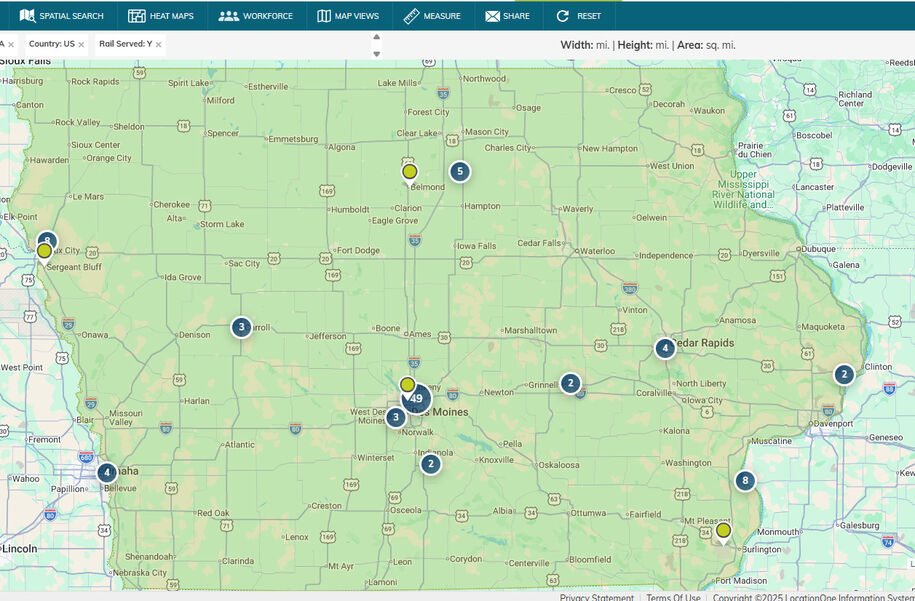
IEDA can help companies find the perfect place for their expansion or relocation. A credentialed Iowa Certified Site has relevant site-related data and documentation accumulated and is designated as “development ready.” Certified sites are listed below or see a full list of buildings and sites. Search Properties provide the ability to limit search results to “rail served” building sites.
Freight transportation intermediaries and third-party logistics (3PLs) companies can provide freight transportation logistics expertise that can improve customer service, reduce damage, improve transit times, and save money. Many companies who have a limited workforce or do not have in-house transportation expertise, especially find that hiring a logistics company to plan, store, package, and ship products can improve the quality of transportation for new companies, small shippers, and mid to large companies with complex shipping needs. The following list of considerations about your supply chain can help identify a company or expert who can work with you to improve service.
Rail Toolkit Contacts
The Rail Team in the Iowa DOT’s Modal Transportation Bureau advocates for a safe, secure, and efficient rail system that ensures Iowa’s economic competitiveness and development by maintaining the rail infrastructure and providing rail access and connectivity for people and goods in an environmentally sustainable manner.