
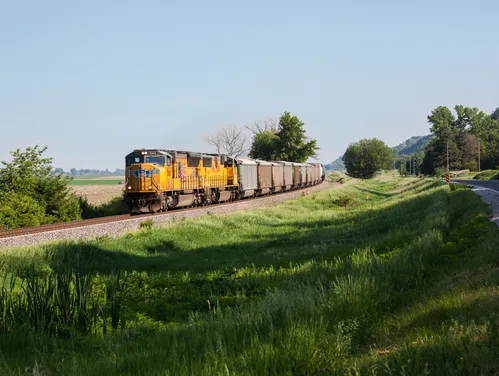
Iowa has a robust and thriving rail transportation system that has 17 operating railroads and 3,801 miles of mainline track. Stretched end to end, that length is equivalent to the distance from Iowa to Ireland. This system is a critical component of Iowa’s agriculture and manufacturing economies and allows Iowa businesses to send or receive shipments around the world through connections with the multimodal transportation system. Individual profiles that include key physical and operational characteristics for each railroad are available below.
Most revenue from rail service is generated by five Class I carriers. Union Pacific and BNSF carry the highest traffic volumes, operating on approximately 2,000 miles of total track in Iowa, including double tracks running east and west.
Class II and III railroads typically provide feeder service to Class I carriers. Iowa has one Class II railroad, Iowa Interstate Railroad, which has over 300 miles of track. Class III railroads have two operating categories – line haul and switching – that facilitate the interchange of rail shipments in urban areas. Switch operators are typically associated with Class I railroads and are common within Class III operations.
2023 Quick Rail Facts
- 3,801 miles of track
- 17 railroads
- 60.1 million tons shipped
- 29.9 million tons received
- 2 Amtrak routes
- 6 Amtrak stations
- 51,499 rail passenger rides
Railroads in Iowa shipped 63.1 million tons of freight and received 29.3 million tons of freight for a total of 92.4 million tons of freight moved by rail in 2022.
Rail service in Iowa is owned and run by 19 different railroad companies. Freight rail service is mostly controlled by six major carriers, with Union Pacific Railroad (UP) and BNSF Railway (BNSF) handling the most traffic. Together, they operate over 1,900 miles of track in Iowa, including double tracks that run east to west across the state. For more information, see 2021 Iowa Rail Trends (332.95 KB) Archived .pdf .
Class I Carriers
The major rail companies, called Class I carriers, operate most of the tracks in Iowa and make the most money from freight. They also pay for most of the rail maintenance and improvements, which benefits the public with little cost to taxpayers. Smaller railroads, called Class II and III, often connect to these larger carriers. Even though railroads make up just 3 percent of Iowa's 130,000-mile freight system, they carry almost 14 percent of the state's freight, mainly bulk goods like grain, coal, biofuels, and fertilizers. These goods are usually moved in large 100 to 110-ton railcars, with trains often stretching over 100 cars long.
Class II & III Carriers
The Class II and III railroads often provide feeder service to the Class I carriers. This arrangement is a result of Class I railroads downsizing and selling off their unprofitable and light-density lines in the 1970s and 1980s. Due to Class II’s and III’s ability to facilitate short and mixed car types, these smaller carriers have been able to create local customer-oriented operations with low operating costs.
Rail Network
The railroad network (2.68 MB) .pdf in Iowa connects people and goods to places across the country and even to other countries. This system is always changing, influenced by the state's size, financial situations, and competition with other transportation methods.
Railroads only make up about three percent of Iowa's freight network, but they carry around nine percent of the state's freight tonnage. Railroads play a big part in moving large amounts of goods produced and used in Iowa to local processors, livestock farms, river terminals, and ports for export. Because railroads can carry large loads over long distances at low costs, they are key to moving goods and boosting Iowa's economy. Railroad service in Iowa keeps changing as companies try to cut transportation costs and work more efficiently.
View the Cargo Capacity Comparison Chart (321.84 KB) .pdf
Railroads in Iowa shipped 63.1 million tons of freight and received 29.3 million tons of freight for a total of 92.4 million tons of freight moved by rail in 2022.