
Content Information
On this page...
Cross Slopes
Tangent Sections
Criteria for cross slopes are established in Section 1C-1.
Back to topHorizontal Curves
Superelevation transitions present a challenge to cross slope drainage because they create locations with 0% cross slope. This can lead to ponding and icing problems. Avoid locating 0% superelevation transition points in the following areas:
- Vertical sag curves.
- Vertical crest curves.
- Areas where longitudinal centerline grade is less than 0.5%.
- Paved raised median openings.
- Areas that already have the potential for ponding and icing.
Longitudinal Pavement Grades
Centerline Profile
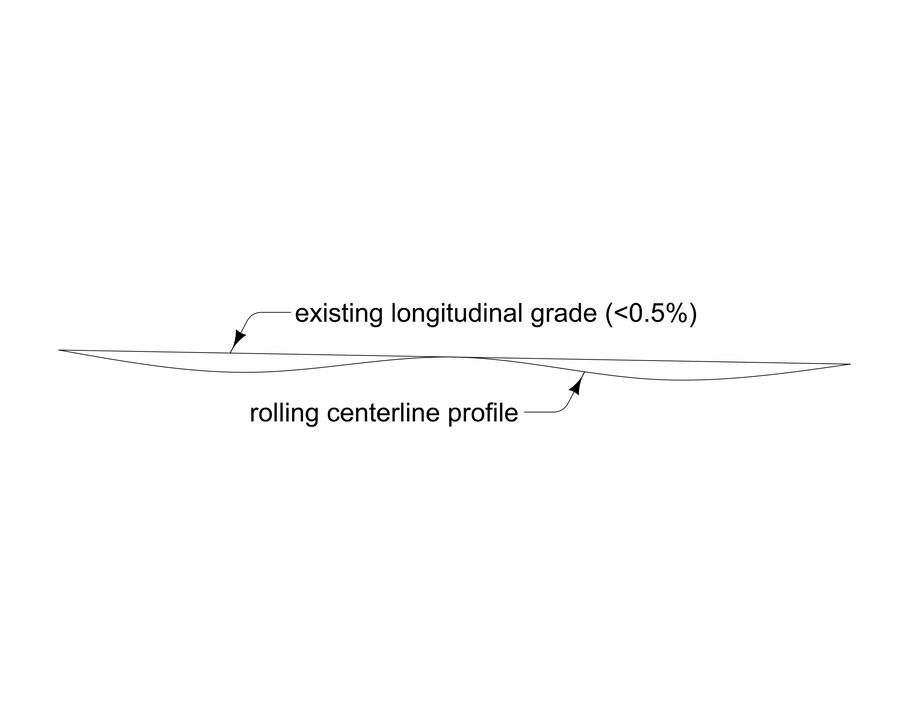
Longitudinal slopes less than 0.5% can result in ponding and the accumulation of debris on curbed roadways and in areas without adequate cross slope (e.g. superelevation transition areas). Verify longitudinal grades meet the design criteria requirements laid out in Section 1C-1 1C-1. Use of a rolling centerline profile may be needed. Figure 1 demonstrates this concept.
On bridges a minimum slope gradient (vector sum of cross slope and grade) of 2% is desired. If a grade plus cross slope of 2% cannot be obtained, the designer should work with the Bridges and Structures Bureau to find an acceptable solution.
Back to topRolling Gutter Profile
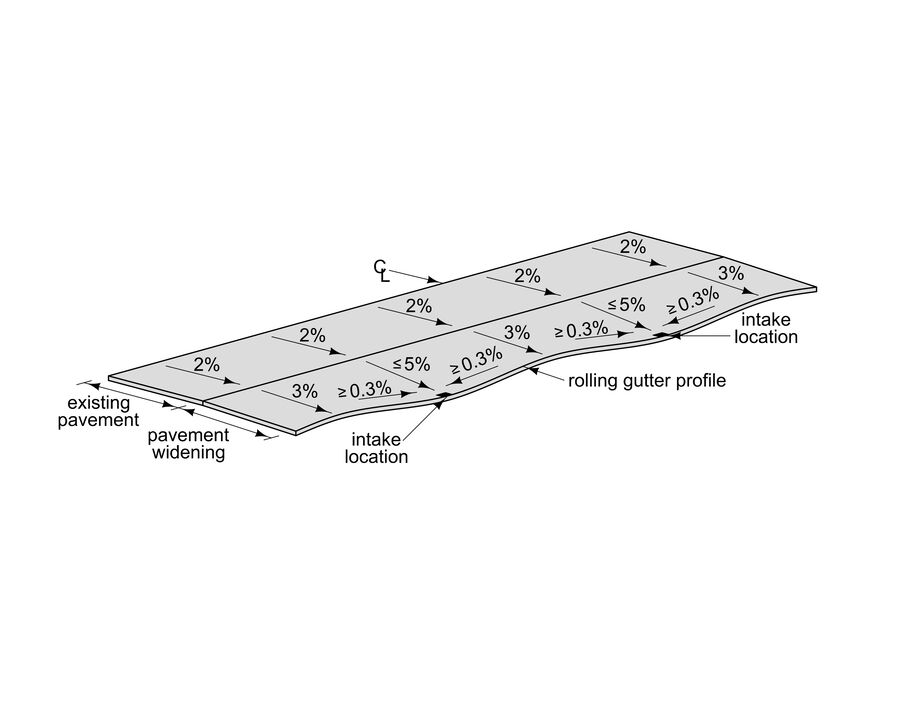
Widening existing pavement can present a challenge if the existing centerline grade is less than design criteria requirements (refer to Section 1C-1 1C-1). To meet the minimum gutter grade in cases such as these, use a rolling gutter profile for the pavement widening. Minimum gutter grades can be maintained by warping the cross slope of the pavement widening to a maximum of 5.0%. See Figure 2 for an example.

| For curbed roadways, gutter grades less than 0.3% require the approval of the Design Engineer. A grade greater than 0.3% overcomes surface tension and small construction bumps. |
|---|
Gutters on Vertical Curves
A long vertical curve or a vertical curve on a flat grade will create a flat area at the crest or sag. If the flat area is large enough, water may pond or leave debris in the gutter. To check for this problem, use the following formula.
\(\frac{L}{A} > 167\)
Where, L is the length of the vertical curve in feet
A is the algebraic difference of the centerline percent grades(\(g_2 - g_1\)).
If L/A is greater than 167
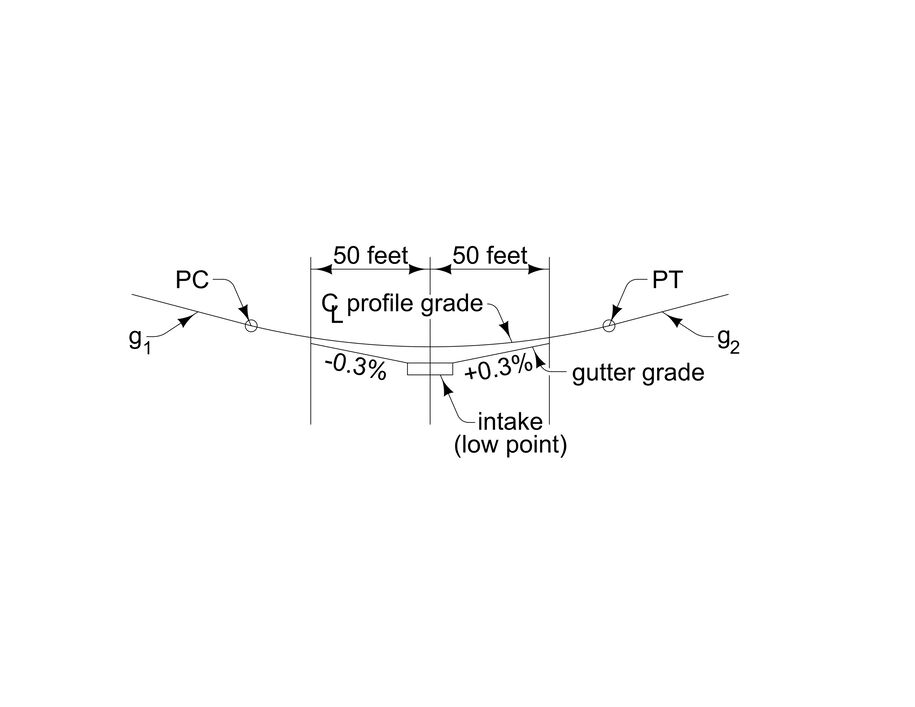
Where the centerline grade approaches zero, warp the cross slope similar to the rolling gutter profile (see Figure 2) to maintain a constant gutter grade of 0.3% within 50 feet on either side of the crest or sag (see Figure 3).
If L/A is less than 167
No special cross slope warping is necessary because the grade of the gutter should theoretically be steep enough to carry water to the intake.
|
| Check for minimum gutter grades on CREST vertical curves as well as SAG vertical curves. Note: the low point of a taper may not match the low point of the mainline. |
|---|
Location of Vertical Curves
Make drainage requirements a priority when determining grades. The locations of sag vertical curves can be critical to pavement drainage. For instance, a sag located in the middle of a block may require extra intakes and storm sewer unless it is the natural low spot. On the other hand, a sag located in the middle of an intersection may cause ponding (and potential icing) problems requiring grate intakes and special shaping. Do not locate sags on bridges.
Back to topDrainage at Intersections
Use the following guidelines when designing drainage at intersections:
- Avoid ponding or trapping water during the minor storm design event. Evaluate maximum ponding depth and elevation potential by determining available overland or overstreet flow paths during the major storm design event.
- Design returns so that water will flow toward intakes and away from intersections.
- Do not locate intakes within pedestrian curb ramps.
- Avoid locating intakes within intersection returns.
- Maintain gutter grades at a minimum of 0.3%.
- Maintain drainage away from the center of intersections.