Content Information
On this page...
Temporary sediment control in urban areas can present difficulties for designers because often few, or even no, areas are available for temporary storm water detention. This could be a result of right-of-way constraints, risks associated with the potential for ponding water on private property, or a variety of other reasons.
Back to topTemporary Sediment Control Options
Several details are available for designers to use in urban areas to address temporary sediment control. These devices (Standard Road Plan EC-602 and Design Details 570-5 and 570-7) are discussed Section 10C-4. Designers can also look into the use of vegetated buffers (see Section 10C-3). Designers don’t do storage calculations for these practices because they aren’t designed to store storm water – only to filter it. Other best management practices, such as sodding, may also be used. Contact the Agronomist for assistance with temporary sediment control in urban areas.
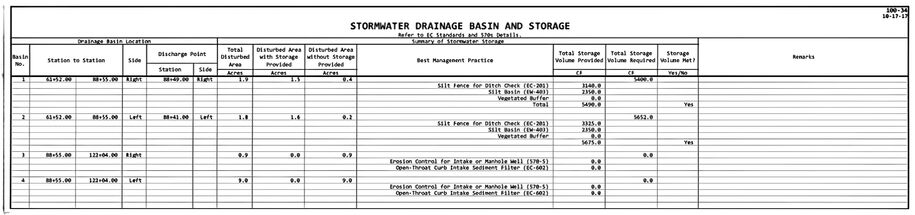
Designers should first look to using storm water detention. If that is not an option, look to using the above design details and/or vegetated buffers. In some cases, designers may have a combination of storm water detention, the above mentioned design details, and/or vegetated buffers. For these projects, follow the procedures of Section 10C-2 for disturbed areas filtered through detention basins. Indicate in Tabulation 100-34 which areas are filtered using the design details and/or vegetated buffers, and the size of these areas, see example below. In other cases, drainage all goes to existing or proposed intakes and the only options are the above mentioned details.

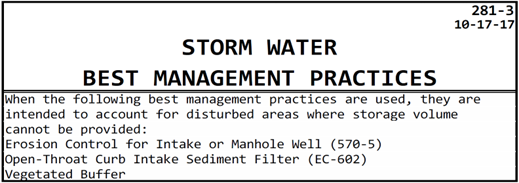
| If storm water detention is not possible, include Standard Note 281-3 in the plans to indicate which best management practices (design details, vegetated buffers, etc.) are being used in place of storm water detention. Do not use Standard Note 281-03 without permission of the Agronomist. |
|---|
Example for a Transitional Area
A project is located in a transitional area. Part of the cross section is rural with ditches, while the remainder is urban curb and gutter with no storage areas available. Some of the runoff in the rural section runs through vegetation. Tabulation 100-34 might look something like:
Standard Note 281-3 might look like: