
Content Information
On this page...
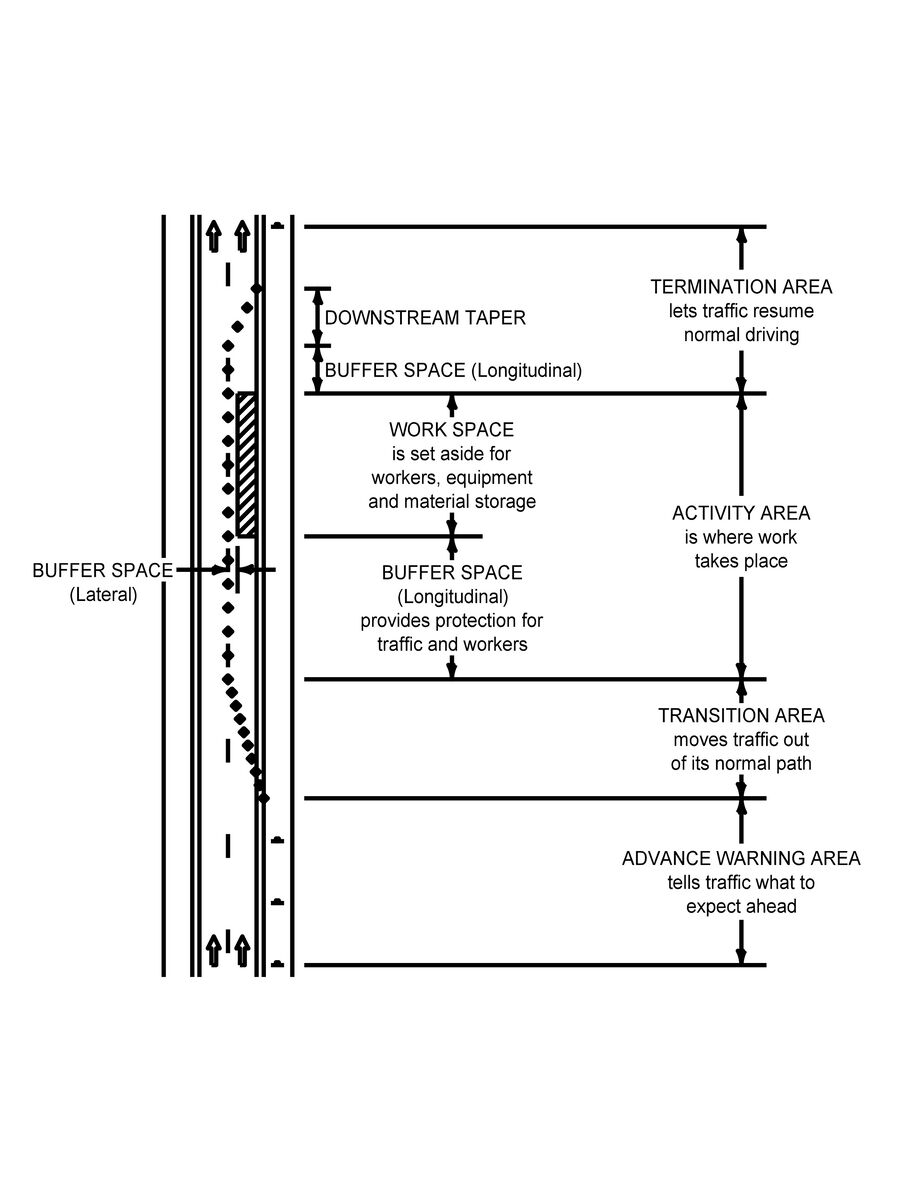
When construction or maintenance activities affect traffic, traffic control is needed to help guide and protect motorists, pedestrians, and workers in a traffic control zone. A traffic control zone is the segment of roadway between the first advance warning sign and the point beyond the work area where traffic is no longer affected. MUTCD defines the portions of a traffic control zone as shown in Figure 1.
- The Advance Warning Area
- The Transition Area
- The Activity Area
The Termination Area
Advance Warning Area
An advance warning area is necessary in all traffic control zones because drivers need to know what to expect. Before reaching the work area, drivers should have enough time to alter their driving patterns. The advance warning area may vary from a series of signs starting a mile in advance of the work area to a single sign or flashing lights on a vehicle.
The advance warning area must be long enough to give motorists time to respond to changing conditions. Advance warning distances should be:
- 1/2 mile to 1 mile (800 to 1600 meters) for freeways and expressways,
- 500 feet (150 meters) for most other roadways or open highways,
- At least one block for urban streets.
Transition Area
When work is performed within one or more traveled lanes, a lane closure is required. In such cases, a transition area is necessary. In the transition area, traffic is channelized from the normal highway lanes to the path required to drive around the work area. The transition area contains the tapers used to close lanes. Refer to Section 9A-3 for more information on tapers.
The transition area should be made obvious to drivers. The correct path should be clearly identified by channelizing devices and pavement markings.
Back to topActivity Area
The activity area is that portion of the roadway where some closure is in effect and where the work activity is taking place. It can be divided into two spaces: the buffer space and the work space. Channelizing devices are to be placed adjacent to the traveled way to keep traffic out of these spaces.
Buffer Space
The buffer space is the open or unoccupied space between the transition area and the work space. The buffer space provides a margin of safety for both traffic and workers. If a driver does not see the advance warning or fails to negotiate the transition, the buffer space provides time for the driver to react before entering the work space. Lengths of buffer spaces range from 100 to 500 feet (30 to 150 meters) depending on the type of roadway. Refer to Standard Road Plans TC-213, TC-214, TC-418, and TC-419 for typical lengths of buffer spaces.
Work Space
The work space is that portion of the roadway which contains the work activity. The work space is closed to traffic and set aside for exclusive use by workers, equipment, and construction materials. The area is usually delineated by channelizing devices or shielded by barriers to exclude traffic and pedestrians.
Refer to Section 9B-3 for spacing channelizing devices in activity areas.
Back to topTermination Area
After motorists have passed the work area, they should have a positive indication that they may drive in the lane that has been closed. The termination area provides a short distance for traffic to clear the work space and return to the normal traffic lanes. It extends from the end of the activity area to the end of the downstream taper, or to the END ROAD WORK sign.
For some work operations, such as spot-location maintenance repair, it may not be necessary to use a downstream taper since it will be obvious to drivers that they have passed the work area. For other situations, the designer will want to include a transition. For example, if a taper is used to shift traffic into opposing lanes past the activity area, then the termination area should include a taper to shift traffic back to its normal path.
Back to top