
Content Information
On this page...
Trucks or similar high-center-of-gravity vehicles typically lean over a barrier upon impact. Designers need to account for this when shielding objects taller than the barrier, for example bridge piers or sign trusses. Space may be needed between the back of a barrier and the object being protected. The space needed depends on the zone of intrusion (ZOI). The Roadside Design Guide defines the ZOI as the region measured above and behind the face of a barrier system where an impacting vehicle or any major part of the system may extend during an impact, see Figure 1.
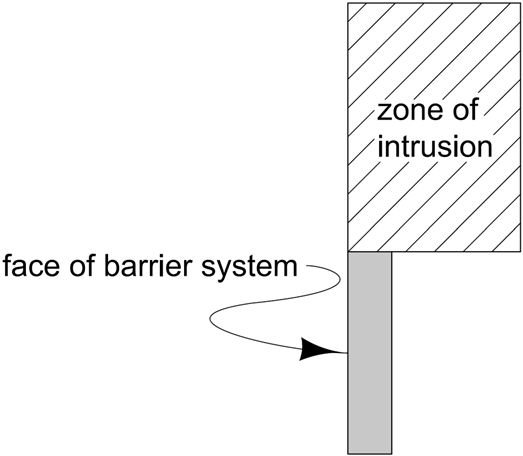
Figure 1: Zone of intrusion.
ZOI is related to vehicle type, barrier type, barrier height, and impact angle and speed. As noted above, high-center-of-gravity vehicles lean more than low center-of-gravity vehicles. Rigid barriers tend to result in tall vehicles leaning more than do flexible systems. Taller barriers reduce vehicle lean. Vehicles impacting barriers with sloped faces climb up the face of the barrier, resulting in increased lean. High impact angles and high impact speeds also increase vehicle lean. Designers need to consider all these factors when choosing and placing a barrier system.
NCHRP Report 1018 provides ZOI estimates for permanent barrier rails at various test levels (TLs). For concrete barrier rail used by the Iowa DOT:
For pickup trucks at TL-2, the ZOI can extend as far as 12.1 inches behind the face of a concrete barrier system and 64 inches above the roadway surface. Intrusion figures are based on a minimum 32 inch barrier height.
For pickup trucks at TL-3, the ZOI can extend as far as 18 inches behind the face of a concrete barrier system and 78 inches above the roadway surface. Intrusion figures are based on a minimum 32 inch barrier height.
For single unit trucks at TL-4, the ZOI for the cargo box can extend as far as 88 inches behind the face of a permanent concrete barrier system and as much as 181 inches above the roadway surface. The ZOI for the cab can extend as far as 36 inches behind the face of a permanent concrete barrier system and as much as 115 inches above the roadway surface. Intrusion figures are based on a minimum 36 inch barrier height.
For tractor trailer trucks at TL-5, the ZOI for the cargo box can extend as far as 86 inches behind the face of a permanent concrete barrier system and as much as 185 inches above the roadway surface. The ZOI for the cab can extend as far as 21.5 inches behind the face of a permanent concrete barrier system and as much as 113.5 inches above the roadway surface. Intrusion figures are based on a minimum 42 inch barrier height.
Section 8A-7 discusses test levels in more detail.
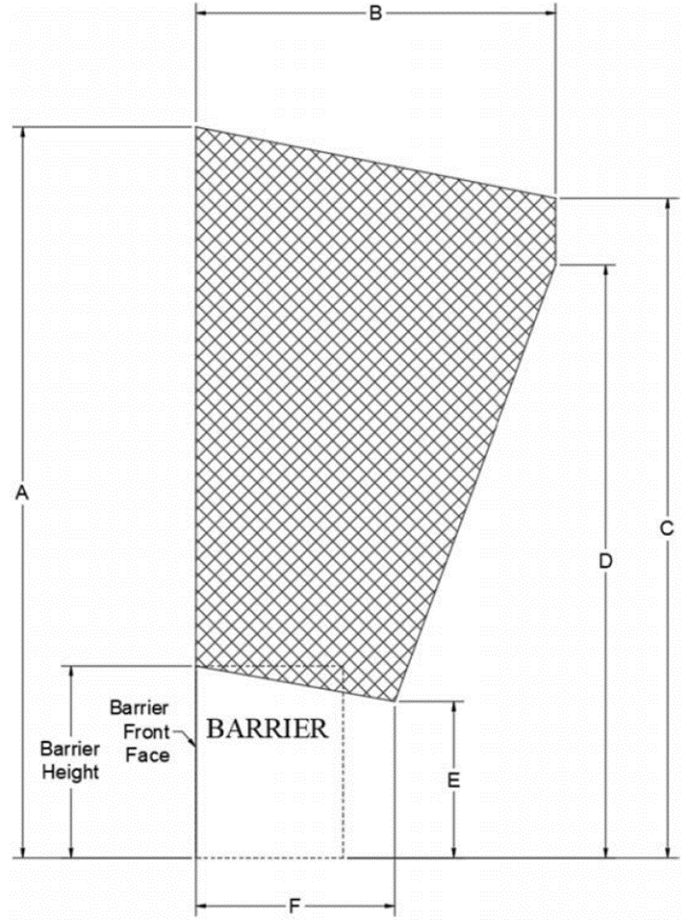
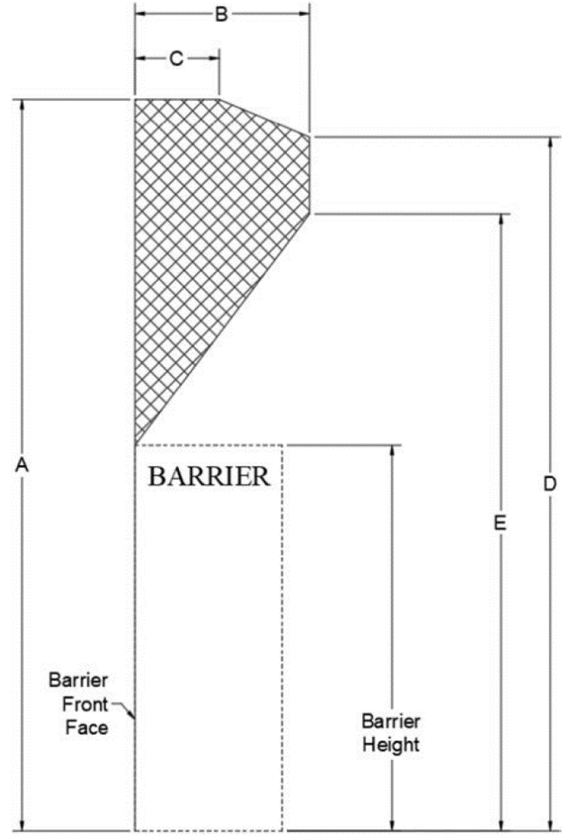
Barrier selection for maintaining a ZOI that is clear of obstructions depends on the established test level designation. The choice of appropriate barrier height will depend on the distance to the obstruction from the top front traffic face corner of the barrier, and the type of vehicle associated with the established test level. See Figures 2, 3, and 4 with associated dimension tables for clear ZOI limits for different barrier heights used at different test levels.
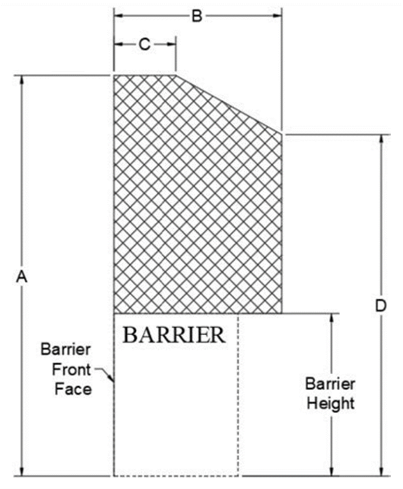
Figure 2: MASH ZOI Recommended Envelope Dimensions (passenger vehicle, pickup, and SUT/TT truck cab only; adapted from NCHRP Report 1018). Refer to Table 1 for A, B, C, and D dimensions.
Table 1: A, B, C, and D Dimensions for Figure 2.
38 in. and 44 in. Barrier Heights (1st table)
54 in. Barrier Height (2nd table)
Figure 3: MASH ZOI Recommended Envelope Dimensions for SUT and TT Truck Cargo Box (adapted from NCHRP Report 1018). Refer to Tables 2 and 3 for A, B, C, D, E, and F dimensions.
Table 2: A, B, C, D, E, and F Dimensions for Figure 3 (38 and 44 inch Barrier Heights).
Table 3: A, B, C, D, and E, Dimensions for Figure 3 (38 and 454 inch Barrier Heights).
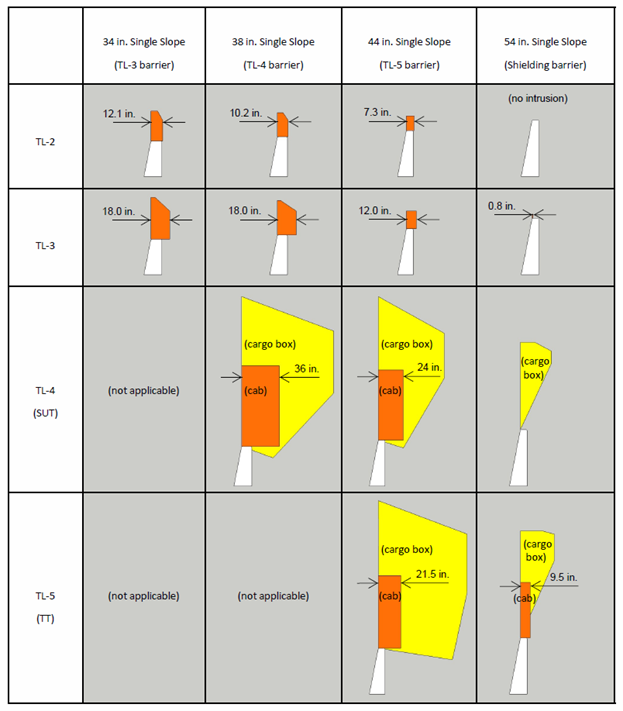
Figure 4: Comparison view of recommended ZOI envelopes for different concrete barrier heights in different conditions (adapted from NCHRP Report 1018).
Back to topBridge Piers and Sign Trusses
The most prevalent situation of concern for Iowa DOT projects is bridge piers and sign trusses located behind permanent concrete barrier rail. Section 8C-1 provides information pertaining to permanent concrete barrier rail height related to distance from object. Typically, the guidelines in Section 8C-1 will address ZOI issues related to bridge piers and overhead sign truss supports for new construction except for bridge mounted sign trusses, which are covered in BDM Section 3.14. For reconstruction, taller barrier (44 or 54 inch) may need to replace shorter barrier (34 inch) to meet the requirements of Section 8C-1.
Back to topRetaining Walls and Noise Walls
Refer to Section 8C-1.
Back to topTemporary Barrier Rail
Designers also need to consider ZOI when placing temporary barrier rail (see Sections 8C-1 and 9B-9 for more on temporary barrier rail). Pinned temporary barrier rail (TBR) will behave similar to permanent barrier rail. Unpinned TBR is more flexible than permanent concrete barrier rail, so the ZOI will typically be less than permanent concrete barrier rail; however, deflection will be much greater. Designers will need to keep in mind the deflection of the rail plus ZOI when placing TBR in front of tall objects.
Back to top