
Content Information
On this page...
The Traffic Critical Projects (TCP) program was established to facilitate improving safety and mobility in work zones on Iowa highways. The following mission and vision help guide the program:
Vision: Provide safe, reliable, and efficient travel through construction and maintenance work zones throughout Iowa’s highway system.
Mission: To identify and implement traffic management strategies that address safety and mobility challenges encountered in construction and maintenance work zones.
In support of the TSMO strategic goals of safety, reliability, efficiency, convenience, and coordination, the TCP program’s primary goals include:
- Identifying upcoming projects during the planning and design stages that have potential to cause significant safety or mobility impacts.
- Applying various mitigation strategies to address safety and mobility concerns, including quick recovery from traffic incidents or queueing.
- Evaluating TCP mitigation efforts to determine if they are reliable, timely, and effective.
- Developing performance measures that can be used to establish safety goals and travel time delay targets in Iowa and applying performance measures to quantify the safety and mobility impacts of the TCP program.
- Developing support throughout Iowa DOT for the TCP program by establishing easily understood and implementable program procedures.
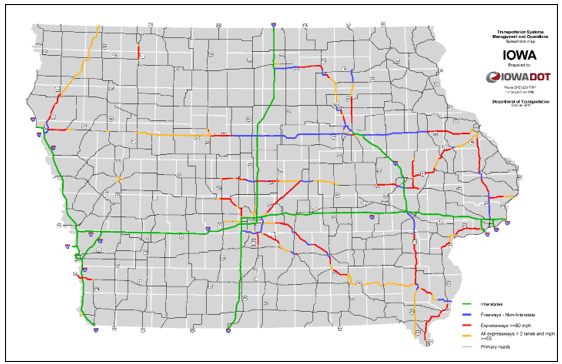
Complete the TCP Checklist for any project located on a highlighted/colored roadway shown above. This checklist identifies key construction projects as Traffic Critical Projects that may cause significant safety or mobility issues to the traveling public. The checklist includes the Lane Closure Planning Tool (LCPT), which aids in selecting times when work zones can be present with minimal impact on mobility and safety.
The checklist and LCPT can be accessed at: https://webapps.srfconsulting.com/idottcp/
Questions regarding the TCP program, the TCP Checklist, and the LCPT can be sent to [email protected].
Back to top