
Content Information
On this page...
Temporary markings are pavement markings or devices placed within Temporary Traffic Control (TTC) zones to provide road users with a clearly defined path of travel through the TTC zone when the permanent markings are either removed or obliterated during the work activities. Temporary markings are typically needed during the reconstruction of a road while it is open to traffic, such as overlays or surface treatments or where lanes are temporarily shifted.
Back to topPavement Markings
Pavement markings provide positive guidance for road users, especially when traffic must be moved out of its normal path to accommodate construction and maintenance activities. For a single lane of traffic, positive guidance can be accomplished using channelizing devices. But when multiple lanes in the same direction are shifted from the normal path, pavement markings are required to provide road users with proper guidance. For temporary painted markings, use a 6-inch line width. For temporary tape markings the line width is 8 inches.
When pavement markings are used to shift traffic at a diagonal across a permanent lane surface, removable tape is required. Removal of painted temporary marking causes pavement scarring, which could lead to driver confusion when the roadway is returned to normal traffic. See Specification 2527.03.I.2.
Shifts and Crossovers
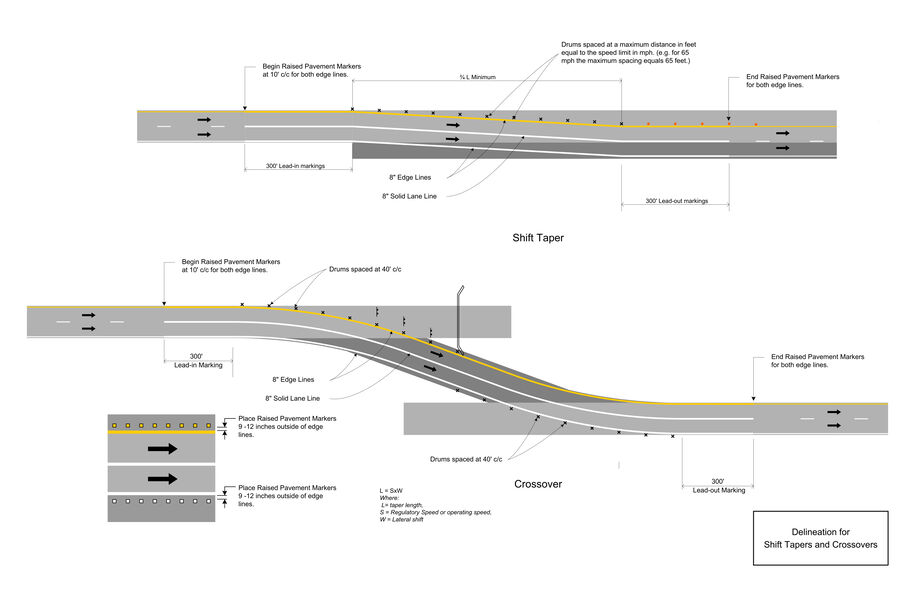
When traffic is moved laterally from its normal path, shifting tapers or reverse curves are used to delineate these maneuvers. Eight-inch-wide temporary pavement markings should be used to delineate traffic shifts. On high-speed roadways, the shifts should include 300’ lead-in and lead-out longitudinal pavement markings.
Figure: Shifting tapers and reverse curves
Raised Pavement Markers
Raised pavement markers (RPMs) are used to supplement pavement markings when a higher degree of nighttime visibility is warranted. Use RPMs on long-term, multilane freeways and expressways to delineate shifts and crossovers. To reduce the likelihood of vehicles off-tracking and dislodging the RPMs, place the RPMs 9 to 12 inches outside of the right and left edge lines. RPMs should be spaced at 10’ c/c to supplement a solid line. The color of the RPM should be the same as the pavement marking that it supplements.
Back to topDelineators
Delineators are post mounted retroreflective units with minimum dimensions of approximately 3 inches in diameter. The reflector units can be seen from up to 1,000 feet under normal conditions when reflecting the high beam of standard automobile headlights.
Delineators should not be used alone as channelizing devices in work zones but may be used to supplement the other channelizing devices in outlining the correct vehicle path. To be effective, several delineators need to be seen at the same time. The color of the delineator should be the same as the pavement marking that it supplements. Delineators are not to be used in lieu of arrows, chevrons, signs, or any other warning devices.
Post mounted delineators should be used with on-site detours and shoulder runarounds. They should be spaced no more than 50 feet apart when placed in work zones. See SI-172 for general information regarding delineators.
Back to topLongitudinal Rumble Strips
Longitudinal Rumble Strips are devices used to detect the edge of the traveled way that alert drivers that the vehicle is very close to the pavement edge and so the driver should steer the vehicle back into the traffic lane. When shoulders or detour pavements are used to maintain capacity of the highway, it is not cost-effective to provide a full shoulder beyond the traveled lane. In these instances, a 4-foot minimum shoulder width is desirable to reduce the likelihood of vehicles driving off the pavement, especially large trucks. If a 4-foot or wider shoulder is not possible adjacent to the edge of pavement, then longitudinal rumble strips are required for 2-foot shoulders and should be considered for a 3-foot shoulder.
Back to top