
Content Information
On this page...
Speed feedback trailer signs are radar activated changeable message signs that display to drivers their speed. They may be installed in conjunction with a regularly posted speed limit sign, or with a work zone speed limit sign. These signs are sometimes referred to as "speed display signs", "driver feedback signs", or "your speed is" signs.
Back to topEffectiveness
Studies have shown that speed feedback trailer signs result in drivers reducing their speed. This is especially beneficial when workers will be close to an open lane with high-speed traffic, or when drivers may not readily recognize the need to slow down, such as at a curve or lane shift. The use of the speed feedback trailer signs is not limited to any certain speed limit value; however, they may have better utility in areas with higher speeds. While the signs do improve compliance to a lower speed, they have limitations and the typical practice of lowering speed limits by 10 or 15 MPH in a work zone should be followed. The following are some high-level considerations related to speed feedback trailers:
- More effective if perception of regular enforcement (and threat of citation) exists at site.
- More effective if the sight distance to the treated condition is less than decision sight distance.
- More effective where only one lane exists per direction.
- More effective if used with other information indicators of a need to reduce speed.
- More effective if the speed feedback trailer is used to support a regulatory speed limit.
- More effective if the overall information system at the location does not overwhelm the speed display sign.
Overuse of speed feedback trailer signs can reduce their effectiveness. Rotating them to different work zones or more critical areas within a project is recommended. The signs should prove most effective during the initial stages of any long-term project, especially in combination with law enforcement.
Back to topDisplay
The changeable message portion of the sign displays the speed of the approaching vehicle as “XX” in MPH. The speed limit sign supplemented by the speed feedback trailer is either a permanent or work zone regulatory speed. When used to supplement a regulatory speed limit, a black on white SPEED LIMIT XX sign and a black on white YOUR SPEED sign is installed immediately adjacent to the dynamic “XX” sign as shown in Figure 1 below.
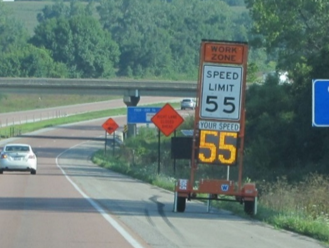
Figure 1: Speed feedback trailer sign.
Back to topOperational Guidelines
Speed feedback trailer are programmed to meet the following:
- The speed feedback trailer sign is blank when no vehicles are present.
- Threshold speed settings should be set at 30 mph over the speed limit
- For speeds measured over the speed threshold setting, the speed feedback trailer sign goes blank.
- Only speed values that are constantly on are used to convey messages to drivers with these devices. No text, icons, strobe lights, or flashing is used.
- Speed feedback trailer signs should only operate for the time that the regulatory speed limit is in effect and workers are present, or roadway conditions warrant reduced speeds for traffic safety.
- No countdown function is used even if the sign is so equipped.
Location and Placement
Speed feedback trailer signs are used at the point of speed reduction, immediately adjacent to the workers and work activity, or in advance of roadway conditions that require speed reduction.
On single lane sections, speed feedback trailers can be placed on either side of the open lane adjacent to or opposite of the work zone speed limit sign. When more than one lane is open to traffic and an adjacent lane(s) is closed, speed feedback trailers should be placed in the closed lane(s) adjacent to the work zone speed limit sign.
Speed feedback trailer signs should not be more than one mile in advance of active work activity or roadway condition that warrants the use of reduced speeds.
Good Placement
Studies have shown that the optimum distance for speed reduction is 1000 feet. It is advisable to place the speed feedback trailer sign on a tangent section of roadway between 500 and 2500 feet of the workers or hazardous condition. If used on a longer construction project involving miles of lane closure or two-way traffic, the speed feedback trailer sign should be relocated several times nearer the active work area to improve its effectiveness and should be adjacent to a regulatory speed limit sign.
Bad Placement
Do not install near a curve to prevent the sign’s radar from incorrectly detecting an approaching vehicle’s speed. This condition is known as the “cosine effect”, see Figure 2.
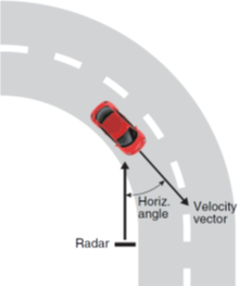
Figure 2: Cosine effect caused by placing speed feedback trailer sign along a horizontal curve.
This occurs when the target vehicle’s path is at an angle to the radar, including conditions such as the vehicle traveling on a curve or hill. As the angle between the radar beam and the target vehicle increases, the displayed speed decreases. Ideally, an angle of zero degrees is preferable (i.e., the vehicle is traveling directly at the radar beam) because the displayed speed is the actual target vehicle speed. In all applications, however, the radar device is generally at a slight angle to the target vehicle.
Back to topSetup and Aiming
The angle of the speed display to the roadway is important for viewing by motorists. Proper positioning ensures motorists have the best chance of seeing and reacting to the display. Optimal positioning provides the radar with a line-of-sight from 500 to 1000 feet, which allows ample time for the speed to appear on the display and for motorists to read and react to it.
- Position the trailer so it faces the near lane of oncoming traffic.
- Angle the trailer slightly toward the roadway, as indicated in Figure 3 below.
- Too great an angle creates a short viewing distance, which does not allow motorists enough time to see the speed display.
- A slight angle provides a long viewing distance and gives motorists plenty of time to see the speed display.
- For nighttime operations ensure this angle does not cause glare for approaching drivers.
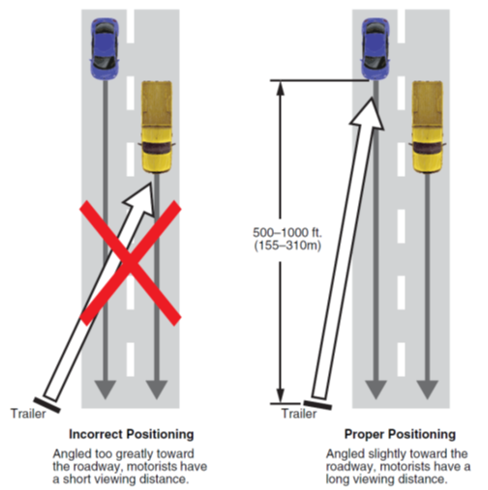
Figure 3: Angling trailer towards roadway.
Back to top