
Content Information
On this page...
When using mobility mitigations, especially when applying more than a single mitigation, it is sometimes necessary to develop formal Traffic Operations (TO) Plans. This plan details how traffic is being maintained on the project to ensure mobility and safety performance goals are achieved. This plan is important to communicate these needs and plans to all project stakeholders during project development and delivery. Traffic Operations Plan mitigations include:
- Extra enforcement,
- Contractor ingress/egress to work zone,
- Maximum allowable delay,
- On-site/off-site detour, and
- Contraflow operation.
All Traffic Operations Plan mitigations contained in this section, except for extra enforcement, are included in the project PS&E.
Back to topExtra Enforcement
Traffic Operations often include a provision to provide extra enforcement on projects to address mobility and safety needs. The use of extra enforcement (paid law enforcement) on Iowa DOT construction projects is encouraged for high volume projects and/or those with high complexity where the driver may be confused. Guidelines for Use of Extra-Enforcement in Iowa Department of Transportation Construction Work Zones provides guidelines to promote uniformity in the planning, operation, and payment for extra enforcement
Back to topContractor Ingress/Egress to Work Zone
Most projects require ingress and egress to the work zone to deliver materials and equipment or remove debris. Some projects require extensive material and equipment movement and may also have space constraints making it necessary to detail how the contractor can approach, enter, and exit the work space. For these situations, it is important to include these restrictions and requirements in the TO plan and PS&E.
Back to topMaximum Allowable Delay
Although not common on a multi lane highway project it is sometimes necessary to specify a maximum delay to traffic that is allowed. An example is when removing an overhead structure where it is necessary to close the highway to all traffic during removal. This is typically limited to a 15 minute closure and resulting delay to traffic.
Back to topOn-site/Off-site Detour
Occasionally the use of detours may offer a mobility and safety mitigation by allowing for the contractors to have the entire roadway for construction activities. This can provide both reduced construction and associated closure time, and improve the quality of the work reducing the need to perform maintenance in the future. The use of detours should always consider the capability of the detour, both on-site and off-site, to safely handle the additional demand of the detoured traffic.
Back to topContraflow Operation
In some instances, capacity can be maintained by moving a lane or lanes to the opposing roadway while maintaining open lanes on the roadway being maintained or reconstructed. For example, on a four lane divided freeway, the shoulder and right lane for one direction can be used to carry the existing two lanes, and the left lane can be used to carry one lane of the opposing direction (separated by TBR) while the remaining lane of traffic continues to use a lane on the opposing roadway.
Considerations:
- Shoulder width, strength, and condition.
- Restrict trucks from using shoulders.
- Restrict wide loads due to narrow lanes and shoulders.
- Longitudinal Rumble Strips.
- Fill if in the wheel path during construction.
- Place after reconstruction is complete to avoid location in wheel path.
- Narrow shoulders.
- Provide for quick recovery from incidents and vehicle breakdown.
- Provide emergency pull-offs since shoulders are narrow.
- Narrow bridge in section.
- Abandon concept.
- Widen bridge(s) before roadway reconstruction.
- Glare screen may be necessary on TBR.
- Pavement Markings.
- Remove all conflicting markings.
- Install temporary edge lines and lane lines.
- TBR.
- Ensure all blunt ends within the clear zone are properly treated.
- Crossovers.
- Requires the construction of temporary crossovers immediately outside construction limits.
- Consideration of water resources is necessary.
- Cost of crossovers may be a concern.
Contraflow Concept for Four Lane Divided Highway
Figure 1 shows the contraflow concept for a four lane divided highway. For Stage 1, TBR is installed the length of the project on both roadways to separate traffic in opposite directions and separate traffic from the work space. Once reconstruction is complete in Stage 1, the TBR is relocated and traffic switched onto the new pavement section. When reconstruction is completed for Stages 1 and 2, traffic is switched to the other roadway. Stage 3 mirrors Stage 2 and Stage 4 mirrors Stage 1.
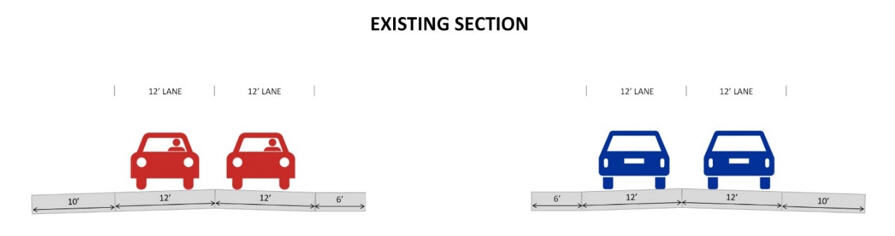
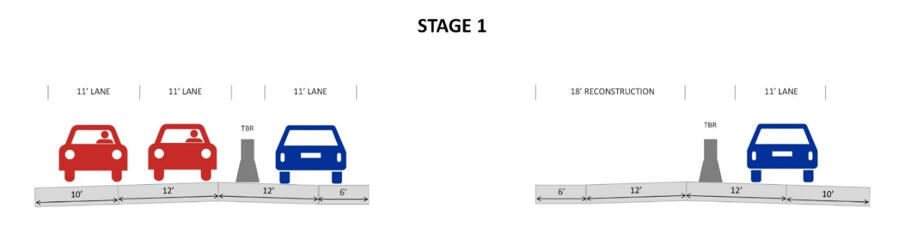
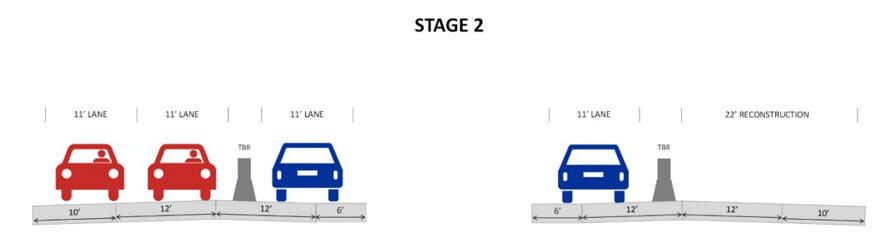
Figure 1: Contraflow concept for four lane divided highway.
Once reconstruction is completed on both roadways traffic is returned to the normal configuration on the final section which is similar to the existing section.
Back to topContraflow Concept for Six Lane Divided Highway
Figure 2 shows the contraflow concept for a six lane divided highway. For Stage 1 TBR is installed the length of the project on both roadways to separate traffic in opposite directions and separate traffic from the work space. Once reconstruction is complete in Stage 1, the TBR is relocated and traffic switched onto the new pavement section. When reconstruction is completed for Stages 1 and 2, traffic is switched to the other roadway. Stage 3 mirrors Stage 2 and Stage 4 mirrors Stage 1.
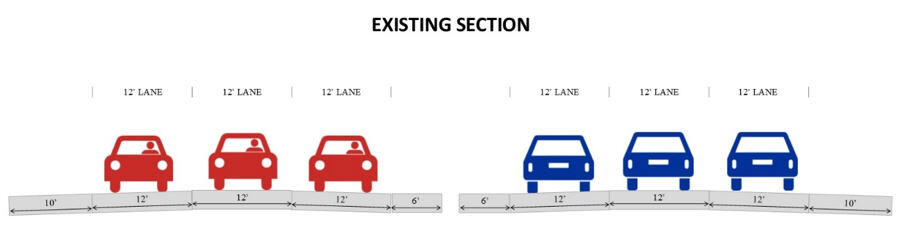
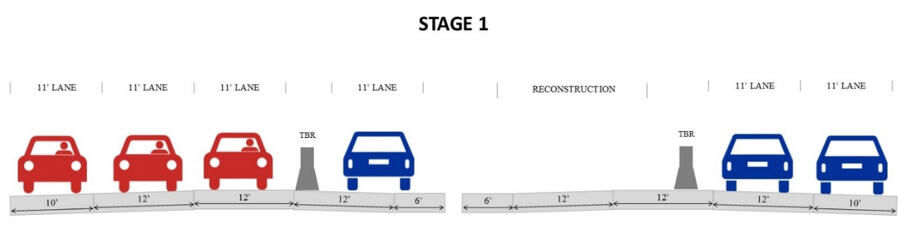
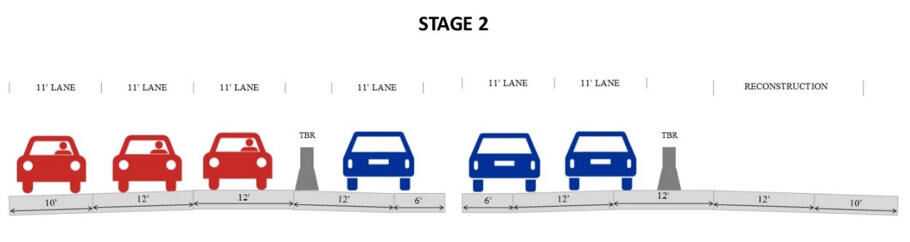
Figure 2: Contraflow concept for four lane divided highway.
Once reconstruction is completed on both roadways traffic is returned to the normal configuration on the final section which is similar to the existing section.
Back to top