
Content Information
On this page...
Quick Tips
Vertical grades need to be checked with the design criteria tables in Section 1C-1. A formal design exception may be required.
Vertical curves need to be checked for stopping sight distances with the design criteria tables in Section 1C-1. A formal design exception may be required.
Topography has a pronounced effect on vertical alignment. It is the Design Bureau’s best practice to adopt design principles and parameters for rolling terrain classification.
Vertical Grades
Maximum Grade
Values for maximum vertical grades listed in the design criteria tables from Section 1C-1 are based on the AASHTO Greenbook criteria for rolling terrain.
Minimum Grade
Values for minimum vertical grades listed in the design criteria tables from Section 1C-1 are based on surface drainage. The cross slope of the pavement surface is usually adequate to drain laterally. The vertical grade drains the pavement surface longitudinally.
Curbed Roadways
Roadways with curbs need a grade of at least 0.3% to drain longitudinally to inlets.
Non-Curbed Roadways
Flat grades (0%) are usually adequate to drain the pavement surface for roadways without curb since the pavement cross slope drains the water off the roadway. Flat grades will create flat areas on the pavement surface in areas of superelevation transition. The grade through superelevation transition should drain the pavement since the cross slope will not drain water off of the surface. See Section 2B for superelevation and pavement drainage considerations.
On Bridges
For rural bridge replacement projects, the existing grade of the approach may be flatter than the preferred 0.5% minimum listed in the criteria tables from Section 1C-1 . Updating these grades to 0.5% may need several hundred feet of reconstruction while providing only minimal benefit. Use the following criteria for rural bridge replacement projects with approaches less than a 0.5% grade.
For bridges lengths less than 250 feet:
Maintain the existing grade when the new shoulder width is equal to or greater than 10 feet.
Maintain the existing grade with 8 foot shoulders and an open barrier rail system.
For bridge lengths greater than 250 feet, or when shoulder widths are less than or equal to 8 feet without an open barrier rail, the approaching grade will need to be corrected to at least 0.5% minimum or to be evaluated to make sure water does not encroach upon the traveled part of the roadway.
Critical Length of Grade
Critical length of grade is the maximum length of a specific upgrade on which a loaded truck can operate without an unreasonable reduction in speed. The combination of the gradient and length of the grade will determine the truck speed reduction. A reasonable reduction in speed is less than 10 mph.
Designers can use Figure 2C.1 when designing Interstates, Freeways, and Expressways to estimate the speed reduction for a loaded truck with an entering speed of 70 mph.
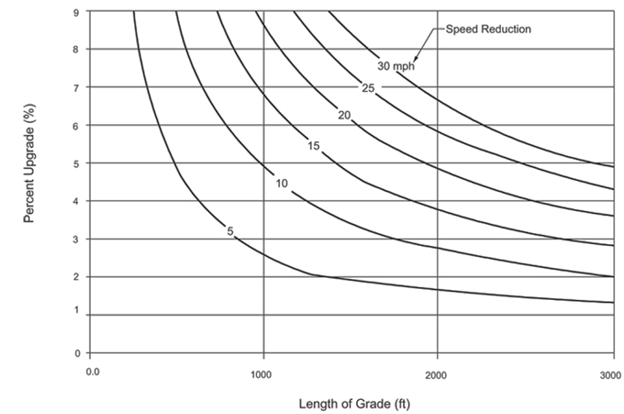
Figure 2C.1: Critical Length of Grade for Design, Assumed Typical Heavy Truck of 200 lb./hp. Reference: Figure 3-21, AASHTO Greenbook, 7th edition, 2018.
Back to topVertical Curves
The AASHTO Greenbook notes vertical curves should be simple in application and should result in a design that enables the driver to see the road ahead, enhances vehicle control, is pleasing in appearance, and is adequate for drainage.
Use vertical curves to smooth changes in vertical direction. A crest curve occurs when the arc of the curve is below the VPI. A sag curve occurs when the arc is above the VPI. Typically, vertical VPI to VPT. Figure 2C.2 illustrates the components of a vertical curve.
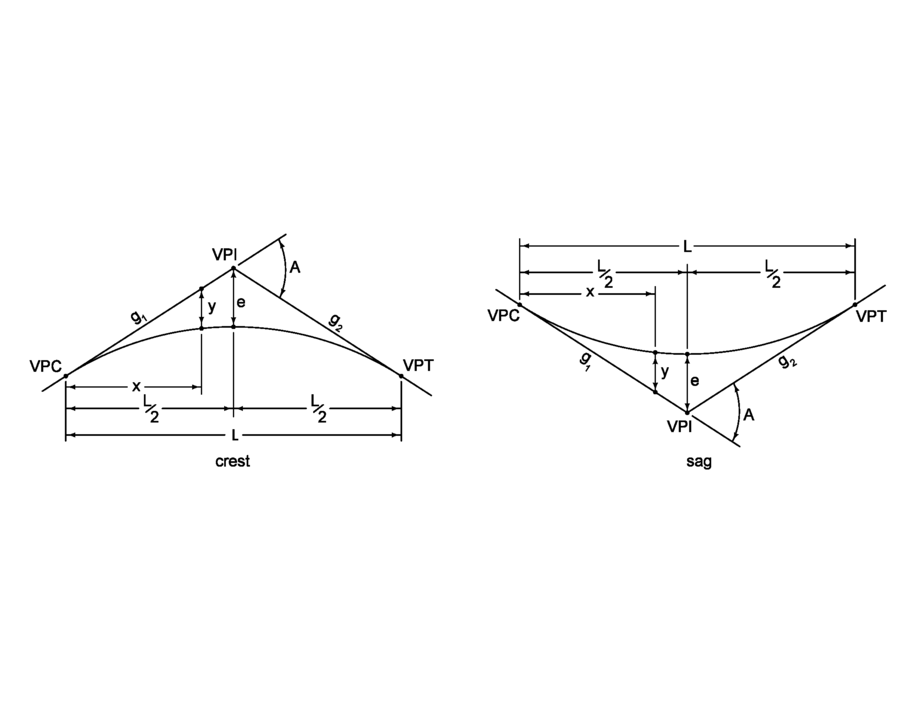
Figure 2C.2: Illustrations of a crest and sag vertical curve.
Vertical Curve Components
Defined below are the components that apply to crest and sag vertical curves.
L = Total length of vertical curve.
K = Rate of vertical curve.
VPC = Vertical Point of Curvature.
VPT = Vertical Point of Tangency.
VPI = Vertical Point of Intersection
x = Horizontal distance to any point on the curve from the VPC.
xt = Turning point, which is the minimum or maximum point of the curvature.
e = Vertical offset or middle ordinate, which is the vertical distance from the VPI to the arc.
y = Vertical distance at any point on the curve to the tangent grade.
r = Rate of change of grade.
EVPC = Elevation of VPC.
EVPT = Elevation of VPT.
Ex = Elevation of a point on the curve at a distance x from the VPC.
Et = Elevation of the turning point.
Formulas
The formulas below are used in the design of vertical curves.
Back to topDesign Considerations
Several items to consider in the process of designing a vertical curve are:
Sight Distance
The principal control in the design of a vertical curve is stopping sight distance. Stopping sight distance is required throughout an alignment. Rate of vertical curvature (K value) is a design control to measure stopping sight distance. See Section 6D-1 for rate of vertical curvature criteria.
Decision sight distance is desirable to decision points on a roadway. Crest vertical curves influence the available decision sight along a roadway. See section 6D-1 for decision sight distance criteria.
Pavement Surface Drainage
Pavement surface drainage should be considered in the design of a vertical curve. A K value greater than 167 may cause pavement surface drainage problems, specially near the high point of a crest curve of low point of sag curve. Designers should check pavement surface drainage near the turning points of vertical curves to make sure the pavement surface drains. The evaluation should confirm the cross slope of the pavement drains the pavement surface.
For curbed roadways, the longitudinal grade drains water to the inlets.
Combination of Horizontal and Vertical Alignment
Horizontal and vertical alignments should be designed together to provide stopping and decision sight distance.
Poor coordination between superelevation transition and a vertical alignment may result in a flat spot in the pavement surface which will not drain water off the surface. See Section 2B for more information about the coordination between superelevation transition and vertical alignment.
Coordination with Bridge Design
Try to avoid sag vertical curves which result in a low point on a bridge. Adjust the vertical alignment to move the low point off the bridge if possible.
Bridge Clearances
Profiles must be designed to provide adequate bridge clearances. See Section 1C-1 for clearance criteria.
Snow Concerns
In areas of flat open ground, a vertical alignment 3 to 5 feet above natural ground can reduce snow drifting. A vertical alignment 3 feet above the natural ground provides a 5 foot standard ditch depth.
Conveying Drainage Underneath Roads
Locate profiles such that:
- Culverts do not extend into the subgrade, and preferably not into the subgrade treatment.
- Adequate headwater is provided for culvert design.
Profiles for bridges over streams or rivers need to accommodate bridge structure, design flows, and freeboard. Coordinate with Preliminary Bridge Design.
Earthwork
The vertical alignment should desirably balance the earthwork, but this should not be achieved at the cost of providing stopping and decision sight requirements through vertical curves.
Minimum Vertical Curve Length
Short curves or no curve is not a desirable practice; therefore, a minimum curve length (in feet) of three times the design speed is the minimum length for both sag and crest vertical curves.
Passing Opportunity Considerations.
The level service of a two way, two lane roadway is directly impacted by the percentage of the roadway that provides adequate sight distance to safely pass a slow moving vehicle. Designers should provide frequent passing opportunities for drivers. No table for a minimum number of passing opportunities per given distance for different design situations exits; however, procedures presented in the Highway Capacity Manual provide an evaluation of the level of service based on passing opportunities and vehicle volume and mix. Providing frequent passing opportunities becomes increasingly more important as traffic volumes increase. If ample passing opportunities cannot be provided, alternative alignments or providing passing lanes should be considered.
Back to top