
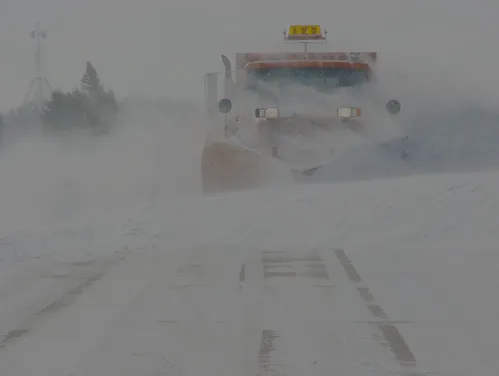
When harsh winds, heavy snow, and whiteout conditions make pavement markings invisible, driving risks are multiplied if Iowa DOT snowplow operators can’t even see the roads beneath their blades to clear them. You know these low-visibility weather events. We’ve logged several already this winter – including two severe storms requiring interstate closures – and it’s only mid-January.
Simply put, as storms and blizzards roll in and the inches build up, plowing slows down as trucks need more time to cycle a route. Our snowfighters can also lose track of lane locations and start drifting over centerlines or toward ditches. In worst-case scenarios, plows may need to stop completely, leading to stranded vehicles, road closures, and a lengthy dig-out after the storm passes.
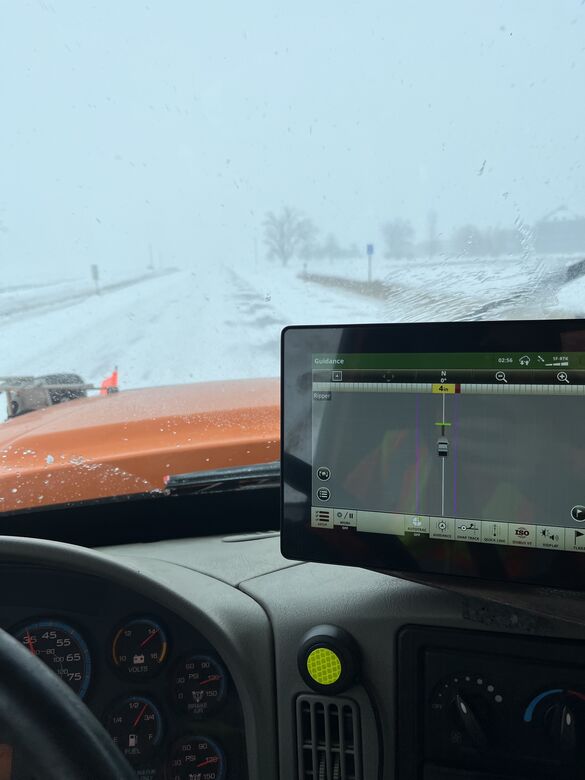
We can’t stop Mother Nature, but technology offers a solution to increase the safety for staff and the motoring public through a snowplow guidance system that provides more precise by-the-inch vehicle positioning within a pre-mapped lane.
Originally engineered for tractors and motor graders, John Deere Path™ is a road mapping guidance system designed to help operators with real-time visualization and navigation of road boundaries, especially in challenging low-visibility conditions. By applying Deere’s agricultural satellite technology to DOT snowplows, operators can “see” their position relative to the road to enhance safety and operational efficiency.
How the system sees the road
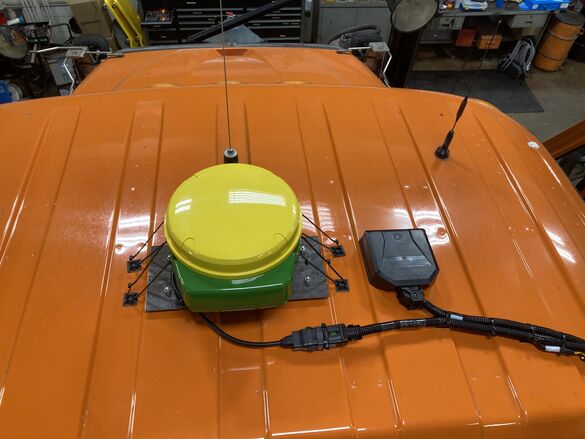
Key system componentry includes a state-of-the art receiver that mounts on the cab’s roof and a display mounted inside the cab. Plow operators train or program the system’s software by driving a route during clear road conditions and digitally marking the location of potential obstacles or transition points.
Using these stored navigation points during operation, the system will locate the position of the plow truck on a display of the route map and provide feedback to the operator if the vehicle deviates a set lateral distance from its programmed path.
Winter Operations Administrator Tina Greenfield says these systems reduce the impact of bad visibility or deep snow on plowing efficiency, allowing operators to better keep up with conditions. Significant to operators is that roads receiving regular plow passes are less likely to drift shut, are likely to remain serviceable for emergency vehicles during and after a storm, and are quicker to restore to normal conditions since they don’t have as many or as deeply drifted sections.
“But the biggest benefit is road safety,” Greenfield said. “If we can operate without losing plowing frequency or stopping operations, we can maintain accessibility for emergency crews and reduce crashes and stranded vehicles. We estimate that each route covered by one of these units will be able to return to normal approximately six hours sooner. That’s invaluable time throughout a storm and cleanup,” Greenfield said.
She added that while the technology is available and installed, it doesn’t mean roads will not be shut down during hazardous conditions for the safety of the motoring public and DOT staff. “The navigation system will keep our trucks on the road even when the road is closed and help us open them up a lot sooner when the conditions allow,” Greenfield added.
Accurate guidance during severe weather and emergency response
While a research partnership between DOT winter operations administrators and Iowa State University’s Institute for Transportation was exploring ways to achieve greater pavement visibility in 2024, John Deere reached out to Greenfield to gauge interest in testing their road mapping guidance system and its potential capabilities for snowplows.
The DOT agreed and incorporated units on snowplows last winter which returned favorable results and reviews from field staff including District 1 Highway Maintenance Supervisor, Mohamed “Moe” Mohamed, who oversees the Grinnell, Malcom and Tama maintenance garages.
In February of 2025, Mohamed operated a snowplow equipped with the John Deere Path™ to clear portions of U.S. 30, Iowa 21, and Iowa 8 for most of a day. “The unit never lost signal and performed very well. The route we had mapped is what was displayed, and it kept the truck in the lane when the paint lines were covered with snow and visibility was poor,” Mohamed said.
Following that first winter of testing, Greenfield developed a business case to request the purchase additional units and subscriptions to be integrated by the 2025-26 winter. Today, a total of 25 units are distributed across fleets in all six DOT districts where they’ve been tackling a challenging season of early severe weather marked by hazardous roads with impossible visibility at times.
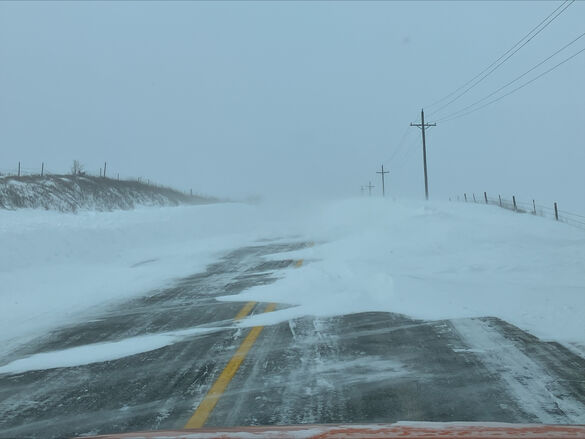
The system’s capabilities demonstrated its intrinsic value to DOT operations again during a recent emergency situation. On December 29 at 1:30 a.m., the Garner Volunteer Ambulance Service put out a call for assistance to the District 2 garage that serves the Swea City-Garner-Algona area. The ambulance desperately needed an escort service to transport a patient from Garner to the Mason City Emergency Room approximately 30 miles away along U.S. 18 in north central Iowa.
It was a rare but necessary request because this stretch of road was quickly becoming impassable with treacherous conditions including whiteouts and partially to completely snow and ice-covered pavement.
Fortunately, two staff members were staying overnight at the garage since conditions were getting too dangerous to guarantee a return for their morning shift. They quickly stepped up to the assignment. Partnering with law enforcement, the snowplow outfitted with the John Deere Path system led the convoy east across the rural highway.
While the route the crew took was not yet officially mapped into the system, the operator used system features to identify their position on the road and calculate the distance they had traveled and miles remaining to their destination.
“The lead truck was in constant communication with the entire group, letting them know where they were and essentially guided them the entire way to Mason City,” Rauk said. “Everyone arrived safely to the emergency room and back to Garner. The operator commented that the guidance system gave him extra confidence in leading this group and helping the citizen that needed medical treatment. I’m excited that this equipment is an option for us in this area of the state. We have many storms where the visibility is an issue,” he added.
Although there are few visual clues that these units are deployed on state roads, Iowans and visitors can have confidence that even when winter is at its worst, there’s a path forward for the Iowa DOT.