
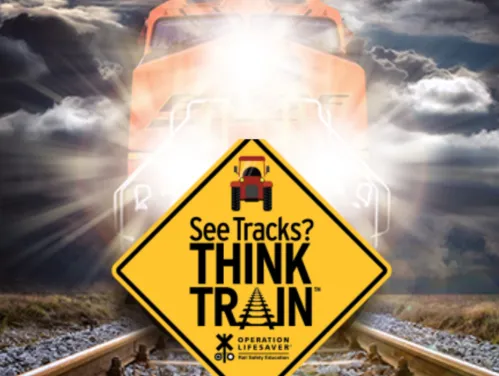
AMES, Iowa – April 6, 2026 – Spring is here, soil temperatures are warming up, and farmers across Iowa are preparing to plant their crops for another growing season. That means rural railroad crossings will be busy with traffic from planting and field maintenance equipment.
The Iowa Department of Transportation is encouraging agribusinesses to practice good rail safety at Iowa’s public and private at-grade rail crossings where trains have the right of way. As spring planting approaches, ag rail safety is a high priority for the Iowa DOT, which advocates for both a safe and secure rail infrastructure, along with ensuring Iowa's economic stability and growth through efficient agricultural operations.
With the majority of at-grade rail crossings in rural areas, the primary focus of the spring planting season is the safe transport of equipment through a network of crossings where ag equipment and trains have the potential to collide.
Safety at Iowa's at-grade crossings
Agribusinesses using crop planting and maintenance equipment are often traveling though active (signs/lights/gates/bells) and passive (crossbuck signs only) at-grade crossings as they seed fields. These crossings are where the risk of crashes is greater due to misjudging the time it takes for their vehicles to cross tracks against an approaching freight or passenger train’s speed, or not seeing or hearing an oncoming locomotive.
Iowa currently has 4,111 public at-grade railroad crossings and 2,448 private at-grade crossings. Within the public crossings, 2,235 are passive (crossbuck signs only) and 1,886 of those are active (1,245 with flashing lights gates and 641 with flashing lights only). More than half of the public crossings intersect with public roadways at passive crossings, where most collisions occur.
Miscalculations and unsafe decisions at passive crossings and trespassing on tracks often lead to dangerous and fatal consequences. For example, if equipment or vehicles get stalled on tracks, it takes the average freight train traveling 55 mph more than a mile – the length of 18 football fields – to stop. Every year, 2,100 North Americans are killed or seriously injured when they engage in unsafe behavior around tracks and trains. In the U.S. alone, a person or vehicle is hit by a train every three hours.
Spring is a peak time for moving crop planting and maintenance equipment between fields. That's when chances increase for encounters with trains that often occur during the low-visibility hours of sunrise or sunset. The DOT encourages agribusinesses to use these four key tips to stay safe on or around tracks:
- Stop, Look, Listen - Stop at least 15 feet from the nearest rail, turn off audio sources, and open a door/ window to look and listen for trains.
- Don't Shift Gears - Once you begin crossing, avoid changing gears to reduce the risk of stalling.
- Check Clearance - Ensure there is enough space for your equipment to completely clear the tracks before starting to cross.
- Use ENS - If equipment gets stuck on the tracks, immediately abandon the vehicle and call the emergency phone number posted on the blue sign (Emergency Notification System) at the crossing.
To learn how the Iowa DOT keeps safety on track, please visit: Track Safety | Department of Transportation. For additional information on participating or to access campaign materials, please visit the Operation Lifesaver, Inc. website.
#
For general questions on rail-ag safety, contact Iowa DOT Rail Director Amanda Martin at [email protected] or 515-239-1653.
About Operation Lifesaver
Operation Lifesaver, Inc. (OLI) is a national #RailSafetyEducation nonprofit dedicated to stopping track tragedies through public awareness and education campaigns as well as a national volunteer network that gives free presentations encouraging safe behavior near tracks and trains. OLI supports the efforts of 47 state programs and the District of Columbia in sharing the rail safety education message. Explore OLI's virtual library of rail safety materials on the oli.org website. Visit oli.org to learn more, take a rail safety pledge, request free presentations and volunteer. Follow OLI on social media via Facebook, Instagram, LinkedIn, Pinterest, X and YouTube.