
Content Information
On this page...
General
Medians separate opposing directions of travel. They benefit the vehicle operator by providing freedom from interference of opposing traffic. Other benefits include:
- Providing refuge for emergency stops.
- Reducing headlight glare.
- Providing areas for deceleration and storage of left-turning vehicles.
- Providing areas for storage of side road turning or crossing vehicles at intersections.
- Providing space for snow storage.
- Increasing drainage collection area.
- Providing areas for placement of luminaire supports, traffic signs, traffic signals, guardrail, and bridge piers.
- Providing areas for pedestrian and bicycle refuge.
- Providing areas for future lanes.
Width
Median width is the distance between the inside edges of opposing directions of travel. Refer to Section 1C-1 for various median widths based upon roadway type. Project constraints usually dictate the project median width. Considerations when establishing a median width are:
- Available right of way.
- Construction costs.
- Construction work area.
- Maintenance of traffic during construction.
- Environmental impacts.
- Traffic operations at crossings.
- Median type.
- Future expansion.
- Stopping sight distance.
Determining Median Type
The use and type of a median depends on:
- The type of highway being planned.
- Developed property near the highway.
- The type of access control.
- Available right-of-way.
Types of Medians
The four basic types of medians are:
- Depressed.
- Closed.
- Raised.
- Painted or Flush.
Depressed Medians
Depressed medians have a common ditch between divided highways. A depressed median provides room for storing snow in rural areas. A narrow median width can introduce problems with either shallow ditches or steep foreslopes. These are best avoided with a median width wide enough for proper shoulder widths, flat foreslopes, and a ditch depth that provides enough cover for median pipes beneath the roadway.
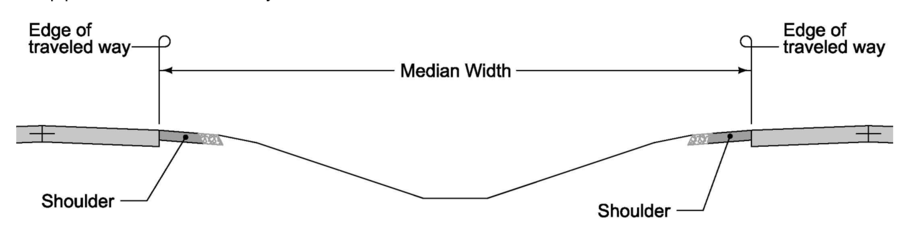
Figure 1: Depressed median.
64 Foot Median Width
A 64 foot median is the standard median width the Iowa Department of Transportation has used for the quite some time on multi-lane rural facilities. The 64 foot median provides 30 feet of clear zone to bridge piers within the median for each direction of travel and 4 feet for the median pier. This median width also allows the following: sufficient width for shoulders, a resurfacing lip, 6:1 foreslopes, a 4 foot deep ditch, and space to store a conventional school bus.
82 Foot Median Width
An 82 foot median is the standard median width for rural Interstates. This width provides future expansion within the median from a 4-lane facility to an 8-lane facility with a closed median width of 34 feet. Expanding the facility within the median provides expansion within the right of way and highway infrastructure. Rural Interstates designed for a day of opening 6-lane facility have a 58 foot median in corridors where traffic growth shows a limited need for additional lanes.

Figure 2: 82 foot Median.
Back to topClosed Medians
Closed medians are normally used on multi-lane highways in urban areas with limited right of way. A narrow closed median can introduce problems with shoulder cross slope near median intakes and where the roadway is superelevated. These are best avoided by a median wide enough for proper shoulder widths, intakes located within the median pad, and super elevating the roadway as shown in the PV Standard Road Plan series.
34 Foot Median Width
A 34 foot median is the standard median width for a closed median facility. The 34 foot median provides 12 foot inside shoulders and a 10 foot median pad for the concrete barrier rail.
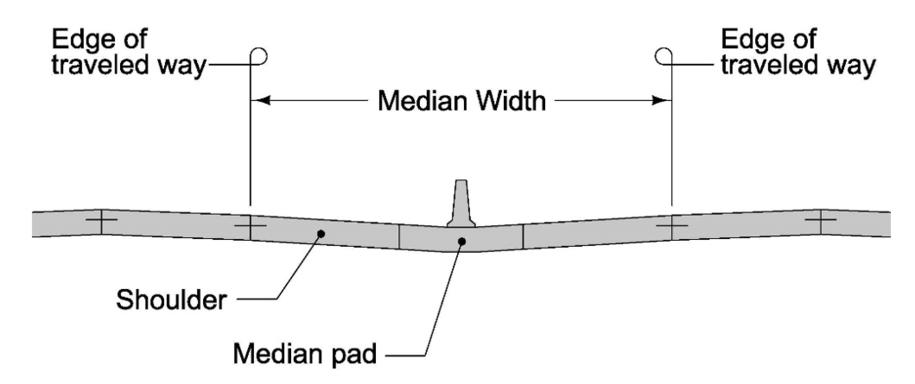
Figure 3: Closed median.
Back to topRaised Medians
Raised medians are normally used on roadways to increase access control to prevent mid-block left turns. Raised medians give delineation for left-turn lanes and give a pedestrian refuge area within the channelizing island. Raised medians are also used on transitional facilities to alert drivers that the driving environment is changing. To optimize operations at signalized intersections, use a narrow median width.
16 Foot Median Width
A 16 foot median provides channelization for a 12 foot left turn lane with a 4 foot channelizing island, measured between the face of the curbs. Use a wider channelizing island for pedestrian/bicycle refuge. Refer to Chapter 12 for pedestrian and bicycle design criteria.
18.5 Foot Median Width
An 18.5 foot median provides a 2.5 foot curb offset for through lanes, and channelization for a 12 foot left turn lane with a 4 foot raised channelizing island, measured between the face of the curbs. Use a wider channelizing island for pedestrian/bicycle refuge. Refer to Chapter 12 for pedestrian and bicycle design criteria.
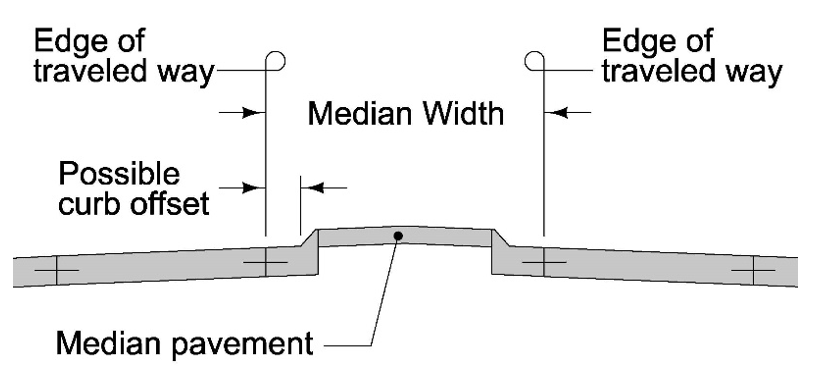
Figure 4: Raised median.
Back to topPainted Medians or Flush Medians
Painted or flush medians are normally used for left-turn channelization. Painted medians on roadways with closely spaced accesses provide space to convert to a continuous two-way left-turn lane. Painted medians are less hindrance to maintenance activities and are commonly used in rural areas, stop-controlled intersections, signalized intersections with limited right of way, and along corridors with closely spaced commercial entrances.
14 Foot Median Width
A 14 foot median is adequate for a continuous two-way left-turn lane.
16 Foot Median Width
A 16 foot median provides channelization for a 12 foot left turn lane with a 4 foot painted channelizing island.
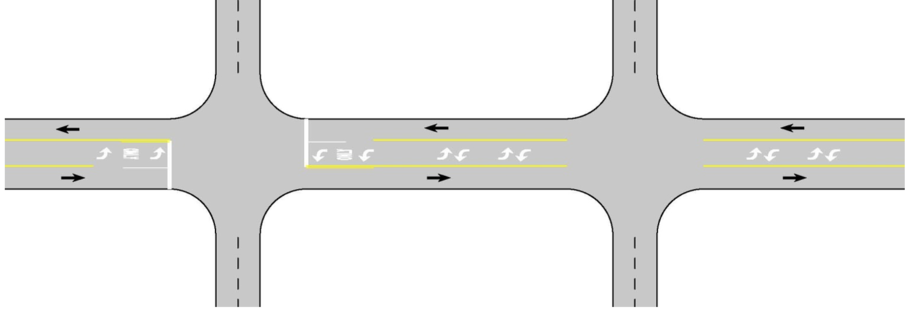
Figure 5: Continuous two-way left-turn lane.
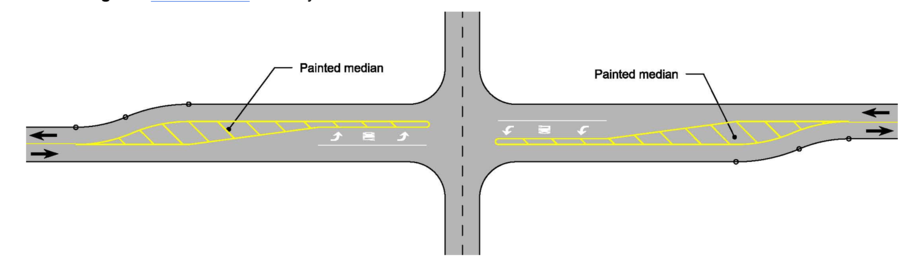
Figure 6: Painted median.
Back to top