
Content Information
On this page...
The purpose of this section is to provide designers with guidance regarding the selection of appropriate shoulder type. The Iowa DOT uses four types of shoulder composition (refer to typical components for details):
Full width paved shoulders.
Composite (partial width paved) shoulders.
Granular shoulders.
Earth shoulders.
The appropriate shoulder type is primarily determined by roadway classification and design year traffic volume. Other considerations include the likely presence of pedestrians and/or bicyclists and specific geometric issues.
Paved shoulders, either full width or composite, offer several benefits including:
Increased safety by reducing run-off-the-road crashes, especially when used in conjunction with shoulder rumble strips.
Better accommodation of bicyclists by providing an area for them to ride on that is off of the mainline of the roadway.
Reduction of edge rut and associated repairs.
Selection of Shoulder Width and Type
For shoulder design criteria guidance, refer to the shoulder tables in Section 1C-1. Figure 1 shows the various shoulder components. Effective shoulder width is the actual shoulder width including additional pavement width in excess of the lane width.
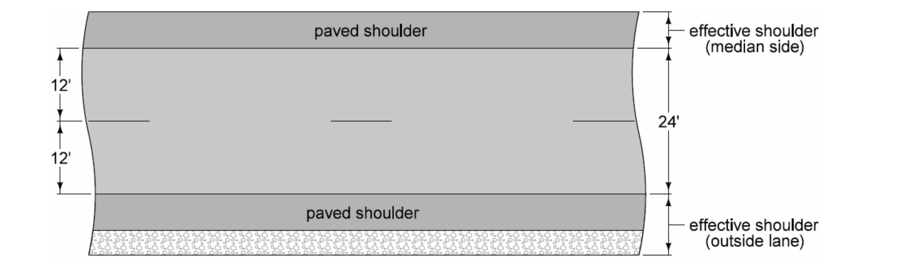

| Consideration to constructability should be given when bidding HMA shoulders or paved shoulder alternates. Equipment is not available to pave HMA in widths that are narrower than 2 feet.
|
|---|
For non-NHS Two-Lane Highways with design year ADT of less than 3000, a combination of factors such as those listed below should be considered to determine if composite shoulders are appropriate:
Run-off-the-road crash rate.
Segments of roadway with a high number of small radius horizontal curves (to reduce problems associated with off-tracking).
Segments of road with steep grades (to reduce shoulder rock erosion on steep grades caused by stormwater runoff).
Ongoing edge rut problems.
Shoulder width continuity.
The number of times the pavement has been or may be widened (multiple narrow widening units are undesirable).
Cost differential of paved shoulders compared to widening (the safety benefits of paved shoulders may outweigh the extra cost).
Bicyclists are to be accommodated. In this case, the shoulders need to be wide enough to place milled rumble strips with a minimum of 4 feet outside of the rumble strips for bicyclists.
The District should make the final determination if and where composite shoulders are included in a project.
If a determination is made not to include composite shoulders, two foot pavement widening will likely need to be included. See Section 7D-8 for guidance on pavement widening.
Back to topPaved Shoulders and Non-motorized User Accommodation
When bicycles are to be accommodated on the shoulders, a minimum of 4 feet of paved area free of obstructions or rumble strips should be provided, with a minimum of 5 feet where the shoulder is adjacent to a curb, barrier, or railing. In constrained areas where 4 feet cannot be provided, a minimum of 3 feet is acceptable. See Section 3C-5 for more on shoulder rumble strips.
Back to topBridge Replacement Projects
Normally, four foot paved shoulders will not be placed with bridge replacement projects. If the replacement project also involves realignment, then paved shoulders should be considered.
Back to topSpecial Situations
Full width paved shoulders should be provided at curves with a superelevation rate of 7.0 % or greater and at locations where a curbed shoulder is used.
Back to topRetrofitting Paved Shoulders
Road Design Details 7151 should be used for retrofitting paved shoulders on resurfacing projects. Road Design Detail 7152 should be used if the project does not involve resurfacing.
Designers may encounter two situations requiring special attention: 1) retrofitting paved shoulders with pavements less than 24 feet wide, and 2) retrofitting paved shoulders where less than six feet of shoulder is available.
Retrofitting Paved Shoulders with Pavements Less Than 24 feet Wide
For situations when a highway pavement is less than 24 feet wide and the highway meets the qualifications stated above for paved shoulders, contact the Pavement Design Section in the Construction and Materials Bureau for assistance.
Retrofitting Paved Shoulders where Less Than Six Feet of Shoulder Is Available
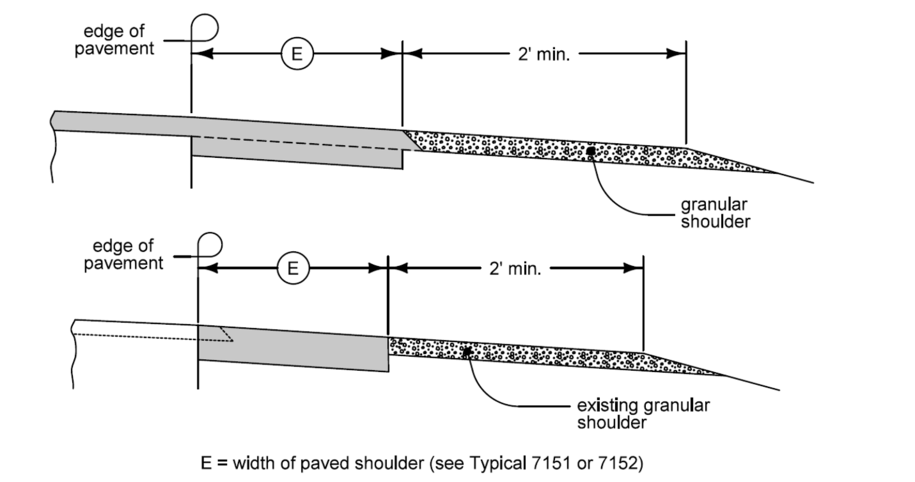
A minimum two foot granular shoulder should be placed outside of a paved shoulder for pavement support and delineation. This is not possible if a four foot paved shoulder is to be placed where less than six feet of shoulder is available. One option is to widen the shoulder to accommodate a four foot paved shoulder with a two foot granular shoulder. A second option is to reduce the width of both the paved and granular portions of the shoulder. The width of the paved portion of the shoulder (E) is determined as shown in Figure 2.
Designers are likely to encounter other situations which are not covered in this section or do not fit well with existing Shoulder Typicals and Road Design Details. In cases such as these, the designer is encouraged to contact the Methods Section in the Design Bureau for assistance.
Back to topReturns and Tapers
Road Design Detail 7154B should be used for returns at intersections. Road Design Detail 7154A should be used for turning lanes and 7155 for passing and climbing lanes.
Back to topAdditional Considerations
Shoulder slopes: refer to Section 3C-3.
Milled rumble strips: refer to Section 3C-5.
Back to top