
Content Information
On this page...
This section is intended to describe subgrade slopes for two-, four-, and six- or more-lane roadways.
Back to topTwo-Lane Roadways
The subgrade on two-lane roadways is parallel to the pavement surface. Subdrains are generally located on both sides of the roadway; however they can be omitted on the high side of the curves when full superelevation is present. Standard Road Plan PV-301 illustrates subgrade cross sections within a superelevated curve. When subdrains are omitted on the high side of curves, the subdrain should end approximately 100’ beyond section A-A (refer to Figure 1).
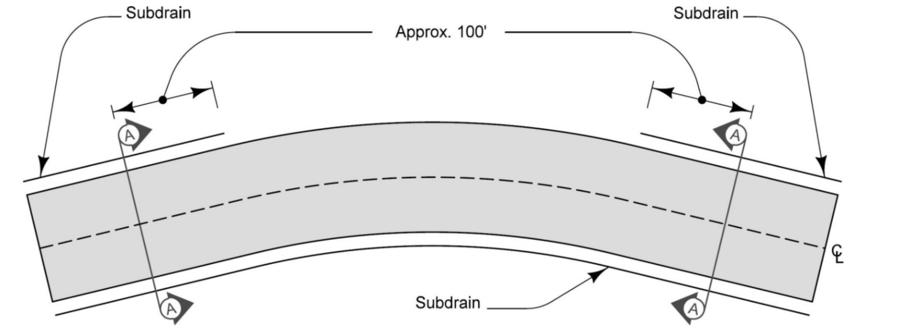
Figure 1: Subdrain installation at superelevated curves.
Back to topFour-Lane Divided Roadways
On four-lane divided highways, the 1% slope should be away from the median on both sides of the roadway. Edge Subdrains are installed on the ‘downhill’ side of the 1% slope. This practice minimizes the occurrence of shallow subdrains in the median. The one exception is at superelevated curves, where the subgrade slope is in the same direction as the superelevation. This means one side of the facility will have the subdrains on the median side of the pavement. As the cross section returns to normal crown beyond the curve, the breakpoint is transitioned back so that the 1% slope is again away from the median on both sides. Standard Road Plan PV-302 illustrates subgrade cross sections within a superelevated curve. When subdrains are omitted on the high side of curves, an overlap of approximately 100’ beyond section A-A is to be provided resulting in a total 200’ overlap area.
For projects that are graded one year and paved the next, the subgrade is first graded to be parallel to the future pavement surface (See Grading Typical G_4D—Grade_Delay). The purpose of the parallel subgrade is to provide adequate surface drainage until the paving operations begin the following year. The next year, prior to paving, the subgrade is trimmed to provide a 1% slope away from the median on both sides of the roadway to eliminate the need for subdrains in the median.
Back to topSix- or More-Lane Roadways
The subgrade on six- or more-lane roadways is parallel to the pavement surface. The width of the pavement is too great for one subdrain line, therefore median subdrains are necessary. Standard Road Plans PV-304, PV-305, and PV-306 illustrate subgrade cross sections within superelevated curves.
Back to topTabulation
Subgrade dimensions are tabulated in the Grading Typicals for each roadway type. The subgrade cross sections should be tabulated at the beginning and ending of the project and at the beginning and ending of each transition area. The variable ‘X’ is a function of the subbase thickness and the pavement thickness.
Include the corresponding PV300 Series Superelevation Standard Road Plan if superelevated curves are present.
Back to top