
Content Information
On this page...
Upgrade/Replacement Guidance
Whenever existing guardrail is encountered within the limits of a project, it should be evaluated for replacement. Primary considerations include the type of approach end terminal, the posted speed, and whether the route is part of the NHS. Other factors include the height of the existing rail, its age, and whether it is long enough to shield the intended object(s). Refer to the guidance in Table 1.

| When evaluating existing guardrail, designers must keep in mind several years may pass until another project is done in the area. Old and/or outdated guardrail installations should be replaced as soon as possible and not pushed out to future projects. |
|---|
Next, consider whether a barrier is still needed. In some cases, the object may no longer exist, or conditions may have changed since the guardrail was installed. One common example is an installation designed for two way traffic that was left in place after the facility was widened to four lanes. If the object still exists, it may be possible to eliminate the need for a barrier by removing, redesigning, or relocating the object. See Section 8A-3 for treatment options.
If a barrier is still needed, determine if guardrail is the best option. Other barrier types, such as concrete or high tension cable, may be more desirable due to offset, impact frequency, maintenance needs, or other factors. Refer to Section 8B-5 for additional information. The District Office may also have a preference.
Finally, if the decision is made to replace the existing guardrail with new guardrail, remove the existing installation in its entirety.
|
| Do not combine new and existing guardrail within a single installation. |
|---|
Also, avoid replacing the guardrail in-kind because its length may not be sufficient based on current needs. Instead, establish the limits of the new installation using the guidance in Section 8B-6.
Back to topBridge Maintenance (MB) Projects
MB projects often involve work that affects bridge approaches and/or bridge rail end sections. Updating existing guardrail installations to current standards is preferable, but not always feasible. Existing guardrail should be examined to determine if it can simply be removed and reinstalled, or if it should be replaced.
Some situations necessitate replacing existing installations with current BA standards:
- If the connection to the bridge rail end section is not a Thrie-beam transition section (STS or BTS, see below).
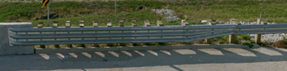
BTS
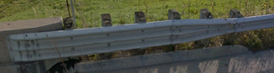
STS
- If the end treatment is not a SKT or FLEAT energy absorbing terminal, see below.
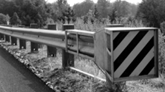
SKT
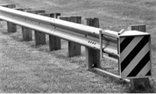
FLEAT
- The end treatment is an ET-Plus, see below. Repair parts are no longer available.
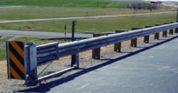
ET-Plus
- If posts are damaged (e.g. broken or rotted) and/or rails are damaged (torn, bent, flattened, and/or rusted) to the point the system may not function properly.
- If the installation is a bullnose installation.

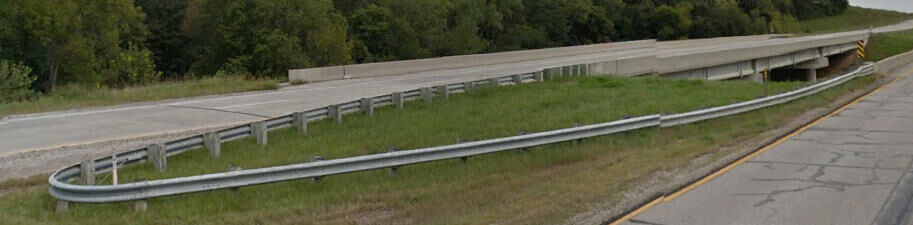
As noted above, new and existing guardrail should not be combined. If any part of an installation needs to be replaced, replace the entire installation.
Back to topRemoval of Bullnose Installations
In the past, bullnose installations were commonly placed in the median between dual bridges and were also used around median bridge piers. Due to their unique design, their removal deserves special mention.
|
| Bullnose installations make a U shape. Each end of the U is attached to another barrier (typically a bridge rail or more guardrail). Proper functioning of the bullnose depends on both of these attachments remaining intact. Therefore, whenever any part of an existing bullnose installation is removed, the entire installation must be removed. |
|---|
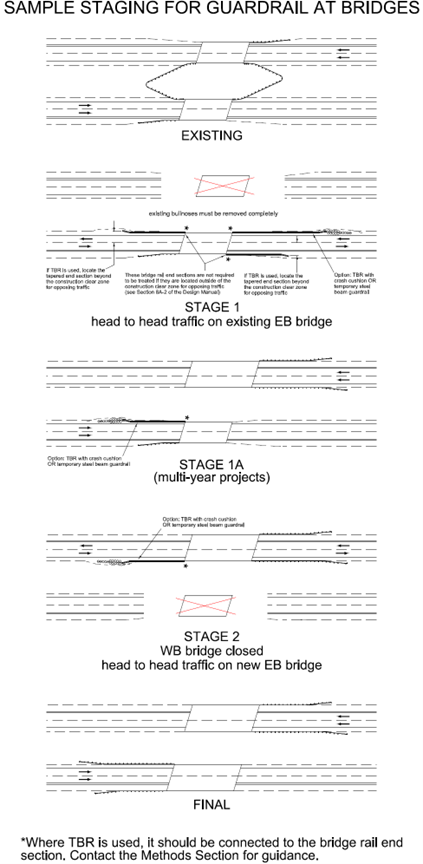
A common situation arises during staged construction where one side of the bullnose conflicts with construction operations, but a barrier is still needed for traffic on the opposite side. In these cases, the bullnose should be completely removed during the first stage and replaced with a single run of guardrail or TBR. The example on the next page demonstrates a sample staging plan. The Methods Section has details available for connecting TBR to bridge rail end sections. Contact the Roadside Safety Engineer.
- Additional priority should be given to replacing "BA-" style installations that:
- Will have a post-construction top-of-rail height less than 28 inches.
- Have a length sufficient enough to shield only the primary obstacle (i.e. bridge end post).
- Additional priority should be given to replacing "RE-" style installations that:
- Will have a post-construction top-of-rail height less than 26 inches.
- Have a length sufficient enough to shield only the primary obstacle (i.e. bridge end post).
- Are more than 20 years old.
Back to top