
Content Information
On this page...
Crash cushions are devices used to protect errant vehicles from impacting potentially hazardous objects. Because they are shorter than other barriers, crash cushions are typically used in areas where a long barrier installation might not be feasible.
Crash cushions are used within the clear zone of approaching traffic where an obstacle exists that cannot be moved, made breakaway, or otherwise protected with a longer barrier. They are designed to dissipate the energy of a vehicle either partially during a side impact or fully in the case of a head-on impact. Obstacles that are commonly shielded with crash cushions include bridge rail end sections, temporary barrier rail (TBR) ends, and concrete barrier ends.
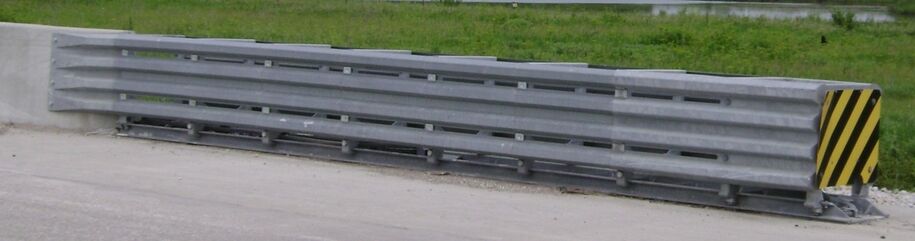
Figure 1: A typical crash cushion.
Back to topTypes of Crash Cushions
Crash cushions are separated into two main catagories: temporary and permanent. Temporary crash cushions are those that are used during the construction phase of a project. When construction is complete, temporary crash cushions are removed from the job site. Conversely, permanent crash cushions are left in place after the work is completed, and should be expected to last 10 years or more.
A list of approved crash cushions is located in MAPLE search. Any of the systems on the list can be used as a temporary crash cushion. However, only a system identified in the list as permanent can be used as a permanent crash cushion.
Depending on the capabilities of a specific system, three other designations are applied to an approved crash cushion: non-redirective, redirective, and severe use.
Non-Redirective
When impacted from the side, the system has no capability to deflect a vehicle back in the opposite direction. The vehicle will usually pass completely through the system, although its speed should be reduced.
When impacted head-on, the system slows and stops an impacting vehicle through the transfer of momentum to masses of sand contained in plastic barrels.
Repairs after any type of impact usually involve complete replacement of damaged units.
Redirective
When impacted from the side, the system reacts in a manner similar to a guardrail, absorbing some energy from the impacting vehicle and deflecting it back in the opposite direction. Some repairs may be necessary following a typical side impact.
When impacted head-on, the system slows and stops an impacting vehicle by collapsing and crushing or ripping specially designed internal parts. Significant repairs are required after a typical head-on impact, including removal and replacement of the crushed internal parts.
Severe Use (also known as low maintenance)
When impacted from the side, the system reacts identically to a redirective crash cushion.
When impacted head-on, the system slows and stops an impacting vehicle by compressing flexible plastic components or a fluid filled piston. Minimal repairs are required after a typical head-on impact. The system can usually be pulled out, inspected, and put back into service within an hour.
Choosing a Temporary Crash Cushion
Temporary crash cushions provide a method for shielding obstacles that are located within the clear zone of a temporary traffic control zone. Depending on the situation, one type of crash cushion may be more appropriate than the others. Often, choosing the best type depends on the object being shielded and the likelihood that a specific installation will be impacted during the course of a construction project.
Consider the following variables when determining which type of temporary crash cushion to use:
Distance from the crash cushion to approaching traffic:
4 feet or less: severe use crash cushions should be used.
4 to 8 feet: redirective crash cushions are appropriate. However, severe use or temporary crash cushions may also be used, depending on other variables. Consider checking with the District to see if they have a preference.
Beyond 8 feet: almost always use a non-redirective crash cushion.
Traffic volumes:
Higher volumes increase the probability that a crash cushion will be impacted; therefore, consider using severe use crash cushions on projects with high traffic volumes.
Duration of use:
Longer projects increase the probability that a crash cushion will be impacted. If a project will extend into the winter months or into the next construction season, use redirective or severe use crash cushions.
Type of surface on which the crash cushion will be installed:
Redirective and severe use crash cushions are easiest to install on existing pavement. However, they can be installed on other surfaces following construction of a concrete pad. Non-redirective crash cushions can be installed on paved and unpaved surfaces.
Size of the obstacle:
Narrow obstacles lend themselves well to being shielded by redirective or severe use crash cushions. Wider obstacles can be effectively shielded with non-redirective crash cushions.
Size of the crash cushion:
Non-redirective crash cushions are approximately 6 feet wide by 35 feet long.
Redirective and severe use crash cushions are approximately 3 feet wide and range from 20 to 36 feet long.
Availability of clear space behind the crash cushion:
Because vehicles may penetrate through non-redirective crash cushions, an obstacle-free recovery area should be provided on the back side of non-redirective systems. However, redirective and severe use crash cushions do not allow an impacting vehicle to penetrate the system, so clear space behind these systems is not necessary.
Design Considerations for Temporary Crash Cushions
Non-redirective Crash Cushions (Sand Filled Barrel Arrays)
For design purposes, assume that a non-redirective crash cushion is equivalent to a sand filled barrel array. Sand filled barrel arrays can be installed either on pavement or on a dirt pad. If a barrel array will be located behind a curb, the curb must be ground to a 4 inch sloped curb adjacent to, and for 50 feet in advance of, the barrel array. If the barrel array will be located fully or partially off existing pavement, provide a graded dirt pad as shown on Standard Road Plan BA-500.
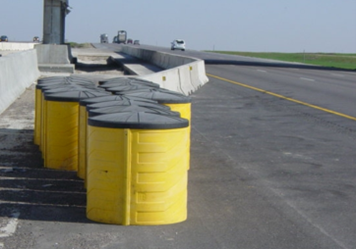
Figure 2: Sand filled barrel arrays are adaptable to many types of obstacles.
In a standard sand filled barrel array, the weight of the barrels increases incrementally, with the heaviest barrels at the rear. Standard Road Plan BA-500 shows the heaviest and rearmost barrel is offset at least 30 inches in front of the obstacle. While this protects the end of the obstacle for approaching traffic, it creates some risk for opposing traffic. Therefore, do not use sand filled barrels in situations where it could be easy for an opposing vehicle to impact one of the heaviest barrels first. Figure 3 presents an example of a sand filled barrel installation that may be a concern for opposing traffic. The installation shown on Figure 3 should not be used. This places the rearmost barrel in a location where it could easily be impacted from the rear by the opposing traffic.
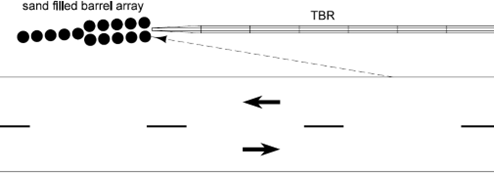
Figure 3: A sand filled barrel installation that creates an obstacle for opposing traffic.

| Do not locate a sand filled barrel array where the heaviest, rearmost barrel will be within the work zone clear zone of opposing traffic. |
|---|
Trailing bridge rail end sections seldom require protection because they are typically located beyond the work zone clear zone of approach traffic. In the rare case where a trailing bridge rail end section does fall within the work zone clear zone of approach traffic, consider shielding it with TBR (refer to 9B-9) or with a redirective or severe use crash cushion instead.
Redirective and Severe Use Temporary Crash Cushions
Unlike non-redirective crash cushions, redirective and severe use crash cushions must be installed on a flat, paved surface. If an existing curb conflicts with the footprint of the crash cushion, the curb must be ground flat, or the pavement must be reconstructed in a manner similar to the paved footing described in the next paragraph. If the crash cushion will be located behind a curb, the curb must be ground to a 4 inch maximum sloped curb adjacent to, and for 50 feet in advance of, the crash cushion.
If a redirective or severe use temporary crash cushion will be located off existing pavement, a paved footing must be constructed (which is incidental to the crash cushion). For design purposes, assume an 8 inch PCC footing with a width of 5 feet and a length of 40 feet. If grading is required, grade similarly to Standard Road Plan BA-500.
Back to topShowing Temporary Crash Cushions in the Plans
“Temporary Crash Cushion” Bid Item
Although using this bid item allows contractors to provide any one of the systems on the approved list, they typically install the most common and least expensive crash cushion: a sand filled barrel array. Therefore, when using the “Temporary Crash Cushion” bid item, prepare the plans with the assumption that contractors will use sand filled barrels. List Standard Road Plan BA-500 in the Index of Standard Road Plans and fill out Tabulation 108-30. See the first two tabulation entries in Figure 4 for examples of sand filled barrel installations.
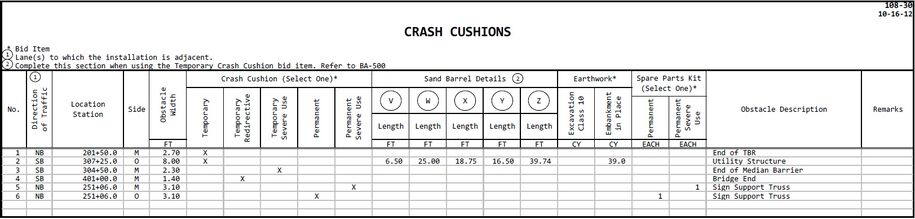
Figure 4: Sample tabulation showing different types of crash cushion installations.
The first entry in the tabulation involves shielding the end of TBR. Often, TBR is located on the pavement and does not require any embankment work to allow for sand barrels. Therefore, all the variables involving construction of the embankment can be left blank or crossed out.
|
| If a temporary crash cushion is to be left in place for use the next construction season, use either the Temporary Crash Cushion, Redirective bid item or the Temporary Crash Cushion, Severe Use bid item. |
|---|
“Temporary Crash Cushion, Redirective” Bid Item
Using the “Temporary Crash Cushion, Redirective” bid item restricts contractors to providing a crash cushion identified as “Redirective” in MAPLE search. Include Tabulation 108-30 in the plans. See installation number 4 of Figure 4 for an example of a tabulation entry covering a redirective temporary crash cushion installation.
“Temporary Crash Cushion, Severe Use” Bid Item
Using the “Temporary Crash Cushion, Severe Use” bid item restricts contractors to providing a crash cushion identified as “Severe Use” in MAPLE search. Include Tabulation 108-30 in the plans. See installation number 3 of Figure 4 for an example of a tabulation entry covering a severe use temporary crash cushion installation.
Back to topDesign Considerations for Permanent Crash Cushions
Permanent crash cushions are approximately 3 feet wide and range from 20 to 36 feet long, whereas a typical guardrail installation is in excess of 100 feet long. This means that permanent crash cushions can be used in a wider variety of situations – especially those where site conditions are constrained. And because they are much shorter than a typical guardrail installation, permanent crash cushions are less likely to be impacted. They do, however, cost significantly more than a typical guardrail installation, so they are most commonly used in situations where guardrail would not fit.
Permanent crash cushions are often used to protect:
Ends of permanent concrete barrier – especially in the median where width is restricted.
Bridge ends that have a side road or an entrance in close proximity.
Gore areas.
Two types of permanent crash cushions are available for use: permanent (which are redirective) and severe use. In general, severe use crash cushions are more expensive initially, but due to their ease of maintenance, their life cycle costs tend to be less. Therefore, the decision to install a severe use crash cushion should be based on the expected number of impacts over the lifetime of the installation. In high crash locations, severe use crash cushions are always preferred.
Consider the following variables when determining which type of permanent crash cushion to use:
Distance from the crash cushion to approaching traffic:
8 feet or less: severe use crash cushions should be used.
Greater than 8 feet: redirective crash cushions are appropriate. However, severe use crash cushions may be used, depending on other variables. Consider checking with the District to see if they have a preference.
Traffic volumes:
Higher volumes increase the probability that a crash cushion will be impacted. Therefore, consider using severe use crash cushions in locations where high traffic volumes are expected.
Installation on Pavement
Redirective and severe use crash cushions must be installed on a flat, paved surface. If an existing curb conflicts with the footprint of the crash cushion, the curb must be ground flat, or the pavement must be reconstructed in a manner similar to the paved footing described in the next paragraph. Do not locate permanent crash cushions behind curbs.
If a redirective or severe use crash cushion will be located off existing pavement, a paved footing must be constructed (which is incidental to the crash cushion). For design purposes, assume an 8 inch PCC footing with a width of 5 feet and a length of 40 feet. If grading is required, grade similarly to Standard Road Plan BA-500.
Gore Areas
One of the most common installation locations for crash cushions is at gore areas. This is because two runs of concrete barrier (or bridge rail) often terminate here – one along the mainline and one along the ramp – and both of the approach ends need to be treated within a limited distance. Crash cushions are well suited for use in gore areas since they are narrow and relatively short. Because gore areas are usually high crash locations, they should be protected with severe use crash cushions.
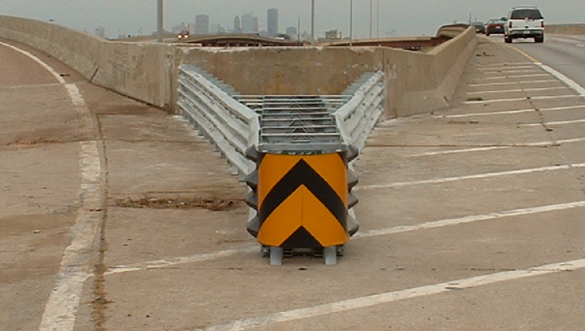
Figure 5: A crash cushion shielding a gore area.
For the crash cushion in shown Figure 5, the ends of the concrete barriers were located approximately 10 feet apart, so the contractor was required to install a wide crash cushion to protect this entire width. This added significantly to the cost of the crash cushion and makes repairs more difficult. Therefore, whenever possible, extend existing or proposed barriers closer together so that a standard width crash cushion can be used. The most preferable condition is to bring the barriers together and transition to a 24 inch wide, 30 inch long, vertical faced block. Contact the Methods Section for details.
Back to topShowing Permanent Crash Cushions in the Plans
“Permanent Crash Cushion” Bid Item
Using the “Permanent Crash Cushion” bid item restricts the contractor to providing a crash cushion identified as “Permanent” in MAPLE Search. Include Tabulation 108-30 in the plans. See installation number 6 of Figure 4 for an example of a tabulation entry covering a permanent crash cushion installation.
“Permanent Crash Cushion, Severe Use” Bid Item
Using the “Permanent Crash Cushion, Severe Use” bid item restricts the contractor to providing a crash cushion identified as “Severe Use” in MAPLE search. Include Tabulation 108-30 in the plans. See installation number 5 of Figure 4 for an example of a tabulation entry covering a severe use permanent crash cushion installation.