
Content Information
On this page...
- General
- Silt Basin
- Silt Basin Bid Quantities
- Silt Dike and Silt Ditch
- Silt Fence
- Silt Fence Bid Quantities
- Paving Projects
- Grade and Pave Projects
- Bridge and RCB Projects
- Silt Fence for Ditch Checks
- Silt Fence for Ditch Check Bid Quantities
- Grade and Pave Projects
- Bridge and RCB Projects
- Rock Check Dam Bid Quantities
- Temporary Sediment Control Basins
- Temporary Sediment Control Basin Bid Quantities
- Perimeter and Slope Sediment Control Devices and Ditch Check Sediment Control Devices
- Perimeter and Slope Sediment Control Device and Ditch Check Sediment Control Device Bid Quantities
- Silt Curtains
- Other Criteria when Determining Controls or Bid Quantities
- Stabilized Construction Entrance
- Pollution Prevention Plans – Stormwater Permit
- Chronology of Changes
General
Temporary sediment control devices should be considered on all projects involving earthwork. They are used to control sediment on new projects until permanent seeding is established. This section describes the following devices that are to be used and their bid quantities:
Silt Basin
Silt Basin Bid Quantities
Silt Dike and Ditch
Silt Fence
Silt Fence Bid Quantities
Silt Fence Ditch Checks
Silt Fence Ditch Check Bid Quantities
Rock Check Dam Quantities
Rock Check Dam Bid Quantities
Temporary Sediment Control Basins
Temporary Sediment Control Basin Bid Quantities
Perimeter and Slope Sediment Control Devices and Ditch Check Sediment Control Devices
Perimeter and Slope Sediment Control Device and Ditch Check Sediment Control Device Bid Quantities
Silt Curtains
Stabilized Construction Entrance
The Erosion and Sediment Control Field Guide provides more information regarding erosion and sediment control.
Section 10C-2 provides more information regarding temporary sediment control devices used for storm water retention.
Back to topSilt Basin
A silt basin collects silt deposits from flowing water. Typically, designers decide when and where to use them. Silt basins should be strongly considered any time soil is disturbed which could result in silt flowing to a waterway. Silt basins are not required if a minimum 50 foot undisturbed vegetated buffer separates a soil disturbance from the waterway. Designers can contact Roadside Development in the Design Bureau and the Construction and Materials Bureau for assistance.
Silt basins may be used in roadway ditches preceding drainage structure inlets (typically at last roadway pipe prior to discharging offsite) and at ditch outlets that flow offsite. Figure 1 illustrates these locations.
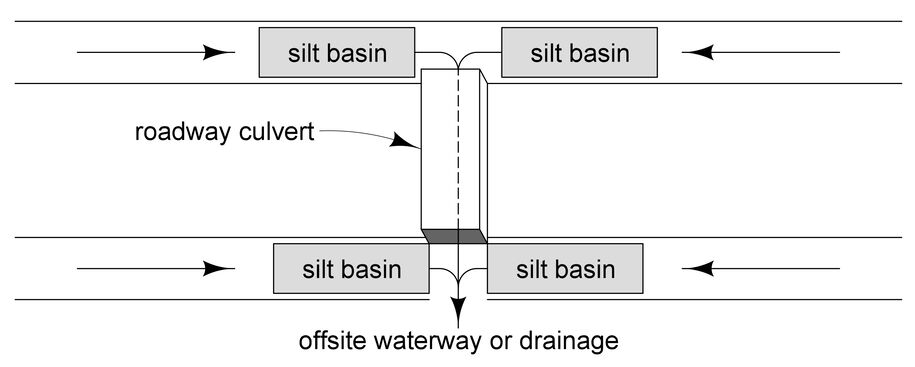
Figure 1: Typical location of silt basins.
Depending on the drainage areas, silt basins may also be placed in ditch grades of 1% to 2% at approximately 100 foot intervals. There is no maximum ditch slope for silt basins.
Standard Road Plan EW-403 shows an example of a silt basin used as a final device at the end of the ditch before water leaves the right-of-way.
Tab 100-14 is used to list silt basin locations.
Back to topSilt Basin Bid Quantities
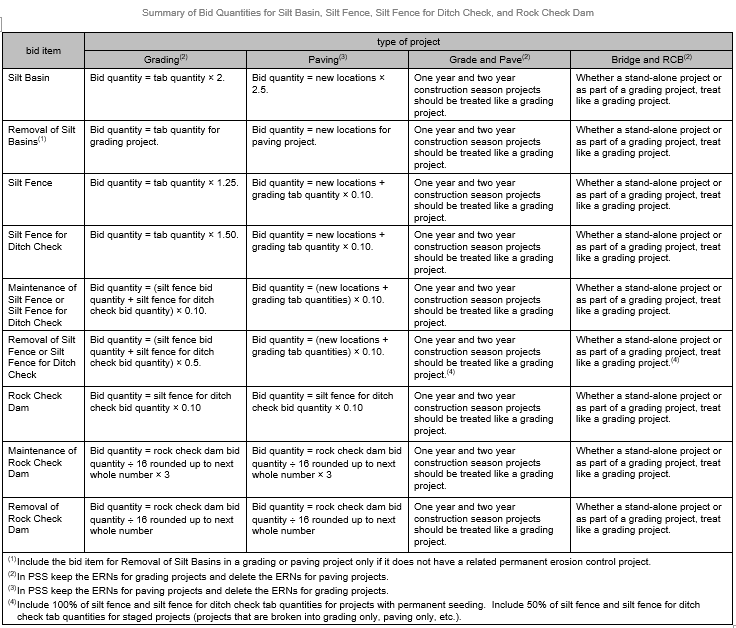
Grading Projects
Bid quantity = tab quantity × 2. The bid quantity is at least twice the tab quantity to reflect possible excavation to clean out and maintain basins.
Include the following bid item Estimate Reference Note:
Refer to Tab. 100-14. The tabulation includes estimated locations for placement of Silt Basins to address possible erosion during construction. Verify the specific locations with the Engineer prior to beginning placement. Bid item includes 100% additional quantity for field adjustments and maintenance.
Paving Projects
Bid quantity = new locations × 2.5. The bid quantity is at least 2.5 times the paving tab quantity to reflect possible excavation to clean out and maintain the basins during paving project. Round the quantity up to a whole number.
Include the following bid item Estimate Reference Note:
Refer to Tab. 100-14. The tabulation includes estimated locations for placement of Silt Basins to address possible erosion during construction. Verify the specific locations with the Engineer prior to beginning placement. Bid item includes 150% additional quantity for the paving project for field adjustments and maintenance.
Grade and Pave Projects
One year and two year construction season projects should be treated like a grading project.
Bridge and RCB Projects
Whether a stand-alone project or as part of a grading project, treat like a grading project.
Removal of Silt Basins
Typically, Removal of Silt Basins will be included in a permanent erosion control project. Include the bid item for Removal of Silt Basins in a project only if it does not have a related permanent erosion control project.
Grading Projects
Bid quantity = tab quantity for grading project.
Paving Projects
Bid quantity = New locations for paving project.
Grade and Pave Projects
One year and two year construction season projects should be treated like a grading project.
Bridge and RCB Projects
Whether a stand-alone project or as part of a grading project, treat like a grading project.
Back to topSilt Dike and Silt Ditch
Silt dikes and silt ditches trap silt in a depressed area to keep it from flowing onto private property. A silt dike and/or a silt ditch may be used when the natural ground slopes away from the foreslope and roadway ditch is not provided. Examples of a silt dike and silt ditch are shown on Standard Road Plan EW-403.
A silt dike is constructed longitudinally along the foreslope. A silt ditch is constructed by excavating the earth to a uniform depth below natural ground at the toe of the foreslope. Silt dikes and silt ditches may be used together or separately, depending on the situation. A silt dike may be constructed by taking the excavated material from a silt ditch and placing it to the side to form a silt dike.
Use Tab. 100-13 to list locations of silt ditches and Tab. 100-15 to list locations of silt dikes.
Back to topSilt Fence
Silt fence is constructed out of engineering fabric. It is used to disrupt the flow of water. By doing this, the soil and debris will settle out of the water and collect behind the silt fence. Silt fence is placed along the contours of the slope. At a minimum, two rows of silt fence should be placed: one near the mid-slope and another near the toe of the slope. The number of rows, and spacing, depends on the length and grade of the slope. Table 1 shows recommended spacing of silt fence along a slope.
Table 1: Guidelines for silt fence spacing on slopes.
For Loess and other highly erodible soils, these spacings should be decreased
Information Source: Based on information in Iowa Construction Site Erosion Control Manual, 2006.
Silt fence typically is not required along the right-of-way line when an existing ditch will convey storm water and the existing ditch will not be disturbed during the course of the project. Silt fence should be placed around intakes when they are constructed.
Silt fence may be placed up to a maximum length of 200 feet. For every segment of silt fence that is placed, place a 20 foot J-hook segment at the lower end skewed towards the foreslope to intercept runoff (see Figure 2). This J-hook segment should be included in the tabulation and the bid items, as demonstrated in Figure 2.
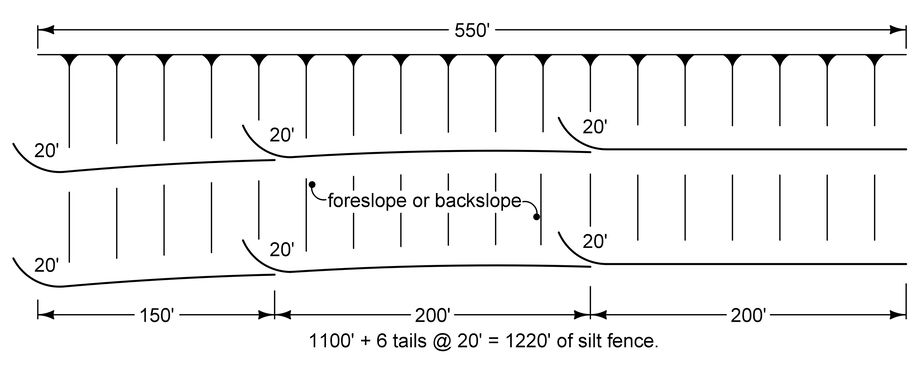
Figure 2: Silt fence placed on a slope.
Standard Road Plan EC-201 shows details for silt fences.
Use Tab. 100-17 to list silt fence locations.
Back to topSilt Fence Bid Quantities
Grading Projects
Silt Fence
Bid quantity = tab quantity × 1.25. The bid quantity should be 25% more than the tab quantity to reflect possible replacements during the grading.
Include the following bid item Estimate Reference Note:
Refer to Tab. 100-17. The tabulation includes estimated locations for placement of Silt Fence to address possible erosion during construction. Verify the specific locations with the Engineer prior to beginning placement. Bid item includes 25% additional quantity for field adjustments and replacements.
Maintenance of Silt Fence or Silt Fence for Ditch Check
Bid quantity = (silt fence bid quantity + silt fence for ditch check bid quantity) × 0.10. The bid quantity is equal to 10% of the bid quantities for silt fence and silt fence for ditch checks.
Include the following bid item Estimate Reference Note:
This item is included for cleanout and repair of the silt fence and silt fence for ditch checks during the project.
Removal of Silt Fence or Silt Fence for Ditch Check
Bid quantity = (silt fence bid quantity + silt fence for ditch check bid quantity) × 0.5. The bid quantity should be 50% of the bid quantities for silt fence and silt fence for ditch checks for staged projects.
Include the following bid item Estimate Reference Note:
This item is included for silt fence and silt fence for ditch check removal required for staging reasons, for replacement (replacement to be paid separately), or for areas that have achieved 70% permanent growth.
Back to topPaving Projects
Silt Fence
Bid quantity = new locations + grading tab quantity × 0.10. The bid quantity should include the new locations for the paving project plus 10% of the grading project tab quantity.
Include the following bid item Estimate Reference Note:
Refer to Tab. 100-17. The tabulation includes estimated locations for placement of Silt Fence to address possible erosion during construction. Verify the specific locations with the Engineer prior to beginning placement. Bid item includes tab quantity for the paving project for new locations and 10% of the original tab quantity for the grading project (insert original tab quantity from the grading project) for field adjustments and replacements.
Maintenance of Silt Fence or Silt Fence for Ditch Check
Bid quantity = (new locations + grading bid quantities) × 0.10. The bid quantity should be 10% of the new locations for the paving project and the bid quantities for silt fence and silt fence for ditch checks installed on the grading project.
Include the following bid item Estimate Reference Note:
This item is included for maintaining the new silt fence and silt fence ditch checks installed for the paving project and existing silt fence and silt fence for ditch checks installed as part of the grading project.
Removal of Silt Fence or Silt Fence for Ditch Check
Bid quantity = (new locations + grading bid quantities) × 0.10. The bid quantity should be 10% of the new locations for the paving project and the bid quantities for silt fence and silt fence for ditch checks installed on the grading project.
Include the following bid item Estimate Reference Note:
This item is included for silt fence and silt fence for ditch check removal required for staging reasons, for replacement (replacement to be paid separately), or for areas that have achieved 70% permanent growth.
Back to topGrade and Pave Projects
One year and two year construction season projects should be treated like a grading project (except as noted below).
Removal of Silt Fence or Silt Fence for Ditch Check
Include 100% of silt fence and silt fence for ditch check bid quantities for projects with permanent seeding. Include 50% of silt fence and silt fence for ditch check bid quantities for staged projects (projects that are broken into grading only, paving only, etc.).
Include the following bid item Estimate Reference Note:
This item is included for silt fence and silt fence for ditch check removal required for staging reasons, for replacement (replacement to be paid separately), or for areas that have achieved 70% permanent growth.
An additional mobilization will be needed for the paving portion of the project if one of the items listed in Section 1G-5 is included for the paving portion the project.
Back to topBridge and RCB Projects
Whether a stand-alone project or as part of a grading project, treat like a grading project (except as noted below).
Removal of Silt Fence or Silt Fence for Ditch Check
The bid quantity should be 100% of silt fence and silt fence for ditch check bid quantities for projects with permanent seeding. For staged projects (projects that are broken into grading only, paving only,
etc.), bid quantity should be 50% of silt fence and silt fence for ditch check bid quantities for staged projects.
Include the following bid item Estimate Reference Note:
This item is included for silt fence and silt fence for ditch check removal required for staging reasons, for replacement (replacement to be paid separately), or for areas that have achieved 70% permanent growth.
Back to topSilt Fence for Ditch Checks
Silt fence ditch checks are used to slow flow of water and to intercept soil and debris from water flowing through ditches. They are installed at right angles to the flow of water.

| When rolled erosion control products are used in ditches or medians, use perimeter and slope sediment control devices for ditch checks rather than silt fence. |
|---|
Follow the spacing guidelines in Table 2 when placing silt fence ditch checks.
Table 2: Guidelines for silt fence ditch check spacing.
Standard Road Plan EC-201 shows details for silt fence ditch checks.
Use Tab. 100-18 for location and storage volume of silt fence ditch checks.
Back to topSilt Fence for Ditch Check Bid Quantities
Grading Projects
Silt Fence for Ditch Checks
Bid quantity = tab quantity × 1.50. The bid quantity should be 50% more than the tab quantity to reflect possible replacements during the grading project.
Include the following bid item Estimate Reference Note:
Refer to Tab. 100-18. The tabulation includes estimated locations for placement of Silt Fence for Ditch Checks to address possible erosion during construction. Verify the specific locations with the Engineer prior to beginning placement. Bid item includes 50% additional quantity for field adjustments and replacements.
Maintenance of Silt Fence or Silt Fence for Ditch Check
Refer to Silt Fence Bid Quantities above.
Removal of Silt Fence or Silt Fence for Ditch Check
Refer to Silt Fence Bid Quantities above.
Paving Projects
Silt Fence for Ditch Checks
Bid quantity = new locations + grading tab quantity × 0.10. The bid quantity should include the new locations for the paving project plus 10% of the grading project tab quantity.
Include the following bid item Estimate Reference Note:
Refer to Tab. 100-18. The tabulation includes estimated locations for placement of Silt Fence for Ditch Checks to address possible erosion during construction. Verify the specific locations with the Engineer prior to beginning placement. Bid item includes tab quantities for the paving project for new locations and 10% of the original tab quantity for the grading project (insert original tab quantity from the grading project) for field adjustments and replacements.
Maintenance of Silt Fence or Silt Fence for Ditch Check
Refer to Silt Fence Bid Quantities above.
Removal of Silt Fence or Silt Fence for Ditch Check
Refer to Silt Fence Bid Quantities above. An additional mobilization will be needed if one of the items listed in Section 1G-5 is included in the project.
Back to topGrade and Pave Projects
One year and two year construction season projects should be treated like a grading project.
Back to topBridge and RCB Projects
Whether a stand-alone project or as part of a grading project, treat like a grading project.
Rock Check Dams
Similar to silt fence ditch checks, rock check dams are used to slow flow of water and to intercept soil and debris from water flowing through ditches. They are installed at right angles to the flow of water. Typically, they are installed in situations where silt fence ditch checks have failed to hold up. For this situation, the quantity bid is based on a percentage of Silt Fence for Ditch Check. Should the Roadside Development Section specifically request the use of rock check dams for storm water storage purposes, follow the spacing guidelines in Table 3.
Table 3: Guidelines for rock check dam spacing.
Standard Road Plan EC-302 shows details for rock check dams.
Use Tab. 100-32 for location and storage volume of rock check dams.
Back to topRock Check Dam Bid Quantities
Used to Replace Silt Fence Ditch Check
Grading Projects
Rock Check Dam
Bid quantity = bid quantity for Silt Fence for Ditch Checks × 0.1. The bid quantity should be 10% of the bid quantity of Silt Fence for Ditch Checks to reflect possible replacement for Silt Fence for Ditch Checks during the grading project.
Maintenance of Rock Check Dam
Assume 3 cleanouts for each rock check dam. Installation of rock check dam is paid in linear feet; however, maintenance is paid per occurrence. This requires converting linear feet of rock check dam bid to a number of rock check dams maintained. To make the conversion, assume each rock check dam is 16 linear feet. Divide the linear feet bid by 16 feet per rock check dam and round up to get the equivalent number of rock check dams.
As an example, suppose 9,000 feet of Silt Fence for Ditch Check is bid for a drainage basin. Then the bid quantity for Rock Check Dam is 0.1 x 9000 feet = 900 feet. This converts to 900/16 = 57 (after rounding up) rock check dams.
Removal of Rock Check Dam
Refer to Maintenance of Rock Check Dam Quantities above to estimate the number of rock check dams to be removed.
Paving Projects
Rock Check Dam
Bid quantity = bid quantity for Silt Fence for Ditch Checks × 0.1. The bid quantity should be 10% of the tab quantity of Silt Fence for Ditch Checks to reflect possible replacement for Silt Fence for Ditch Checks during the grading project.
Maintenance of Rock Check Dam
Assume 3 cleanouts for each rock check dam. Installation of rock check dam is paid in linear feet; however, maintenance is paid per occurrence. This requires converting linear feet of rock check dam installed to a number of rock check dams maintained. To make the conversion, assume each rock check dam is 16 linear feet. Divide the linear feet of installation by 16 feet per rock check dam and round up to get the equivalent number of rock check dams.
Removal of Rock Check Dam
Refer to Maintenance of Rock Check Dam Quantities above to determine the number of rock check dams to be removed.
Grade and Pave Projects
One year and two year construction season projects should be treated like a grading project.
Bridge and RCB Projects
Whether a stand-alone project or as part of a grading project, treat like a grading project.
Used for Storm Water Storage
Rock Check Dam
Rock check dams are bid by linear feet. The bid item includes the revetment, Class 10 excavation, and engineering fabric required to construct rock check dams.
Maintenance of Rock Check Dam
Assume 3 cleanouts for each rock check dam.
Removal of Rock Check Dam
Include 1 removal for each rock check dam installed.
Back to topTemporary Sediment Control Basins
Temporary sediment control basins are used to capture sediment before it leaves the right of way. At a minimum, they should be included for drainage basins which involve 10 or more acres of disturbed area. Disturbed areas are areas where vegetation, rocks, pavement and other protective ground covers are removed during construction resulting in the exposure of underlying soil. Temporary sediment control basin structures are larger than other temporary sediment control devices and are intended to detain more storm water. They include a pipe, the intent of which is to release water from the top of the pond first to allow sediment to settle out. They also include a rock spillway to reduce likelihood of the structure washing out.
Standard Road Plan EC-601 shows details for temporary sediment control basins.
Use Tab. 100-33 for location and storage volume of temporary sediment control basins.
Back to topTemporary Sediment Control Basin Bid Quantities
Temporary Sediment Control Basin
Temporary sediment control basins are bid by count. The bid item includes the materials and labor to construct them.
Maintenance of Temporary Sediment Control Basin
Assume 3 cleanouts for each temporary sediment control basin.
Removal of Temporary Sediment Control Basin
Include 1 removal for each temporary sediment control basin installed.
Back to topPerimeter and Slope Sediment Control Devices and Ditch Check Sediment Control Devices
Perimeter and Slope Sediment Control Devices and Ditch Check Sediment Control Devices are used for a purpose similar that of silt fence – to capture sediment or to slow flow of water. However, the use of these devices is much more flexible than silt fence. For example, this type of control may be installed when weather or site conditions do not permit installation of silt fence, or when it is preferred, as a result of the contractor’s staging, to install a control that can be easily removed and replaced. Because of this flexibility, placement of these controls is difficult to determine during design.
Back to topPerimeter and Slope Sediment Control Device and Ditch Check Sediment Control Device Bid Quantities
Perimeter and Slope Sediment Control Device
Where Perimeter and Slope Sediment Control Devices are used in lieu of silt fence, and specific locations have been determined, use the guidelines in Table 4 for estimating purposes. On slopes, use 12 inch devices for slopes/grades less than 33% and use 20 inch devices for slopes/grades equal to or greater than 33%. Refer to Table 4 for spacing.
Table 4: Guidelines for Perimeter and Slope Sediment Control Device spacing on slopes.
If specific locations for Perimeter and Slope Sediment Control Devices haven’t been determined, then for estimating purposes include the greater of:
- A minimum of 200 feet each of 12 inch and 20 inch Perimeter and Slope Sediment Control Devices or
- 10% of the silt fence quantities up to a maximum of 1,000 feet each of 12 inch and 20 inch Perimeter and Slope Sediment Control Devices.
Some specific locations where use of Perimeter and Slope Sediment Control Devices is ideal include:
- Slopes which are pitched towards the roadway and end at the back of curb or along a sidewalk.
- Inlet protection, such as on guardrail projects to protect inlets of median pipes. Quantity should be based on the number of inlets to be protected.
- RCB or Bridge Projects. Estimated quantity for 12 inch or 20 inch devices would be the length of stream from ROW line to ROW line. If work is being done on both sides of the stream, the quantity would be doubled.
Removal of Perimeter and Slope Sediment Control Devices is bid in the same manner as installation.
Ditch Check Sediment Control Devices
When Ditch Check Sediment Control Devices are used in lieu of silt fence ditch checks, use the guidelines in Table 5 for estimating purposes. Only 12 inch and 20 inch devices are used. Typically, 12 inch devices are limited to use in medians; 20 inch logs are used elsewhere. In the estimate reference note, state 20 foot logs are to be used. Refer to Table 5 for spacing.
Table 5: Guidelines for Ditch Check Sediment Control Device spacing.
If specific locations for Ditch Check Sediment Control Devices haven’t been determined, then for estimating purposes include the greater of:
- A minimum of 200 feet each of 12 inch and 20 inch Ditch Check Sediment Control Devices, or
- 10% of the Silt Fence for Ditch Check quantities up to a maximum of 1000 feet each of 12 inch and 20 inch Ditch Check Sediment Control Devices.
Removal of Ditch Check Sediment Control Devices is bid in the same manner as installation.
Back to topSilt Curtains
Include the Developmental Specifications for Floating Silt Curtain as well as EC-202, which shows installation of hanging and containment silt curtains.
Floating Silt Curtain (Hanging)
Use for soil disturbing operations in or adjacent to a body of water and when requested by the ADE.
Estimate quantities based upon the width from need line to need line or width from need line to need line plus easements (whichever is greater) at the location. For bridges, use 2x the need line to need line (or need line to need line plus easement) width when both berms are impacted or 1x the width if only one berm is affected. The main point is to have a bid item and a reasonable quantity in the plans for the field to work with, so there is no need to be overly precise.
Cleanout is not required and removal is incidental to installation.
For culvert projects, a temporary stream diversion (EW-402) is typically included instead of floating silt curtain.
Floating Silt Curtain (Containment)
Use when specified by the Location and Environment Bureau or when requested by the ADE. It is intended for sensitive areas, protected waters, and where endangered aquatic species are expected to exist. When this item is used, it is installed parallel to the Hanging curtain and both bid items will be used.
Estimated quantities for Floating Silt Curtain (Containment) are the same as used for Hanging. For example, if you have 200 LF of Hanging and OLE says to use Containment also, then you will also have 200 LF of Containment. Include the Clean-out of Floating Silt Curtain (Containment) bid item. The clean-out quantity will be 2x the Floating Silt Curtain (Containment) quantity, as it includes one interim cleanout plus removal. The removal is paid for as one cleanout since the curtain has to be removed to clean it out.
Examples
- Bridge Project
Need line to need line is 150 feet. Work is on both sides of the stream. Containment is not specified by OLE. Bid as follows:
- Floating Silt Curtain (Hanging) = 150 × 2 = 300 feet.
- ER Project
Need line to need line is 100 feet. Only one bank is disturbed. Not directed to use Containment. Bid as follows:
- Floating Silt Curtain (Hanging) = 100 × 1 = 100 feet.
Maintenance of Floating Silt Curtain (Hanging or Containment)
Bid quantity = Floating Silt Curtain × 0.50. The bid quantity is equal to 50% of the tab quantities for Floating Silt Curtain.
Best Management Practices (BMPs) for erosion and sediment control measures are required throughout the site and immediately uphill of the curtains to minimize sediment migration to the curtains.
Back to topOther Criteria when Determining Controls or Bid Quantities
Soil conditions, such as erodibility, should be considered when choosing a sediment control device. For example, sands and silts erode quickly, but clays are more stable. Highly erodible soils may require more devices with a closer spacing than more stable soils. Design decisions should be made on the field exam. For assistance in design or for more information, contact Roadside Development.
On paving projects where sediment control devices have already been installed on the grading project, it is the intent that these be maintained in functional condition during the paving contract. A certain percentage of the original quantity of sediment control devices from the grading project is included on the paving project to account for the reconstruction of the existing devices that are no longer functional (see Bid Quantities of corresponding sediment control device). A tabulation of sediment control devices from the grading project should not be included in the paving project. Instead, include a note in the bid items to distinguish this quantity. The paving project may also have locations of new devices exclusive to the paving project to be included in the bid items. Once again the quantities depend on the existing conditions of the project.
Back to topStabilized Construction Entrance
Stabilized construction entrances are temporary entrances consisting of a layer of aggregate placed on a mat of engineering fabric. The purpose of stabilized construction entrances is to reduce mud tracked on to the roadway, so they should be located at points where construction traffic leaves a construction site and enters on to a public road. Construction staging affects where contractors will enter a roadway. This makes determining the location and number of stabilized construction entrances difficult to determine, so for estimating purposes, assume the following:
For grading or grade and pave projects: 1 entrance at the start of the project, 1 entrance at the end of the project, 2 for each leg of a side road used to access a project, and 1 per structure (bridge or box culvert), if included with grading or paving project.
Each entrance will be 100 linear feet.
For stand-alone structures project: 2 entrances.
As an example, for a grade and pave project with 3 side road legs used for access and 2 structures:
Number of entrances = 1 at the start + 1 at the end + 6 for the side road legs + 2 for the structures
= 10 entrances
Linear feet of Stabilized Construction Entrance = 10 entrances × 100 linear feet per entrance
= 1,000 linear feet
Back to topPollution Prevention Plans – Stormwater Permit
Include a Pollution Prevention Plan (PPP) in all projects involving a disturbed area of one acre or more. A disturbed area is an area where vegetation, rocks, pavement and other protective ground covers are removed during construction resulting in the exposure of underlying soil. All projects requiring a PPP must show drainage patterns. For projects such as shoulder widening, shoulder strengthening, guardrail blisters, etc., as-builts can be included as U sheets to show drainage patterns.
The same PPP must appear in all plans that occur within a permit's limits. Therefore, when covered under a single permit, if a PPP is developed for a grading project, the same PPP must appear in all related plans for paving, culverts, bridges, lighting, erosion control, etc. This means even if a bridge or RCB project within the permit limits involves less than an acre of disturbance, it is covered under the permit and therefore must contain a PPP. See Section 10D-1 for more information regarding PPPs.
Back to top