
Content Information
On this page...
This section addresses the different types of laboratory testing procedures routinely carried out within the Iowa DOT to determine the physical and engineering properties of soil/rock according to ASTM and/or AASHTO standards. For detailed testing procedures, references are given to the applicable Iowa DOT, ASTM and/or AASHTO standard test methods. Extreme care should be taken in selecting a representative sample so that the test values truly characterize the in-situ mass of soil.
Quick Tips:
- Select a representative sample, so that test values truly characterize the in-situ materials.
Back to top
Laboratory Requirements

Caution
All laboratories conducting geotechnical testing must be accredited through AASHTO Materials Reference Laboratory (AMRL) , American Association for Laboratory Accreditation (A2LA), U.S. Army Corps of Engineers (USACE), or other acceptable accreditation program.
Consultant laboratories are allowed to conduct only those tests for which the laboratory is accredited. If the laboratory is in the process of being accredited for a particular test, then that test can be conducted for the Iowa DOT so long as a QA/QC plan for that particular test is submitted to the Office of Design for review and approval prior to testing. Indicate in the QA/QC plan which test method is being followed, the most recent calibration of the laboratory equipment to be used, and the qualifications of the personnel performing the test.
Back to topLaboratory Test Methods
Laboratory tests are performed on obtained soil samples from the subsurface investigation in order to classify the soil and to determine specific engineering properties (density, moisture, compressibility, shear strength) of the soil. The amount of laboratory testing will be a function of the project requirements and subsurface conditions encountered. Enough laboratory testing should be performed to fully characterize each subsurface stratigraphy. The following sections present the basis for why the laboratory testing is performed and what procedures should be used to perform the laboratory tests. Obtain samples according to Office of Materials Test Method No. Iowa 101.
Soil Classification
Soil classification is based primarily on the characteristics that influence the engineering behavior of the soil. Several soil classification systems are used by the Iowa DOT, including the Unified Method for describing the textural characteristics of the soil during the site investigation and the USDA textural classification (see Figure 1) for providing more detailed information on the amounts of sand, silt, and clay sized particles in the soil. The current version of the Standard Specifications should be referenced and used for determining the classifications of select soils, unsuitable soils, etc. The USDA Textural Classification chart (see Figure 1) should also be used in conjunction with all classification criteria included in the Standard Specifications.
For Iowa DOT soil classification purposes, the split between sand and silt is 0.074 mm, and the clay fraction is the percentage of particles smaller than 0.002 mm in diameter. These splits should be carried forward into all classifications. A prefix, “gravelly”, is to precede the grain size classification if more than 10% is gravel. Particle size analysis provides detailed information on the amounts of sand, silt, and clay in the soil. Atterberg Limits tests provide indications of the soil’s physio-chemical characteristics such as plasticity, shrinkage, and swell potential.
The Standard Specifications state that the Group Index of soils is based on AASHTO M-145-91, and that unsuitable soils are those with a Group Index of (30) or more. Note that this is a change from the 1992 Standard Specifications, which used M-145-49 and a Group Index of (19) or (20) for defining unsuitables. Defining unsuitable soils as those with “GI = 30 or more” as per AASHTO M-145-91 and the Standard Specifications has not been found to be universally appropriate. Revision or modification of the “GI = 30 or more” criteria for unsuitable soils has been found to be necessary with some soils in certain parts of Iowa (and especially with the loess and claypan soils in southeast Iowa), with revisions or modifications either above (30) and below (30) being necessary and being implemented on certain projects.
The geotechnical designer should evaluate the applicability of the “GI = 30 or more” criteria for unsuitable soils on each project based on an over-view of the project as a whole, on any relationships to geologic types of soil (claypan, loess, gumbo, topsoil, etc.), on their experience with differing soils, on the geographical location of the project in Iowa, and on any other identifiable and applicable criteria. The designer should solicit concurrence with this evaluation via peer review and supervisory review, and should document in the project files what Group Index criteria is being used to define unsuitable soils on each project. No variation from the “GI = 30 or above” criteria should be made or incorporated into the final design prior to concurrence and documentation.
AASHTO classifications (M145) are determined from laboratory tests for each of the soil samples. The following laboratory test methods are used by the Soils Design Section to aid in determining soil classification:
- Particle Size Analysis of Soils (Office of Materials Test Method No. Iowa 108, AASHTO T88, ASTM D422).
- Atterberg Limits of Soils and Aggregate (Office of Materials Test Method No. Iowa 109, AASHTO T-89 and 90, ASTM D4318).
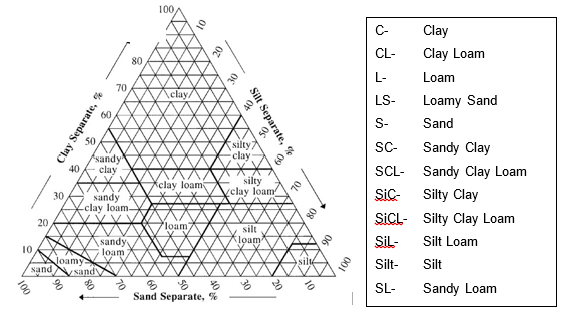
Figure 1: Textural Classification (USDA).
In Situ or Remolded Soil Characteristics (Soil Density, Moisture, etc.)
The density and moisture characteristics of a soil are the most important engineering properties. These characteristics are related to the soil strength, compressibility, permeability, etc., since as the soil becomes more dense, the soil generally becomes stronger, less compressible, and less permeable. In addition, organics within the soil affects the suitability of the soil for road construction purposes due to organic matter being generally spongy (highly compressible), unstable, and chemically reactive. The comparison of in-place density and remolded density provides information on the potential amount of shrinkage/bulking that may occur from borrow excavation to embankment placement. The following laboratory test procedures are used in determining soil density, moisture, and organic content:
Laboratory Determination of Water (Moisture) Content of Soil and Rock by Mass (AASHTO T265, ASTM D2216).
Laboratory Determination of Density (Unit Weight) of Soil Specimens (Office of Materials Test Method No. Iowa 102, ASTM D7263).
Inorganic and Organic Carbon Content (Office of Materials Test Method No. Iowa 111, AASHTO T194 or T267).
Standard Proctor, Moisture-Density Relations of Soil (Office of Materials Test Method No. Iowa 103, AASHTO T99, ASTM D698).
Modified Proctor, Moisture-Density Relations of Soil (Office of Materials Test Method No. Iowa 104, AASHTO T180, ASTM D1557).
Determining Minimum and Maximum Index Densities of Cohesionless Soils, (Office of Materials Test Method No. Iowa 313, ASTM D 4254, ASTM D 4253).
Compressibility
Consolidation of Undisturbed Soils (Office of Materials Test Method No. Iowa 105, AASHTO T216, ASTM D2435) is used in determination of consolidation parameters. The compressibility of soil will affect the amount of settlement that will occur below embankments or structures. Thus, a one-dimensional consolidation test is performed to determine the rate and magnitude of consolidation of undisturbed soils under load. This test measures the strain under a series of axial loads. The results of the test are used to compute the rate and quantity of settlement in undisturbed foundation soils under imposed loads.
Soil Strength Characteristics
The strength of soil is a function of density, moisture, stress history, and drainage condition (undrained vs. drained). Undrained (total stress) condition occurs when the underlying saturated soil is loaded rapidly (embankment construction/foundation loading) and there is insufficient time for the induced pore-water pressure to dissipate and consolidation to occur (drainage does not occur). The second case, drained condition, occurs when the load is applied slowly (no excess pore water pressure is generated) or the soils are in an equilibrium state (long term condition). Several laboratory test methods obtain data that can be used to determine the undrained strength properties and stress-strain relationships for cohesive soils. Lambe (1969) provides detailed information on drained (effective stress) and undrained (total stress) strength determination.
Unconfined Compressive Strength (UCS) Test (AASHTO T208 and ASTM D2166): This is the most conservative of these laboratory methods. It determines the strength of the soil with no lateral confining pressure and is not representative of the in-situ stress conditions.
Unconsolidated-Undrained (UU) Triaxial Compression Test (AASHTO T296 and ASTM D2850): This test includes the influence of the confining lateral stress; however, drainage is not allowed and no pore pressure measurements are obtained during the test. Specimens are tested at lateral (confining) pressures representative of the in-situ levels.
If the test specimens are 100% saturated, consolidation cannot occur when the confining pressure is applied nor during the shear portion of the test since drainage is not permitted. Therefore, if several specimens of the same material are tested at approximately the same water content and void ratio (100% saturation) they will have approximately the same undrained shear strength. The Mohr failure envelope will usually be a horizontal straight line over the entire range of confining stresses, Figure 2a. If the test specimens are partially saturated or compacted specimens, where the degree of saturation is less than 100%, consolidation may occur when the confining pressure is applied and during shear even though drainage is not permitted. Therefore, if several partially saturated specimens of the same material are tested at different confining stresses (Figure 2b), they will not have the same undrained shear strength. The Mohr failure envelope will be curved for unconsolidated undrained triaxial tests on partially saturated soils.
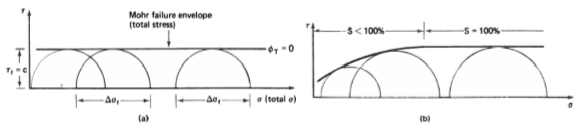
Figure 2: Mohr failure envelopes for UU tests: (a) 100% saturated, (b) partially saturated (from Holtz and Kovacs, 1981).
Consolidated-Undrained (CU) Triaxial Compression Test on Cohesive Soils (Office of Materials Test Method No. Iowa 107, AASHTO T297, or ASTM D4767): Drained and undrained strength parameters can be determined using data obtained from a consolidated-undrained triaxial compression test with pore pressure measurements. Since the pore pressures are measured during shearing in the CU test, both the total and effective stress strength parameters can be determined from the data. Also, in the CU test the shape of the stress and pore pressure versus strain curves will give an indication to if the soil is normally consolidated or overconsolidated (Figure 3).
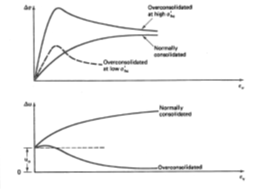
Figure 3: Typical stress-strain and pore pressure-strain curves for normally and overconsolidated soils in consolidated-undrained (CU) shear test (from Holtz and Kovacs, 1981).
Direct Shear Test (DS) of Soils Under Consolidated Drained Conditions (AASHTO T236, ASTM D3080): This test method determines the consolidated drained (CD) shear strength of a soil specimen under direct shear boundary conditions. The direct shear test should be run with a shearing rate slow enough to ensure drained conditions in the specimen. The specimen is deformed at a single shear plane as determined by the test apparatus configuration. Test results may be affected by the presence of coarse-grained soil or rock particles. The test conditions, including normal stress and moisture environment, should be selected by the engineer to represent the field conditions being investigated.
Rock Strength Characteristics
Uniaxial Compressive Strength of Intact Rock Core Specimens (ASTM D7012, Method C or D) is used to determine compressive strength and deformation properties of rock. The uniaxial compressive strength of rock is used in many design formulas and is sometimes used as an index property to select the appropriate excavation technique. In general, uniaxial compressive strength of rock is determined using ASTM D7012, Method C. If deformation properties of the rock are required for design, Method D should be used to determine the elastic stress and deformation constants. Deformation and strength properties of rock cores measured in the laboratory usually do not accurately reflect large-scale in situ properties because the latter are strongly influenced by joints, faults, and other factors. Therefore, laboratory values for intact specimens must be used with proper judgment in engineering applications.
Back to topOther Laboratory Tests
For tests where there is not an established ASTM, AASHTO or Iowa DOT standard, the laboratory may use a testing method established by another Federal or State agency. The use of other agency standards requires written approval by the Office of Design prior to conducting the test. The laboratory requesting the use of another agency standard must prove proficiency in the standard and submit a QA/QC plan for the test method.
Back to topLaboratory Testing Procedures Reference Documents
Laboratory testing procedures are conducted by the following Iowa DOT, ASTM or AASHTO test methods:
- AASHTO T88: Standard Test Method for Particle-Size Analysis of Soils.
- AASHTO T 89: Standard Method of Test for Determining the Liquid Limit of Soils.
- AASHTO T 90: Determining the Plastic Limit and Plasticity of Index of Soils.
- AASHTO T 99: Standard Method of Test for Moisture-Density Relations of Soils.
- AASHTO M145: Standard Specification for Classification of Soils and Soil-Aggregate Mixtures for Highway Construction Purposes.
- AASHTO T180: Modified Method of Test for Moisture-Density Relations of Soils.
- AASHTO T 194: Determination of Organic Matter in Soils by Wet Combustion.
- AASHTO T208: Standard Method of Test for Unconfined Compressive Strength of Cohesive Soil.
- AASHTO T 216: Standard Method of Test for One-Dimensional Consolidation Properties of Soils.
- AASHTO T 236: Standard Method of Test for Bulk Density ("Unit Weight") and Voids in Aggregate.
- AASHTO T 265: Laboratory Determination of Moisture Content of Soils.
- AASHTO Test Method T267: Determination of Organic Content in Soils by Loss on Ignition.
- AASHTO T296: Standard Method of Test for Unconsolidated Undrained Compressive Strength of Cohesive Soils in Triaxial Compression.
- AASHTO T297: Standard Method of Test for Consolidated, Undrained Triaxial Compression Test on Cohesive Soils.
- ASTM D422 Standard Test Method for Particle-Size Analysis of Soils.
- ASTM D698: Standard Test Methods for Laboratory Compaction.
- ASTM D1557 Standard Test Methods for Laboratory Compaction Characteristics of Soil Using Modified Effort.
- ASTM D2166, Standard Test Method for Unconfined Compressive Strength of Cohesive Soil.
- ASTM D2850: Standard Test Method for Unconsolidated Undrained Triaxial Compression Test on Cohesive Soils.
- ASTM D3080: Standard Test Method for Direct Shear Test of Soils Under Consolidated Drained Conditions.
- ASTM D4318: Standard Test Methods for Liquid Limit, Plastic Limit, and Plasticity Index of Soils.
- ASTM: D4767: Standard Test Methods for Consolidated, Undrained Triaxial Compression Test on Cohesive Soils.
- ASTM Test Method D7012: Unconfined Compression Strength of Intact Rock Cores.
- Iowa Test Method 101:, Method of Test for Obtaining Samples from Disturbed Soils.
- Iowa Test Method 102 (ASTM D7263 Method B): Method of Test for Density of Undisturbed Soil Cores by Displacement.
- Iowa Test Method 103: Method of Test for Moisture-Density Relation of Soils (Standard Proctor),
- Iowa Test Method 104: Method of Test for Moisture-Density Relation of Soils (Modified Proctor),
- Iowa Test Method 105: Method of Test for Consolidation of Undisturbed Soils.
- Iowa Test Method 107: Method of Test for Triaxial Compression of Undisturbed Soils.
- Iowa Test Method 108: Method of Test for Determining Fine Particle Size Analysis of Soils.
- Iowa Test Method 109: Method of Test for Determining the Atterberg Limits of Soils and Aggregates.
- Iowa Test Method 111: Method of Test for Determining Total, Inorganic, and Organic Carbon in Soils.
- Iowa Test Method 313: Determining Minimum and Maximum Index Densities of Cohesionless Soils.
Other References
- Holtz R. and Kovacs, W. D., 1981. An Introduction to Geotechnical Engineering, Prentice-Hall, Inc. Englewood Cliffs, NJ.
- Lambe, T. W. and Whitman, R. V., 1969. Soil Mechanics, John Wiley & Sons, New York.