
Content Information
On this page...
A. Introduction
The major categories for bicycle and pedestrian facilities include sidewalks, shared use paths, on-street, and trails. Sidewalks are an integral component of the transportation system, usually used only by pedestrians. For information on designing sidewalks, see Sections 12A-1 and 12A-2. Shared use paths are also an integral component of the transportation system and use the sidewalk standards, but must also be designed for bicycle usage. Shared use paths are generally separate from the street, but in limited instances it may be necessary to utilize an on-street facility.
Iowa DOT’s Bicycle and Pedestrian Long Range Plan recommends the core of a local or regional bicycle network be a system of low-stress bikeways. Interconnected multi-use trails often serve as the foundation for this system, but it is also necessary to identify potential low-stress connections along streets. This section provides guidance on how to select the appropriate bicycle facility type based on posted speed limit, traffic volume, and other context.
The word “trail” has conflicting definitions in ADA, AASHTO, program funding, and common usage. Projects developed around the state and those let through the Iowa DOT are generally shared use paths as defined by the Access Board, not trails. Facilities with a transportation purpose cannot use the trail guidelines published by the Access Board, even though they are commonly referred to as trails. The trail information from the Access Board only applies in parks and other limited locations; therefore, they are not covered in this manual.
Back to topB. Definitions
The following definitions are from the “AASHTO Guide for the Development of Bicycle Facilities” (or AASHTO Bicycle Guide) and Iowa DOT’s Bicycle and Pedestrian Long Range Plan. The definition for advisory bicycle lanes is from the FHWA Bikeway Selection Guide.
Advisory Bicycle Lanes: A portion of the roadway that has been demarcated with dashed lines to indicate preferred space for bicyclists and motorists on narrow streets that would otherwise be shared lanes. Unlike bicycle lanes, motor vehicle use is not prohibited in the advisory bicycle lane and is expected on occasion.
Bicycle Boulevard: A street, usually a low volume, low speed local street, that has been modified to prioritize bicycle travel. It usually includes treatments such as shared lane markings, wayfinding signs, and traffic calming features.
Bicycle Facilities: A general term denoting improvements and provisions to accommodate or encourage bicycling, including parking and storage facilities, and shared roadways not specifically defined for bicycle use.
Bicycle Lane and Buffered Bicycle Lanes: A portion of roadway that has been designated for preferential or exclusive use by bicyclists by pavement markings and, if used, signs. It is intended for one-way travel, usually in the same direction as the adjacent traffic lane, unless designed as a contra-flow lane. A buffered bicycle lane features a striped buffer (typically 18 inches to 3 feet in width) for further separation between motor vehicles and bicyclists.
Separated Bicycle Lanes: A bicycle lane physically separated by a vertical element - such as a concrete or engineered rubber curb, planter, flex post, or a parking lane - from the adjacent motor vehicle lanes. Buffered bicycle lanes without a vertical element are not considered separated bicycle lanes. Some communities refer to separated bicycle lanes as cycle tracks or protected bicycle lanes.
Bicycle Route: A roadway or bikeway designated by the jurisdiction having authority, either with a unique route designation or with BIKE ROUTE signs, along which bicycle guide signs may provide directional and distance information. Signs that provide directional, distance, and destination information for bicyclists do not necessarily establish a bicycle route.
Bikeway: A generic term for any road, street, path, or way that in some matter is specifically designated for bicycle travel, regardless of whether such facilities are designated for the exclusive use of bicycles or are to be shared with other transportation modes.
Electric Bicycle (e-bike): Iowa Code Section 321.1 defines ‘low-speed electric bicycle’ as a device having a saddle or seat for the use of a rider, up to 4 wheels, equipped with fully operable pedals, and an electric motor of less than 750 watts that meets the requirements of one of the following classes:
- ‘Class 1 low-speed electric bicycle’ - a low-speed electric bicycle equipped with a motor that may be used to provide assistance only when the rider is pedaling and ceases to provide assistance when the bicycle reaches a speed of 20 mph or more.
- ‘Class 2 low-speed electric bicycle’ - a low-speed electric bicycle equipped with a motor that may be used exclusively to propel the bicycle and is not capable of providing assistance when the bicycle reaches a speed of 20 mph or more.
- ‘Class 3 low-speed electric bicycle’ - a low-speed electric bicycle equipped with a motor that may be used to provide assistance only when the rider is pedaling and ceases to provide assistance when the bicycle reaches a speed of 28 mph or more.
Independent Right-of-Way: A general term denoting right-of-way outside the boundary of a conventional highway.
Roundabout: A type of circular intersection that provides yield control to all entering vehicles and features channelized approaches and geometry to encourage reduced travel speeds through the circular roadway.
Rumble Strips: A textured or grooved pavement treatment designed to create noise and vibration to alert motorists of a need to change their path or speed. Longitudinal rumble strips are sometimes used on or along shoulders or center lines of highways to alert motorists who stray from the appropriate traveled way. Transverse rumble strips are placed on the roadway surface in the travel lane, perpendicular to the direction of travel.
Shared Lane: A lane of a traveled way that is open to both bicycle and motor vehicle travel, usually a low volume local street.
Shared Lane Marking: A pavement marking or symbol that indicates an appropriate bicycle positioning in a shared lane.
Shared Use Path: (From U.S. Department of Transportation, Federal Highway Administration) The term “shared use path” means a multi-use trail or other path, physically separated from motorized vehicular traffic by an open space or barrier, either within a highway right-of-way or within an independent right-of-way, and usable for transportation purposes. Shared use paths may be used by pedestrians, bicyclists, skaters, equestrians, and other authorized users.
Traveled Way: The portion of the roadway intended for the movement of vehicles, exclusive of shoulders and any bicycle lane immediately inside of the shoulder.
Back to topC. Bicycle Design User Profiles
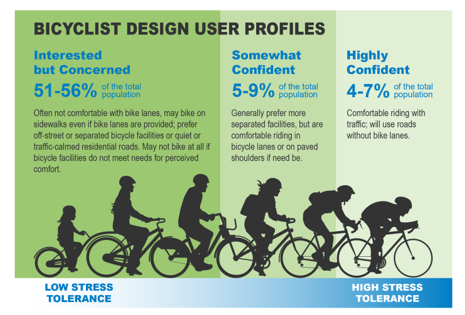
Of adults who have stated an interest in bicycling, research has identified three types of potential and existing bicyclist profiles (see Figure 12B-1.01). These bicyclist profiles consider a person’s comfort level operating a bicycle with motorized traffic, bicycling skill and experience, age, and trip purpose. These user profiles of common types of adult bicycle users and trips can be used to inform bikeway design.
The “interested but concerned” bicyclist profile should typically be used to identify the bikeway design in urban, suburban, and rural town contexts because this group represents the largest of the bicyclist profiles, consisting of 51 to 56% of the general population. Bicycling as a form of transportation by this group is underrepresented in many communities due to a lack of connected low stress bicycle networks. To maximize the potential for bicycling as a viable transportation option, it is important to design facilities to meet the needs of the “interested but concerned” bicyclist user, which will also naturally accommodate the “somewhat confident and highly confident” users.
Figure 12B-1.01: Bicycle Design User Profiles
Source: FHWA Bikeway Selection Guide
D. Bicycle Network Design Process
Chapter 4 of Iowa DOT’s Bicycle and Pedestrian Long Range Plan provides guidance on planning bicycle networks and facility selection. The bicycle facility selection process is linked to the larger transportation planning process. It should be informed by a plan for a future bicycle network developed with input from agency staff and members of the public. Ideally, the facility selection process is also controlled by local bikeway selection or complete streets policies ensuring decisions are consistently and objectively applied across a jurisdiction.
Bicycle networks should be continuous, connect seamlessly across jurisdictional boundaries, and provide access to destinations. Bicycle transportation depends on access to local destinations, many of which are located along higher traffic arterial streets. Adequate, context sensitive bicycle facilities should therefore be provided along these streets. If a continuous bicycle facility is not feasible on a higher-traffic street, alternative routes along parallel lower traffic streets may be provided in the interim until the preferred facility can be implemented.
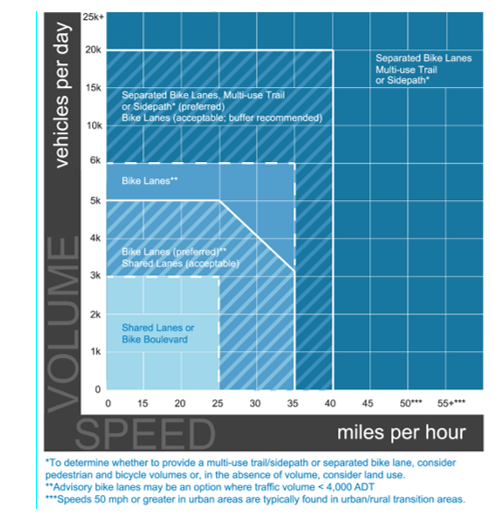
Bikeway Facility Selection: Motor vehicle traffic volume and speed are critical contextual considerations for bicyclist and pedestrian safety and comfort. Proximity to motor vehicle traffic is a significant source of stress, safety risks, and discomfort for bicyclists, and corresponds with sharp rises in crash severity and fatality risks for vulnerable users when motor vehicle speeds exceed 25 miles per hour. Furthermore, as motorized traffic volumes increase, it becomes increasingly difficult for motorists and bicyclists to share roadway space. Figure 12B-1.02 is provided to help determine appropriate types of bicycle (and in some cases, pedestrian) accommodations for any given context. The matrix includes preferred and acceptable values for each facility type. Designers should use forecast traffic volumes if available. Additionally, designers should default to selecting the preferred facility when possible.
Figure 12B-1.02 Urban and Suburban Bicycle Facility Selection Matrix
Source: Iowa DOT Bicycle and Pedestrian Long Range Plan
Bikeway Feasibility Assessment: Once the preferred bikeway type is identified, designers will need to assess its feasibility in the given project location against potential project constraints limiting the ability to implement the preferred bikeway. This assessment may involve determining whether additional separation between motorists and bicyclists is warranted, identifying portions of the roadway to reallocate to achieve desired widths, selecting the “next best” bikeway type, or selecting an alternative route for the bikeway. Designers have an ethical obligation to provide for the health, safety, and welfare of the public, which may require a careful evaluation of mobility and safety for each user. One user’s convenience or mobility should not be prioritized over another user’s safety. When evaluating safety trade-offs, options reducing serious injuries and fatalities should be prioritized over options reducing property damage or minor injuries.
- Conditions for Increasing Separation: There are a variety of conditions indicating the need for greater separation between motorists and bicyclists, which could increase the width of the bikeway or materials used in the buffer. The conditions where greater separation may be appropriate to accommodate the selected design user include the following:
- Unusual peak hour motor vehicle volumes (more than 15% of AADT);
- High percentage of heavy vehicles (trucks, buses, and heavy vehicles are more than 5% of traffic);
- Motor vehicle operating speeds exceed posted speed;
- Frequent parking turnover or heavy curbside activity;
- High volumes of bicyclists (500 bicyclists per hour);
- Presence of vulnerable populations (i.e. school children);
- Network connectivity gaps;
- Proximity to transit; and
- Frequent driveways.
- Options for Reallocating Roadway Space: When constructing new roads, bikeways should be built to the recommended preferred dimensions rather than constrained dimensions. For retrofit projects, it may be necessary to evaluate options to reallocate existing space or use minimum or constrained dimensions. The following are strategies for reallocating roadway space to accommodate a bikeway:
- Narrowing travel lanes, including medians/turn lanes;
- Removing travel or turn lanes;
- Removing parking on one side of street; and
- Converting angled parking to parallel parking.
- Selecting the “Next Best” Bikeway Type or Parallel Routes: Impacts on ridership, comfort/stress, safety, and overall network connectivity should be considered when evaluating alternative bikeway designs or potential parallel routes to ensure the project will still meet the purpose identified at the outset. The following trade-offs should be considered and documented in the design process:
- Reduced or suppressed ridership where the bikeway does not meet the needs of the target design user;
- Additional length of trip when bicyclists must use a parallel route (this length should not exceed 30% more than original route and should not add excessive delay);
- Critical gaps in the network when projects fail to provide bicycle accommodations;
- Reduced safety where bicyclists must operate with relatively high motor vehicle speed and/or high-volume traffic in shared lanes;
- Reduced safety where bicyclists must operate in narrow space (e.g. narrow bicycle lanes adjacent to parking lanes or narrow shared use paths with high volumes of pedestrians or bicyclists);
- Reduced safety where bicyclists improperly use facilities (e.g., ride the wrong way on shared lanes, sidewalk riding, etc.); and
- Increased sidewalk bicycling where bicyclists are avoiding low comfort/high stress roadway conditions.
If selecting a parallel route as the preferred route for the “interested but concerned” bicyclist occurs, the provision of a bikeway along the desired route should still be considered to accommodate the “highly confident” bicyclist and to provide connections for bicyclists to and from properties along the desired route. An example would be the provision of a bicycle lane or shoulder on a higher volume roadway, which can benefit the “highly confident” bicyclists while a convenient, direct parallel route on an adjacent low volume street serves the “interested but concerned” bicyclists.
Chapter 4 of Iowa DOT’s Bicycle and Pedestrian Long Range Plan provides additional guidance on facility selection, with context characteristics for each of the common facility types shown in Figure 12B-1.02, and additional guidance on facility selection and other considerations.
- Conditions for Increasing Separation: There are a variety of conditions indicating the need for greater separation between motorists and bicyclists, which could increase the width of the bikeway or materials used in the buffer. The conditions where greater separation may be appropriate to accommodate the selected design user include the following: