Content Information
On this page...
This section presents guidelines for the alignment, or realignment, of crossroads at intersections with new or reconstructed rural two-lane or multi-lane primary highways. These guidelines apply to all two-way stop-controlled intersections, regardless of whether the crossroad is under state or county jurisdiction. This section is not directly applicable to access locations allowed by the permitting process administered by the Office of Traffic and Safety.
Back to topAlignment
Chapter 9 of the AASHTO Greenbook recognizes intersection angles between 60º and 120º as acceptable. NCHRP Report 279 recommends intersection angles of 75º to 90º be maintained wherever possible with angles as low as 60º considered acceptable. Therefore, this policy establishes an angle of 90º between the primary route and the crossroad as ideal. Intersection angles between 90º and 75º are desirable. Angles between 75º and 60º are acceptable.
Back to topRealignment
General
Intersections with angles less than 60º will be realigned to provide a desirable intersection angle. Traffic volume, accident history, and design vehicle should be evaluated at intersections in the acceptable range to determine if realignment to the desirable range is warranted. Generally, if an intersection is realigned, the angle should be improved 15º or more to justify the additional cost.
Paved Crossroads
Horizontal and vertical geometrics of the crossroad realignment should meet or exceed the intersection’s functional classification design criteria. On an approach with reverse curves, the curve nearest the stop condition may use a minimum radius of 165 feet or one half the design speed of the preceding curve, whichever is greater. A tangent alignment should be placed between the reverse curves to provide for superelevation transition. Approximately 100 feet of tangent alignment should be placed between the edge of traveled way on the primary route and the point of curvature (P.C.) or point of tangency (P.T.) of an approach curve.
Non-paved Crossroads
In general, non-paved crossroads should be realigned using the same criteria as for paved crossroads. However, if a benefit-cost analysis reveals realignment would not be cost effective, intersection angles less than 60º are acceptable. When realignment is warranted, the geometric criteria will be determined as described for paved crossroads.
Any modifications to a county road should be reviewed with the County Engineer, including any primary road relocations that change the skew angle, but otherwise make no changes to the county road.
Realignment Options
Designers have a couple of options for realigning a skewed intersection. One is to realign the crossroad so the intersection is at a right angle. The other is to use offset intersections.
Realigning Intersection to a Right Angle
If crossroad volumes are high, realigning the intersection to a right angle, see Figure 1, is the preferred option. This reduces turning movements and signage when compared to the offset intersection option.
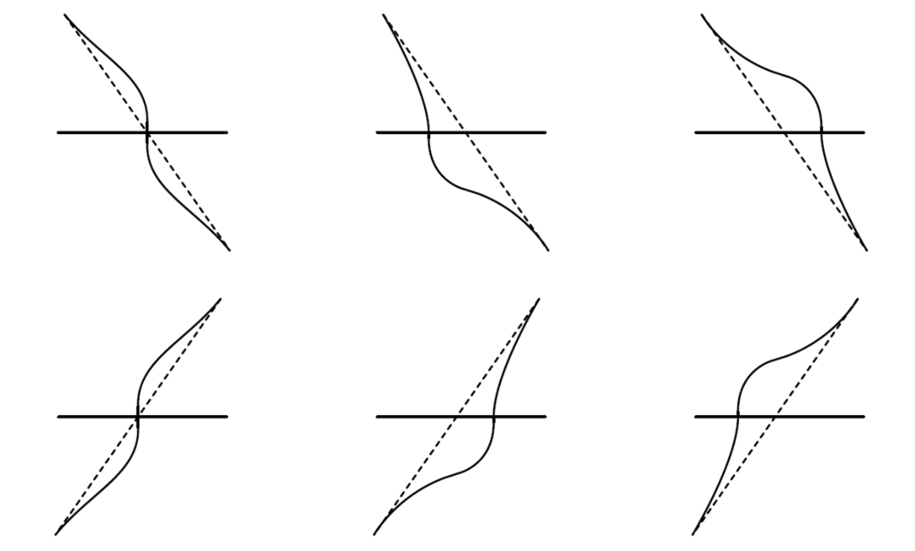
As shown in Figure 1, reverse curves will likely be necessary. Shifting the point of intersection may reduce the number of reverse curves, but could result in the need for substantial additional right-of-way.
Offset Intersections
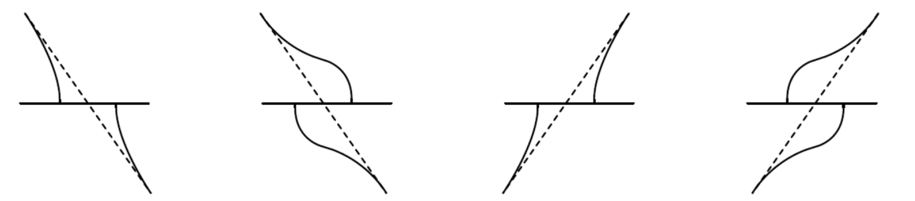
Offset intersections, see Figure 2, are an acceptable design alternative if the crossroad through volume is low and two intersections can resolve deficiencies associated with one intersection. Each of the individual intersections must meet all design criteria and intersection angles should fall within the desirable range.
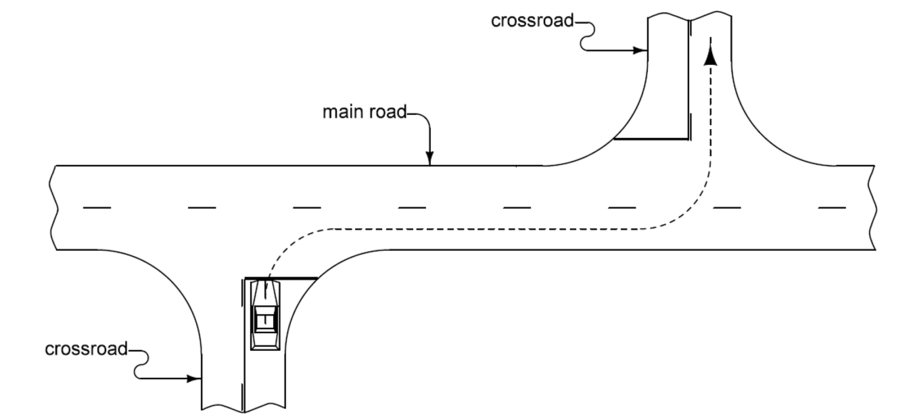
When using offset intersections to realign a crossroad, an alignment which requires traffic on the crossroad to turn left on to the main road, then turn right off of the main road is preferred, see Figure 3. This avoids the need for a left turn movement off the main road. However, depending on skew, it could result in the need for reverse curves and/or substantial additional right-of-way.
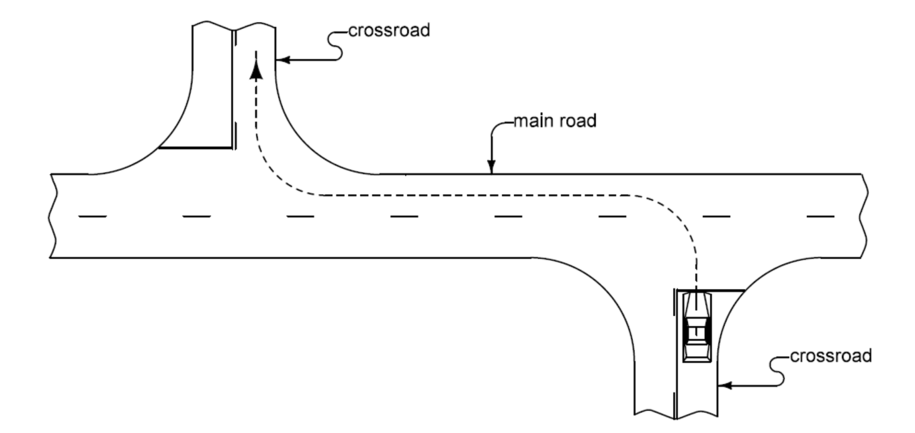
An alignment that requires cross road traffic to right turn on to the main road, then turn left off of the main road (see Figure 4) may be used. However, designers will need to keep in mind sufficient distance must exist between the offset intersections to allow for a potential queue resulting from vehicles turning left off of the main road. Traffic volumes may necessitate the need for a left turn lane on the main road.