
Content Information
On this page...
The Ramps table in Section 1C-1 provides design criteria for one and two lane ramps and loops. This section contains supplemental design information. The criteria in the Ramps table and the information in this section apply to one way ramps (also known as slip ramps or diagonal ramps) and loops (also known as loop ramps). See Figure 1 for an illustration of ramps and loops.
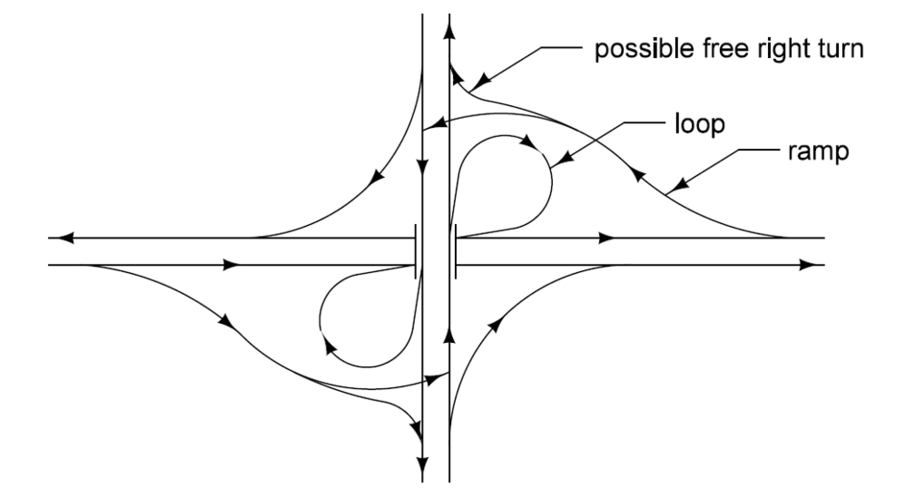
Ramps are divided into four types: diagonal, loop, semi-directional, and directional.
Back to topDiagonal Ramps
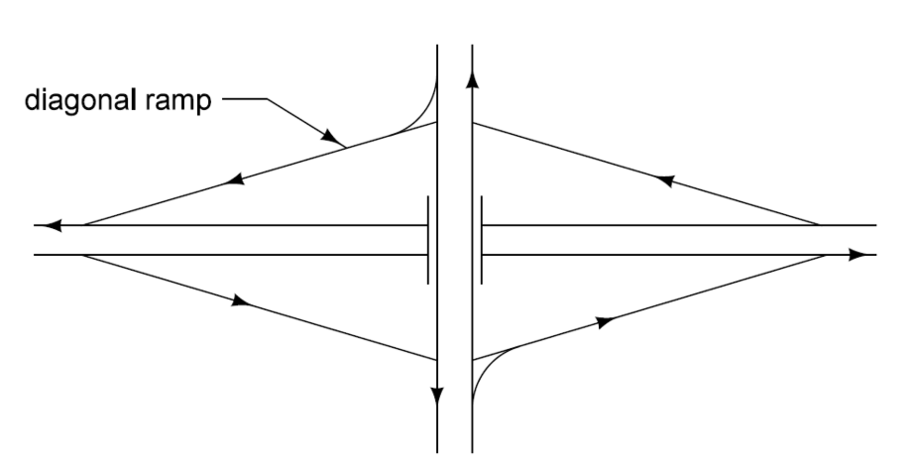
Diagonal ramps, see Figure 2, usually have both a left and right turning movement at the terminal on the side road.
Loops
Loops (see Figure 1 above) are typically used when right-of-way constraints prevent the development of ramps, or where high traffic volumes create the need to eliminate at-grade left turn crossings. They have left and/or right turn movements at the terminal. Alignments for loops usually involve compound horizontal curves where the loop merges with or diverges from the mainline.
Back to topSemi-directional Ramps
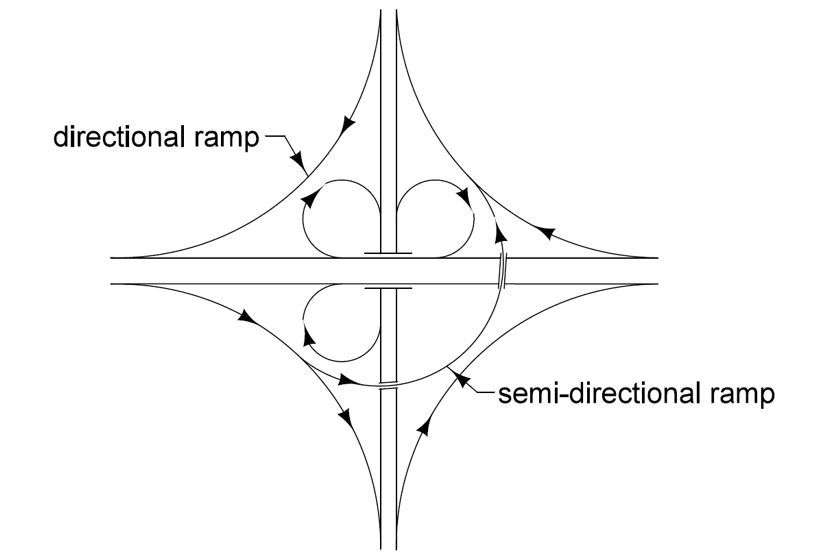
With a semi-directional ramp, drivers exit one direction (typically to the right) first before being redirected the other direction (typically to the left). See Figure 3 below for an illustration of a semi-directional ramp.
Back to topDirectional Ramps
With a directional ramp, drivers exit one direction (typically to the right) and continue without redirection. See Figure 3 below for an illustration of a directional ramp.
Interchanges on the Interstate System
As shown in the Ramps table, ramps on the interstate system are normally designed with a 16 foot pavement width. If any portion of the ramp is designed with a radius between 150 and 249 feet, a pavement width of 18 feet is used for that portion. An example would be where a free right turn movement is designed at a ramp terminal. In this case, the transition in pavement width should occur immediately prior to the ramp terminal. Typical 7131 details the transition area and should be included in the plans if additional pavement width on a ramp is warranted. Additional pavement width is not needed where it is not required by the roadway geometry.
Loops should be designed for one constant cross section width. If the radius of the major portion of the loop curvature (not the tapers) is less than 250 feet, the pavement width should be 18 feet for the entire loop. Otherwise, the pavement width for the entire loop should be 16 feet.
Refer to the Ramps table for information regarding shoulders. Refer to Section 3C-3 for information on shoulder treatment within the superelevated area of the ramp or loop.
Back to topInterchanges not on the Interstate System
For interchanges that are not part of the interstate system, the shoulders are typically granular on both sides of a ramp and paved on both sides of a loop. The exception to this occurs when the ramp is superelevated in excess of 7%, in which case the entire high side shoulder is paved as shown on PV-303. Refer to Section 3C-3 for more information on shoulder treatment within the superelevated area of the ramp or loop.
Back to topWeigh Stations and Rest Areas
Ramps at weigh stations on the interstate system have the same cross section requirements as interchange ramps on the interstate system. Those on the non-interstate system have the same cross section requirements as interchange ramps on the non-interstate system. The shoulder surface of a ramp should match the adjacent mainline’s shoulder surface, subject to the requirements associated with PV-303.
Back to top