
Content Information
On this page...
This section provides guidelines for parking lanes and parking restrictions on urban highways and side streets at intersections. The elimination of parking on primary highways is desirable. Parking along highways can: increase driver tension and accident rates; interfere with the driver’s sight triangle; obstruct the driver’s view of pedestrians, traffic signals, and traffic signs; increase congestion; and reduce capacity. However, due to economic considerations, physical limitations, and a lack of equivalent parking facilities, complete elimination of parking on primary highways is not possible.
Some of the guidelines in this section are based on Iowa Code; however, these guidelines are not necessarily a design policy. Sound engineering judgment, including technical and economic analysis, should be used when applying these guidelines. In addition, the designer is encouraged to make use of turning templates or software to assist with the design of parking lanes near intersections.
Back to topParking on Interstate Highways and Freeways
Parking on interstate highways and freeways is for emergencies only. Parking areas are provided at rest areas and scenic overlooks.
Back to topParallel Parking Lanes on Primary Highways
Parallel parking may be allowed in areas where space is available and there is a lack of equivalent parking facilities. The city will be required to reimburse the Iowa DOT for the entire costs attributable to parking lane construction, including excavation, paving, sidewalk reconstruction, and additional right of way required. The following guidelines should be considered when designing parallel parking lanes:
On Hot Mix Asphalt (HMA) resurfacing projects, the parking lanes may be resurfaced with the traffic lanes; however, the city will pay for the cost of resurfacing the parking lanes.
Parking lanes, when provided, should be in block long segments or an equivalent length. Once introduced, parking should be continuous on one side and not shifted from one side of the street to the other.
The desirable width of parallel parking lanes on new construction is 10 feet : 9 feet should be considered the minimum.
When 10 or 11 foot traffic lanes are being resurfaced or restriped as 12 foot lanes, existing adjacent parking lanes should maintain a minimum 8 foot width, with 10 feet being desirable.
Parking lanes may be constructed sloping downward from the traffic lane between 2% and 6% or sloping upward between 1% and 6%, see Figure 1. A lip curb may be used to adjust the upward slope to the desired range, to prevent water from flowing along the construction joint or to delineate a parking lane from the driving lanes.

Continuity of traffic lanes should be maintained. The number of traffic lanes should not be reduced to add parking.
The need for added traffic lanes or turning lanes may justify eliminating parking.
At signalized intersections a capacity analysis is necessary to determine the need for extra lanes. It may be necessary to eliminate parking near intersections to add traffic lanes or turn lanes if right of way is not available.
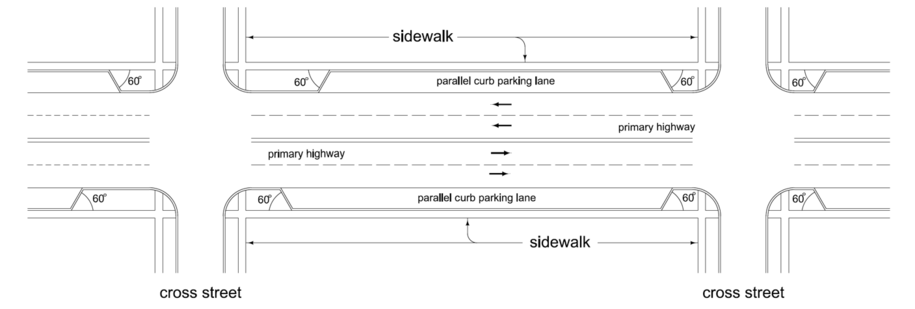
Protected parking, see Figure 2, should be used where possible. This will reduce pedestrian crossing distance.
Diagonal Parking Lanes on Primary Highways
Cities that have parallel parking should not convert to diagonal parking. If diagonal parking already exists, the designer should consult the Traffic and Safety Bureau and the Methods Section in the Design Bureau to determine if diagonal parking may remain or if one of the following alternatives should be applied:
In the case of “End of Route” primary extensions, the end segment in the business district containing the diagonal parking may, on petition from local officials, be considered for removal from the primary road system.
Reconstruct the pavement to provide a barrier that will separate the diagonal parking area from the adjacent traffic lanes. This option will likely require wide right of way.
Substitute parallel parking lanes.
Iowa Code Section 321.358 lists several parking restrictions which apply to primary highways and minor streets, some of which are included here:
No parking within 5 feet of a fire hydrant.
No parking on a crosswalk
No parking within 10 feet upon the approach to any flashing beacon, stop sign, or traffic-control signal located at the side of the roadway.
No parking within 50 feet of the nearest rail of a railroad crossing, except when parallel with such rail and not exhibiting a red light.
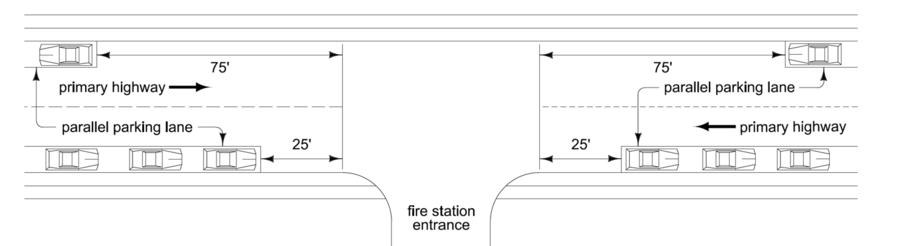
No parking within 25 feet of the driveway entrance to any fire station on the near side of the street. In addition, parking on the opposite side of the street within 75 feet of the driveway entrance to the fire station is prohibited, see Figure 3.
No parking in a manner which blocks access to a curb cut or ramp which is located on public or private property.
Additional Parking Restrictions on Primary Highways
Addition parking restrictions on primary highways include:
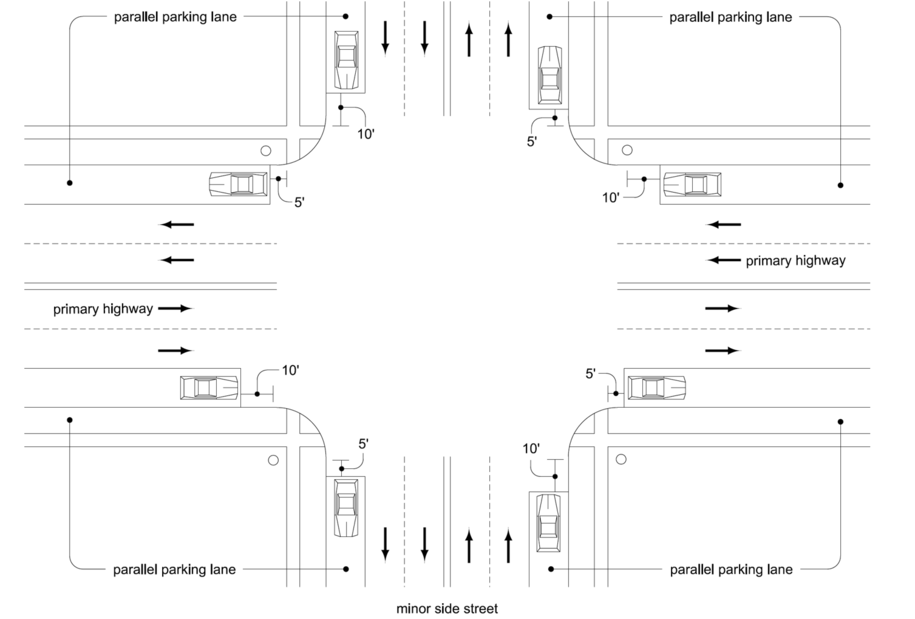
At signalized intersections, parking is prohibited on the primary highway a distance of 10 feet in advance of the near sidewalk or traffic control signal and a distance of 5 feet beyond the far sidewalk, see Figure 4.
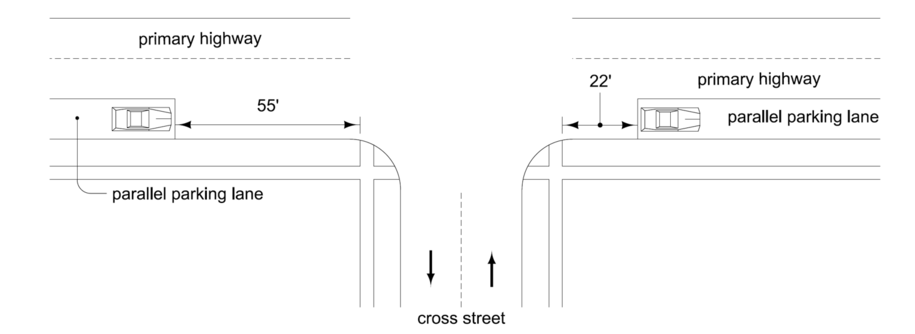
At non-signalized intersections, parking is prohibited on the primary highway a distance of 55 feet in advance of the near sidewalk and a distance of 22 feet beyond the far sidewalk, see Figure 5.
Additional Parking Restrictions on the Side Streets of Primary Highway Intersections
Additional restrictions apply to minor streets.
Minor Side Streets with Stop Signs
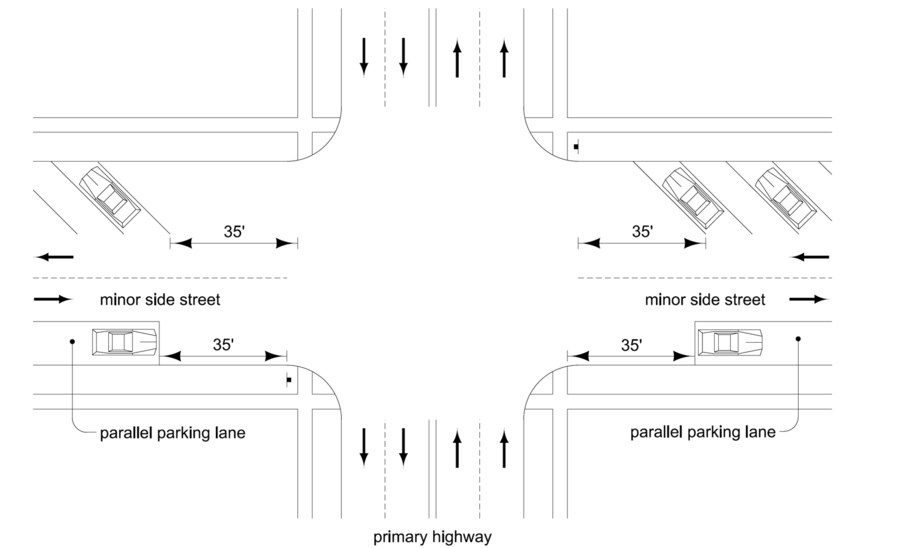
On minor side streets with two lanes and two parking lanes (whether parallel or angled), parking is prohibited a distance of 35 feet in advance of the near sidewalk or stop sign and a distance of 35 feet beyond the far sidewalk, see Figure 6.
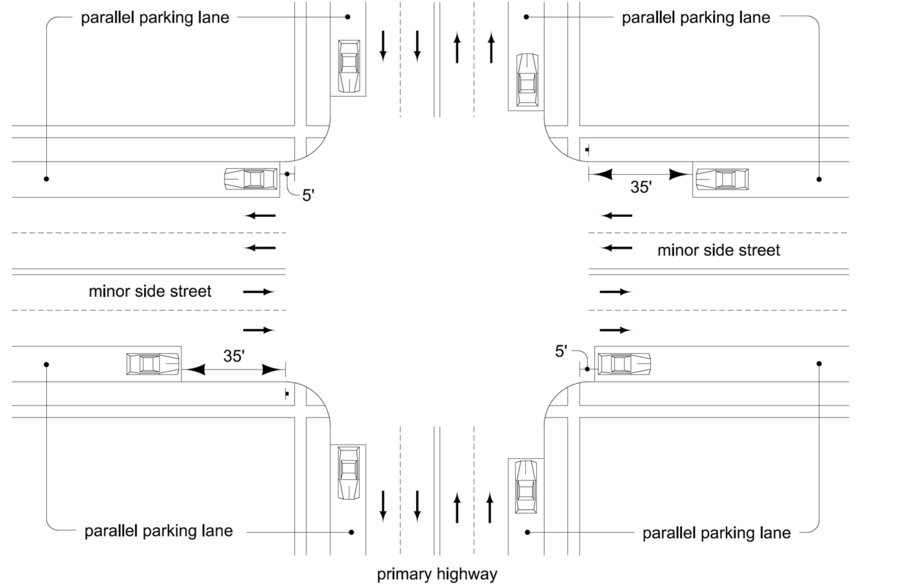
On minor side streets with four traffic lanes and two parallel parking lanes, parking is prohibited a distance of 35 feet in advance of the near sidewalk or stop sign and a distance of 5 feet beyond the far sidewalk, see Figure 7.
Minor Side Streets with Traffic Control Signals
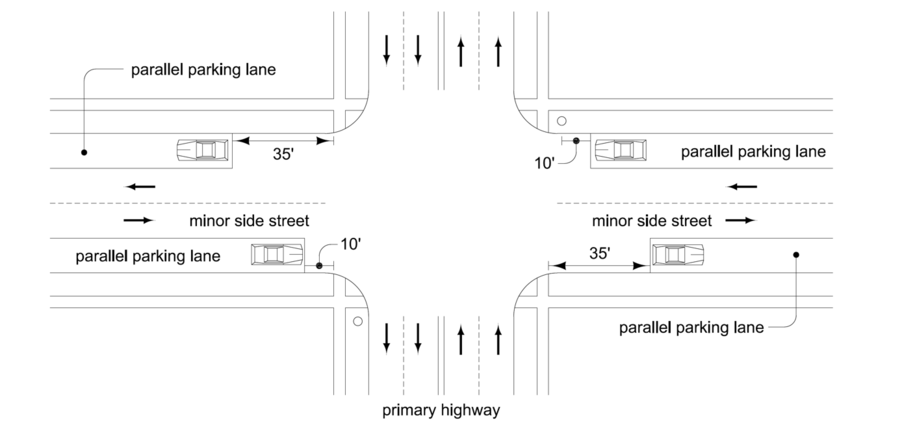
On minor side streets with two traffic lanes and two parallel parking lanes, parking is prohibited a distance of 10 feet in advance of the signal or near sidewalk and a distance of 35 feet beyond the far sidewalk, see Figure 8.
On minor side streets with four lanes and two parallel parking lanes, parking is prohibited a distance of 10 feet in advance of the signal or near sidewalk and a distance of 5 feet beyond the far sidewalk, see Figure 4 above.
Diagonal Parking on Minor Side Streets with Traffic Control Signals
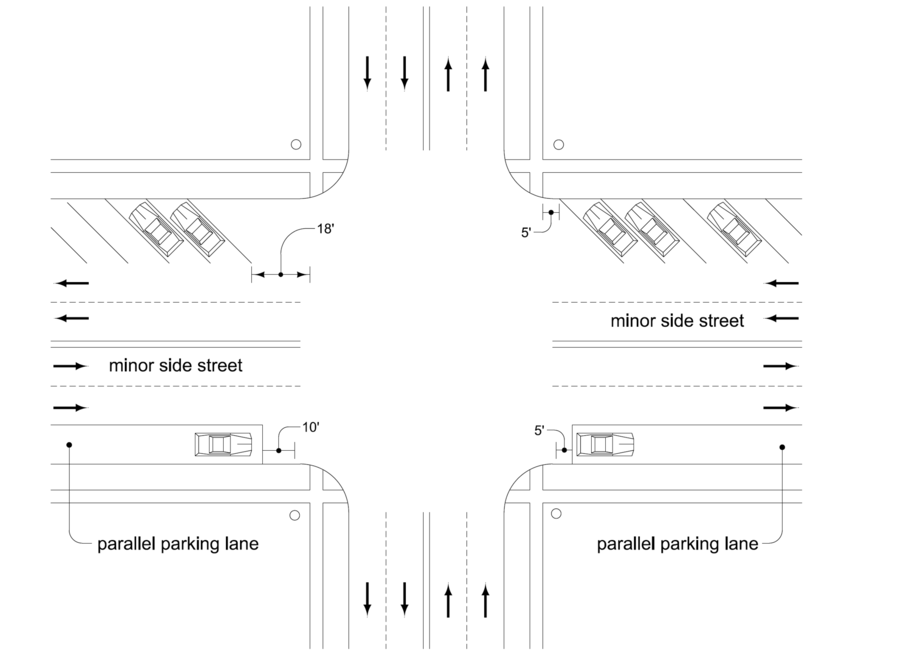
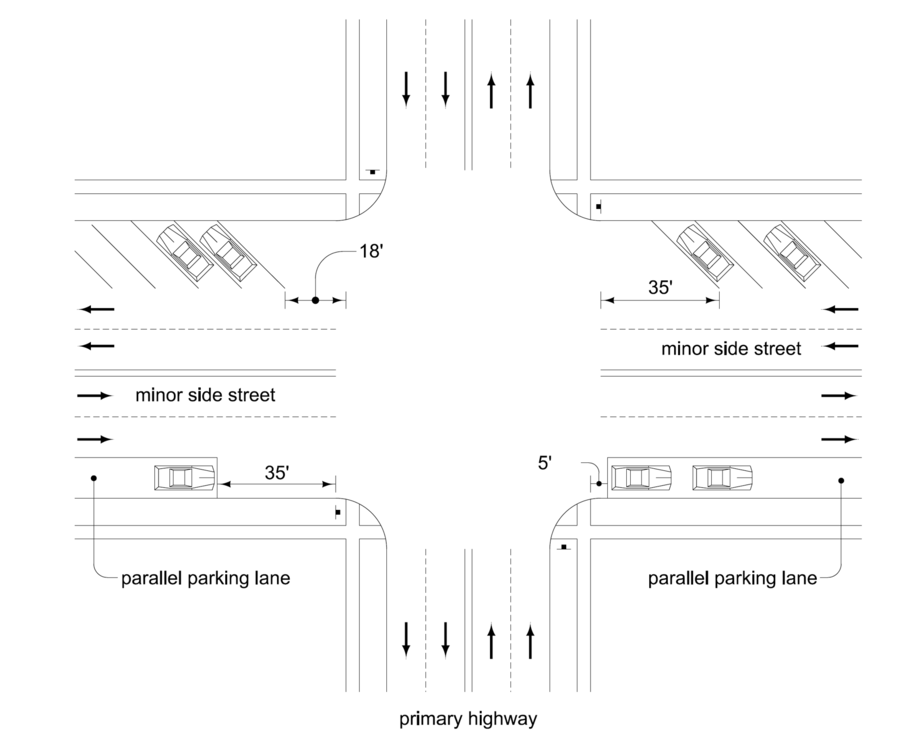
For the case of an intersection with four traffic lanes, traffic control signals, and diagonal parking on the far side of the intersection, diagonal parking should be prohibited for 18 feet beyond the far side sidewalk to allow the parked car to back out without hitting a pedestrian in the far crosswalk, see Figure 9. Refer to Figure 9 for other parking restrictions.
Diagonal Parking on Minor Side Streets with Stop Signs
For the case of an intersection with four traffic lanes, stop signs, and diagonal parking on the far side of the intersection, diagonal parking should be prohibited for 18 feet beyond the far side sidewalk to allow the parked car to back out without hitting a pedestrian in the far crosswalk, and diagonal parking should be prohibited for 35 feet in advance of the near sidewalk or stop sign, see Figure 10. Refer to Figure 10 for other parking restrictions.
Major Intersections and Special Problems
Intersections involving capacity, special turning movements, and skewed angles will require specific engineering studies to determine parking restrictions. At signalized intersections, capacity analysis is necessary to determine the need for extra lanes. It may be necessary to add turn lanes and eliminate parking near the intersection.
Back to topTandem Parking
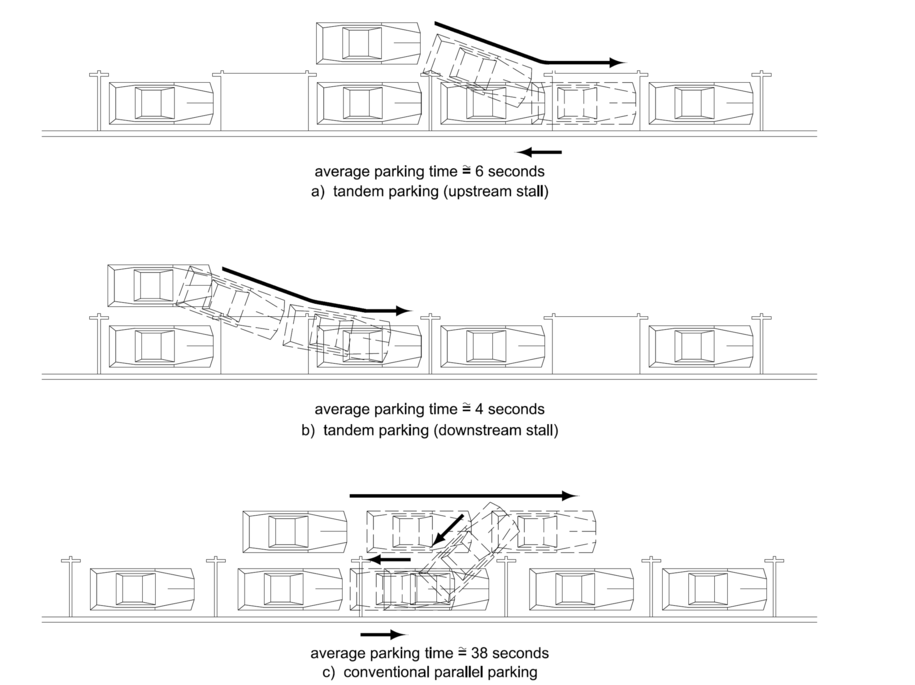
One method to avoid long delays due to parallel parking maneuvers is to use a tandem parking system where two cars are parked together and a 16 foot gap is provided in front of and in back of the two cars, see Figure 10. When there is only one lane of traffic in each direction on the primary highway, tandem parking should be given strong consideration.

As demonstrated in Figures 12a and 12b, cars can pull into parking slots without stopping or backing in the traffic lane. In addition, the amount of time required to complete the maneuver is reduced compared to conventional parallel parking shown in Figure 12c.
Other resources exist that discuss parking along urban highways, for example Parking by R. Weant and H. Levinson published by the Eno Foundation for Transportation, 1990, or the AASHTO Greenbook. Designers are urged to consult these resources. Calculations used for this section are available in A Guide for Evaluating Parking on Primary Road Extensions, Iowa State Highway Commission, March 1967. Contact the Methods Section in the Design Bureau with any questions regarding the values used in this section.
Back to top