Content Information
On this page...
This section discusses the proper procedure for locating accesses and safety dikes opposite to and near ramp/loop terminals. Proper location of accesses and safety dikes opposite of ramp/loop terminals is very important to the safety of drivers, especially in adverse driving conditions. Proper location of accesses near ramp/loop terminals is important to insure they do not conflict with the design of the terminal. The nearest access to a ramp/loop terminal is calculated from the ramp bifurcation; however, this should not be used as the location station for an entrance or dike opposite a ramp/loop terminal.
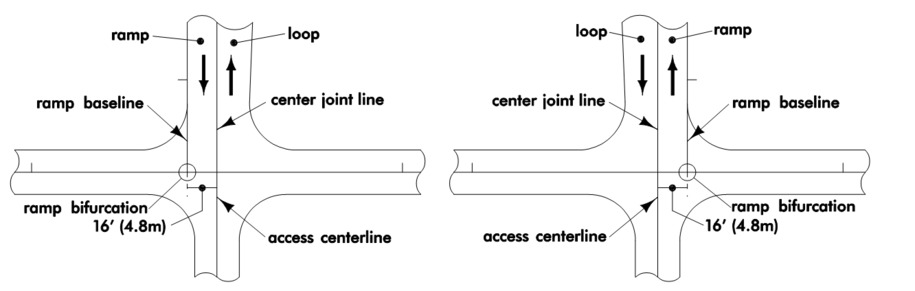
The centerline of an access should be centered on the center joint line 16 feet (4.8 meters) from the ramp baseline, see Figure 1. This will allow drivers to continue through the terminal without jogging to the right or left, as would happen if the access was centered along the ramp baseline.
Location of a Safety Dike Opposite a Ramp/Loop Terminal
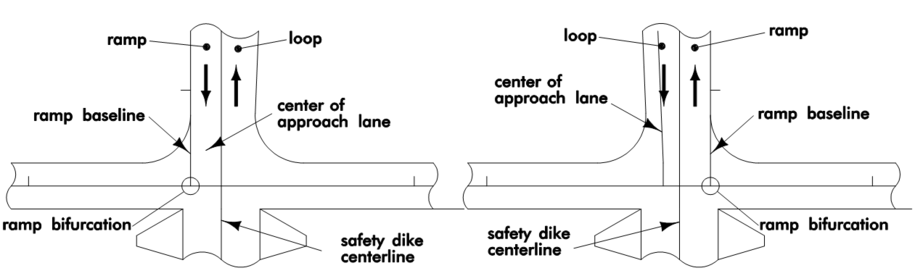
Safety dikes should be centered on the center joint, see Figure 2. This will better allow drivers who accidentally continue through the terminal to use the dike as a recovery area, for there is less of a chance the driver would miss the dike than if the safety dike were centered across from the ramp baseline.
Location of an Access Near a Ramp/Loop Terminal
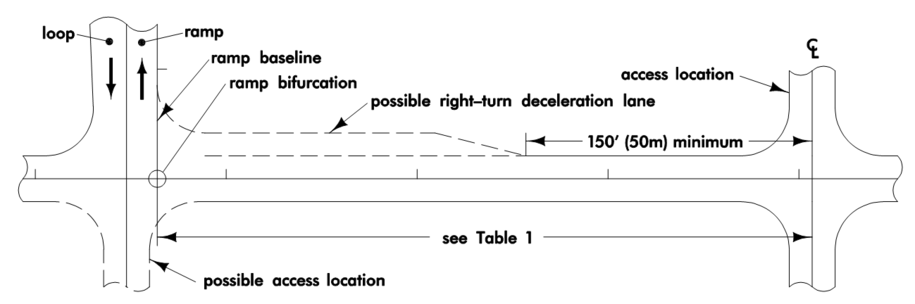
According to the Iowa Access Management Policy, the location of an access along a side road at an interchange is measured from the point of ramp bifurcation. Roadway type classification determines the distances that should be used; these values are presented in Table 1 below.
Table 1: Minimum distances for access location near a ramp/loop terminal.
English units
metric units
However, if a right-turn deceleration lane is required in advance of the ramp bifurcation point, the first access should be located a minimum of the appropriate distance in Table 1 from the point of ramp bifurcation or 50 meters from the beginning of the deceleration lane taper, whichever provides the greatest length from the ramp, see Figure 3. This will help to insure that relocated roads or driveways are not designed such that they are accessing the side road within the taper of the turn lane.