
Content Information
On this page...
This section discusses warrants and design for four-lane expressway turn lanes for both existing intersections and intersections that are in the design process. The warrants apply to unsignalized intersections located in rural areas with stop control on the side road and mainline operating speeds of 55 mph or higher. These warrants should not be used at urban intersections, intersections on transitional highways (where speeds are slowing down or speeding up as a rural roadway transition to or from an urban or more congested environment), or at signalized intersections.
Turn lanes function to maintain smooth mainline traffic flow and facilitate turning movements. Thus,, both turning and mainline traffic are involved in the warranting process and should be considered in the design of turn lanes. Since each intersection is unique, the warrants and designs discussed in this section should be regarded as guidelines rather than rules. The designer will need to examine each intersection carefully to determine when turn lanes are warranted and, if so, the appropriate design.
Back to topRight Turn Lanes
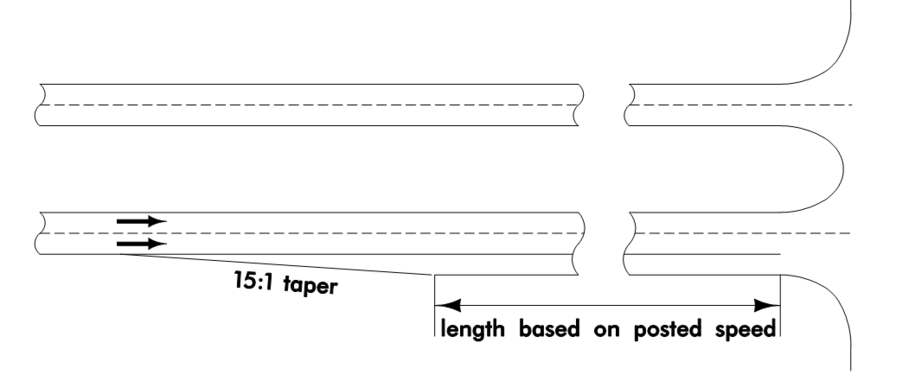
When a right turn lane is warranted, it should be designed as a deceleration lane, see Figure 1, rather than a storage lane, and should normally be designed as a parallel lane.
Right Turn Lane Warrants
The basic guidelines for when right turn lanes are warranted involve turning and approach (mainline) volume, and intersection location.
Turning and approach volumes
A right turn lane may be warranted if right turning traffic flow rate is greater than 30 vehicles per hour measured over a minimum of 15 minutes and either:
- approach volume is greater than 400 vehicles per hour, or
- approach truck traffic volume is greater than 20 vehicles per hour.
Intersection location
Intersection location may warrant a right turn lane even if turning and approach volumes don’t. Local observations in the past have indicated that at some intersections on four-lane expressways within 5 miles (8 kilometers) of some urban areas with a population of 20,000 or greater, drivers have used the granular shoulders as right turn lanes. Therefore, areas similar to these should seriously be considered for right turn lanes even if volume warrants are not met.
Right turn lanes should be provided at all school locations regardless of turning and approach volumes. Other locations where right turn lanes may be judged to be warranted by the Project Management Team (PMT) include main entrances for towns, shopping areas, housing developments, attraction locations such as recreational areas, and locations that would have special users such as truck traffic or campers. Special attention should be given to intersections serving locations that attract elderly drivers such as drug stores, grocery stores, retirement developments, medical facilities, nursing homes, etc. Intersections with paved side roads should also be considered for right turn lanes.
Back to topRight Turn Lane Design
Right turn lanes should be designed as deceleration lanes with a 15:1 taper. The length of the parallel portion of the deceleration lane will normally depend on posted mainline speed and return radius. The posted mainline speed is used as the design speed for the parallel portion of the turn lane. Geometric design of an intersection determines the return radius. If a compound curve is used for the return radius, use the smallest of the radii for determining deceleration lane length. For example, given a mainline posted speed of 65 mph (110 km/h) and a turning radius of 90 feet (25 meters), the length of the parallel portion of the deceleration lane should be 520 feet (170 meters). This was determined in the following manner. The posted mainline speed is 65 mph (110 km/h) and this is used as the design speed for the parallel portion of the deceleration lane. Using Table 2 in Section 6A-1 of this manual, a 90-foot (25-meter) radius with a 65 mph (110 km/h) design speed corresponds to a 520-foot (170-meter) deceleration lane length. The length of the lane may need to be adjusted for grade, see Table 3 in Section 6A-1 of this manual.
To assist drivers on a sideroad determine the proper stopping point at an intersection, stop sign islands are placed at all paved sideroad approaches unless the sideroad ADT is less than 100 vpd, in which case an island is optional.
Back to topOffset Right Turn Lanes
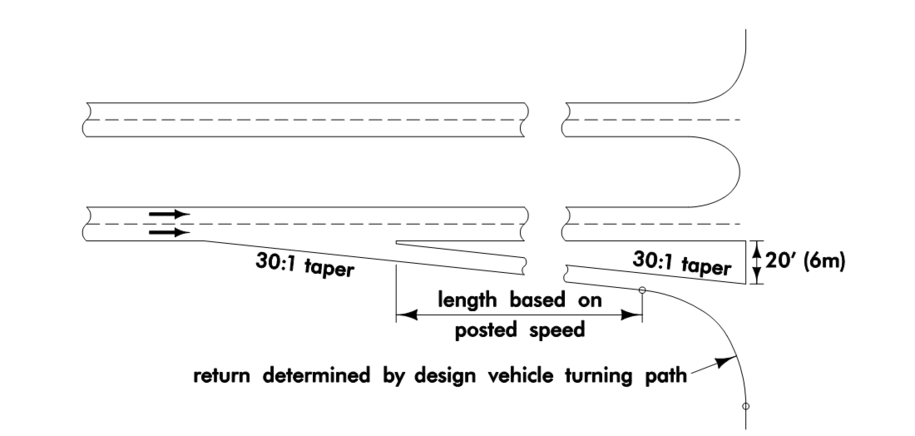
When right turn lane warrants are met, offset (tapered) lanes, see Figure 2, may be considered in areas where sightline difficulties may occur, such as:
- at the base of a long or steep decline (grade = 5% or larger) or
- at the crest of a hill with a minimum K value.
Left Turn Lanes
Left turn lanes provide storage in the median for left-turning vehicles, or when warranted, deceleration outside of the through traffic lanes for left-turning vehicles. All Type “A” and high volume Type “B” entrances should have left turn lanes provided, see Section 3E-2 of this manual. If a left turn deceleration is not warranted, a left turn storage lane should be provided. Normally, left turn lanes are designed as parallel lanes.
Left Turn Deceleration Lane Warrants
The basic guidelines for when left turn deceleration lanes are warranted involve mainline turning and approach volume, and intersection location.
Turning and approach volume
A left turn deceleration lane may be warranted if left turning traffic flow rate is greater than 30 vehicles per hour measured over a minimum of 15 minutes and either:
- approach volume is greater than 400 vehicles per hour, or
- approach truck traffic volume is greater than 40 vehicles per hour.
Intersection location
Intersection location may warrant a left turn deceleration lane even if turning and approach volumes do not. To improve operational efficiency, left turn deceleration lanes should be considered for intersections located within approximately 5 miles (8 kilometers) of an urban area with a population of 20,000 or greater. Other locations where left turn deceleration lanes may be judged to be warranted by the PMT include schools, main entrances for towns, shopping areas, housing developments, attraction locations such as recreational areas, and locations that would have special users such as truck traffic or campers. Special attention should be given to intersections serving locations that attract elderly drivers such as drug stores, grocery stores, retirement developments, medical facilities, nursing homes, etc.
Left Turn Lane Design
Left turn storage lanes
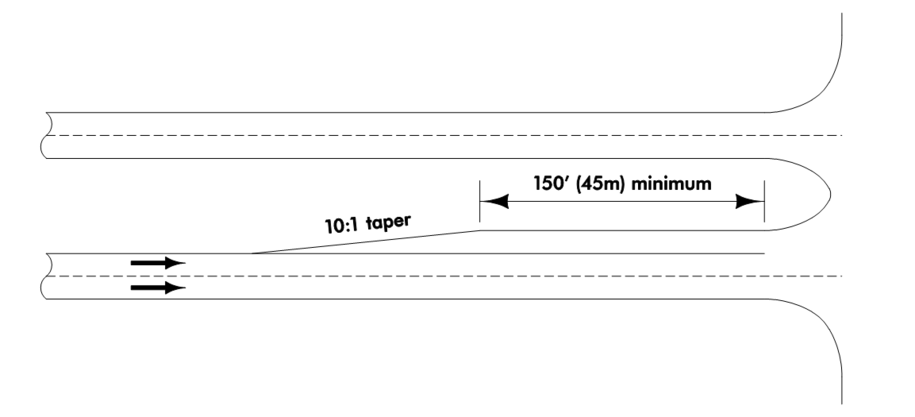
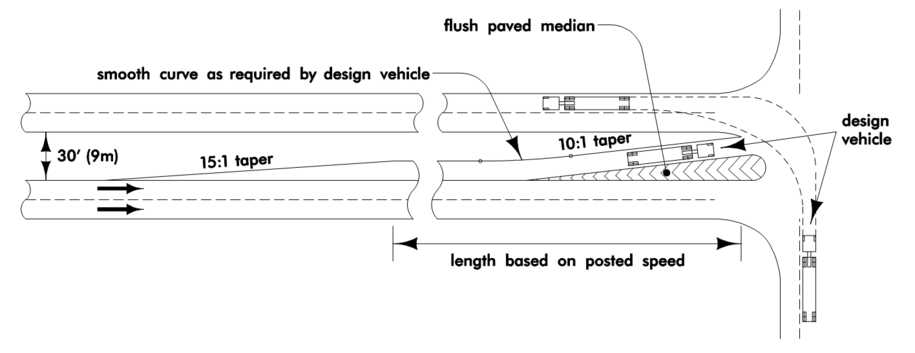
Left turn storage lanes, see Figure 3, should be designed with a 10:1 taper. Turning volume determines left turn storage lane length (see Figure 2 in Section 6A-1 of this manual), but a minimum length of 150 feet (45 meters) is required.
Left turn deceleration lanes
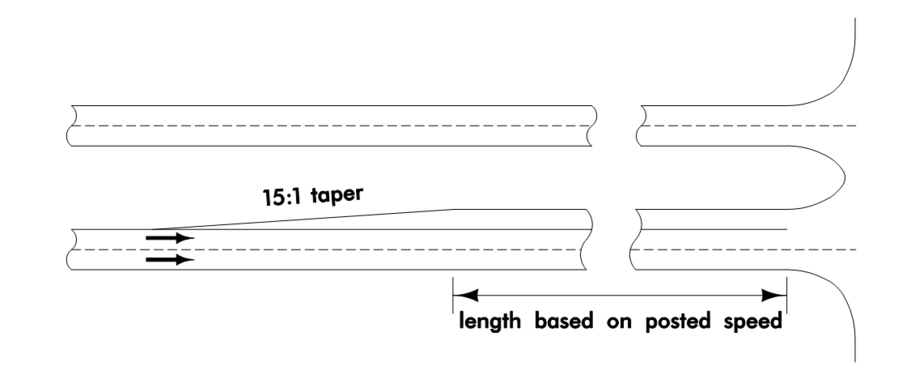
Left turn deceleration lanes, see Figure 4, should be designed with a 15:1 taper. The length of the parallel portion of a deceleration lane is determined using the posted mainline speed and a stop condition. Exhibit 10-73 in A Policy on Geometric Design of Highways and Streets (2001) provides deceleration lengths for various highway design speeds. For example, given a posted mainline speed of 65 mph (110 km/h) and using a stop condition the parallel portion of a left turn deceleration lane should be 570 feet (180 meters). This was determined by using the posted mainline speed of 65 mph (110 km/h) as the highway design speed in Exhibit 10-73 and finding the deceleration length that corresponds with a stop condition. The length of the lane may need to be adjusted for grade, see Table 3 in Section 6A-1 of this manual.
Offset Left Turn Lanes
The use of offset (tapered) left turn lanes should be limited on rural intersections. They should be considered only if:
- traffic signals will likely be installed or
- opposing left-turning vehicles create a significant sight distance problem.
If offset lanes are used, the median width should be reduced to 30 feet (9 meters), as shown in Figure 5. Potential median drainage issues should be addressed before offset turn lanes are incorporated.
Back to top