Content Information
On this page...
Adding Lanes
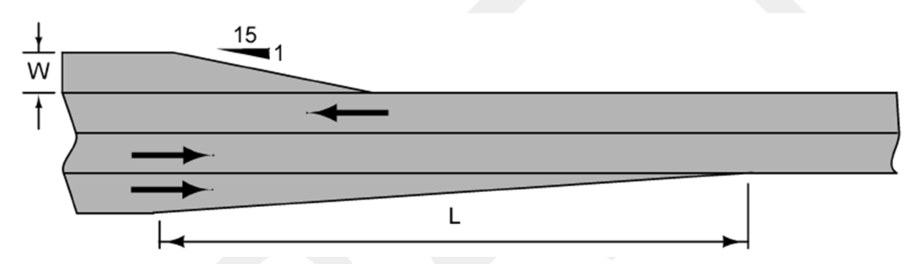
When additional lanes are developed, such as for passing lanes, climbing lanes, additional lanes at intersections, or in other circumstances, they should be developed with a 15:1 taper ratio, as shown in Figure 1. This section discusses adding, dropping, and redirecting through lanes. Taper ratios for right- and left-turn lanes are discussed in Section 6A-1.
Dropping Lanes
When dropping a through lane, the minimum length of taper can be determined by the following formulas:\(^{1}\)
\(L = \frac{WS^2}{60}\) for speeds of 40 mph or less
\(L = \frac{WS^2}{155} \text{ for speeds of 70 km/h or less}\)
\(L = S \times W \text{ for speeds of 40 mph or more}\)
\(L = 0.62 \times S \times W \text{ for speeds of 70 km/h or more}\)
where:
L = minimum length of taper.
S = posted speed limit or 85th percentile speed.
W = width of lane to be dropped or redirection offset.
Preferably, taper ratios should be evenly divisible by 5 (15:1, 20:1, etc.). Calculations that result in odd ratios should be rounded up to the next increment of 5. Table 1 utilizes the formulas to determine the appropriate taper ratios for dropping a 12-foot (3.6-meter) wide lane. The ratio remains constant for a given design speed, while the length varies with the lane width.
\(^{1}\)FHWA, Manual on Uniform Traffic Control Devices, Washington, D.C., U.S. Government Printing Office, 2000.
Table 1: Length and Taper Ratio for Dropping 12-foot (3.6-meter) Lane
Redirecting Lanes
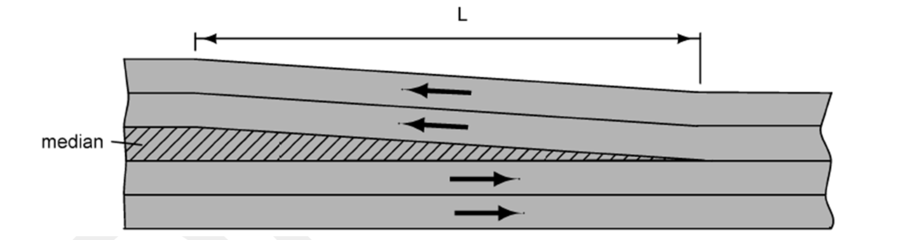
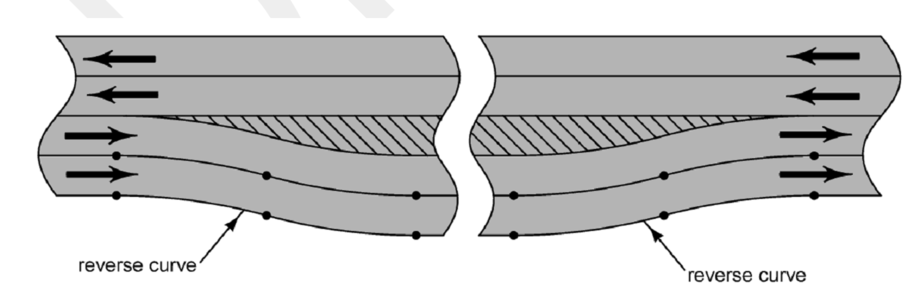
The procedure for determining minimum taper ratios for redirecting through lanes is the same as shown in Table 1 for lane drops; however, for design speeds over 45 mph (70 km/h), the use of reverse curves rather than tapers is recommended. Figure 2 below illustrates a taper for redirecting through lanes and Figure 3 illustrates redirecting through lanes using reverse curves. Section 2D-1 of this manual provides more information regarding reverse curves.