
Content Information
On this page...
A problem that occasionally confronts designers in heavily trafficked urban and suburban areas is traffic turning left onto side streets or into entrances. Left turn lanes can alleviate this problem at side streets, but in some urban and suburban areas, mid-block entrances are too close to place turn lanes, or heavy volumes of left turning traffic cause backups along the main roadway. Cases such as these might be best handled with the use of continuous two-way left-turn lanes (TWLTLs).
A TWLTL is a lane placed between opposing lanes of traffic for the purpose of allowing traffic from either direction to make left turns off of a roadway. Figure 1 illustrates a TWLTL.
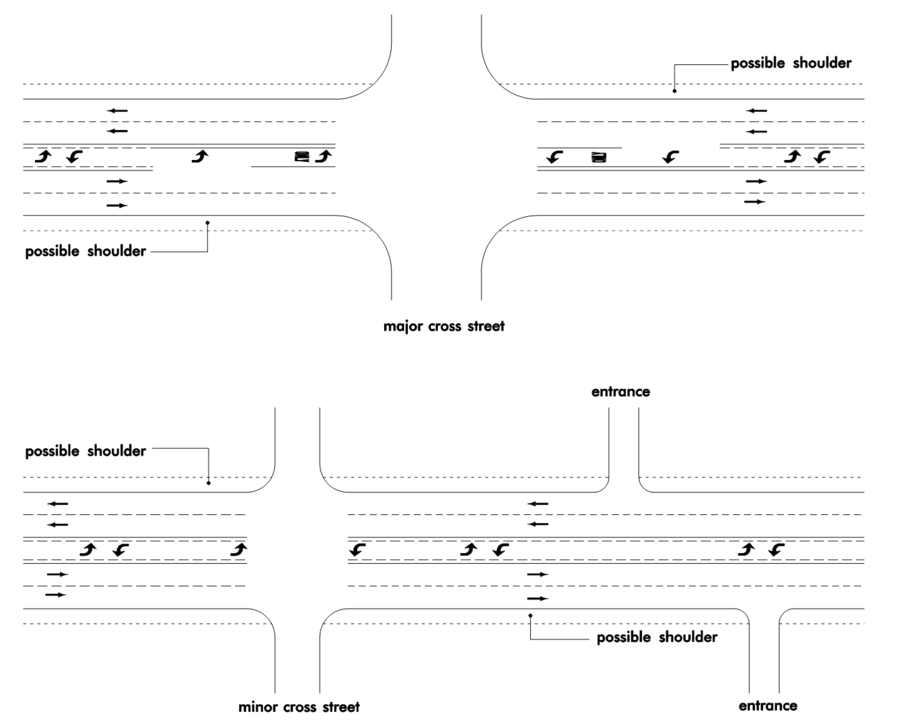
Consideration of TWLTLs
Continuous two-way left-turn lanes offer several advantages. First, TWLTLs remove left turning vehicles from the through lanes, which can reduce delay to through vehicles and can lead to a reduction in rear-end and sideswipe collisions. Second, TWLTLs provide spatial separation between opposing lanes of traffic, which can lead to a reduction in head-on collisions. Finally, two-way left-turn lanes can also function as a lane for emergency vehicles.
Though TWLTLs offer several advantages, there are several considerations\(^{1}\) involved with determining whether or not a TWLTL is an appropriate design. Existing and projected future conditions are two very important considerations, as are constraints and priorities.
Existing Conditions
Existing conditions include geometrics and traffic control, operational demands such as left turn volume, operational conditions such as capacity and level of service, safety conditions, and land use. Geometrics, for example sight distance requirements, may exclude the option of TWLTLs in some situations. Reduced level of service may indicate need for additional lanes. If the reduced level of service is a result of high left turn volume, TWLTLs may be a good alternative to adding lanes to both directions.
Safety issues such as the number of crashes, along with their severity, type and frequency should be considered. The need for a refuge area for pedestrians should also be factored in as the need for a refuge area may eliminate the option of a TWLTL. Land use should also be considered. Urban areas with high intersection and driveway densities may benefit from TWLTLs, whereas a suburban area with low driveway and intersection densities might be better served with turn lanes at the intersections.
Projected Future Conditions
Future projected conditions include traffic volumes (including trucks) and left turn volumes, along with type of land development and driveway and intersection densities. Projected volumes may indicate need for additional lanes: TWLTLs may serve as an alternative. Land development may require the addition of driveways and intersections, leading to an increase in left turn volumes. Two-way left-turn lanes may help to alleviate future problems with left turn movements.
Constraints
In addition to existing and future projected conditions, physical constraints such as right of way must be considered, along with economic limitations. Lack of sufficient funding may exclude the option of TWLTLs. Lack of available additional ROW may eliminate the possibility of a TWLTL.
Priorities
Priorities, namely cost, safety, and speed, must be identified. Though left turn lanes always benefit safety and flow, the priorities between cost, safety, and speed will ultimately determine the choice between no turn lanes at all, two-way left-turn lanes, or raised medians with turn bays.
Back to topLimitations for TWLTLs
There are some limitations to TWLTLs the designer must keep in mind. Extra street width may be required, resulting in an increased need for right of way. In addition, TWLTLs add another lane for pedestrians and bicyclists to cross and do not provide a refuge area for them. Another limitation is that TWLTLs may not alleviate safety problems at closely spaced entrances and intersections, where queuing traffic can block left turning movements.
Placement of TWLTLs should be limited to suburban and urban areas only, as a TWLTL could be mistaken or misused as a passing lane in rural areas. The number of through lanes adjacent to the TWLTL should be limited to two in each direction. Normally, shoulders should not be sacrificed in order to place a TWLTL, as safety problems associated with removal of shoulders may outweigh advantages gained by the use of a TWLTL. However, if the designer can document elimination of the shoulders will not create a safety problem, shoulders can be replaced with curb and gutter in order to accommodate the addition of a TWLTL. Traffic volumes in excess of 6,000 vpd would warrant consideration of a TWLTL on a two-lane facility, as 6,000 vpd is the volume at which additional lanes are considered for two-lane highways. Similarly, traffic volumes in excess of 10,000 to 12,000 vpd would warrant consideration of a TWLTL on a four-lane facility.
\(^{1}\)Harwood, Douglas W. Multilane Design Alternatives for Improving Suburban Highways. National Cooperative Highway Research Program 282. Transportation Research Board, National Research Council, Washington, DC March 1986.
Back to topDesign of TWLTLs
The normal width of a TWLTL is 14 feet (4.2meters), though 10-to-12-foot (3.0 to 3.6 meter) widths may be considered in areas with restricted right of way or pavement width. Pavement markings shall be in accordance with the MUTCD. The minimum length to be considered for a TWLTL should be ¼ mile (400 meters), though shorter lengths may be considered if the engineer documents the need. Right turn lanes should also be considered at major intersections to further reduce delays to through traffic.
The design of transition areas that involve a lane drop is crucial. Transition areas should be located away from high volume driveways and signalized intersections.
Back to topConversion from Four Lanes to Three Lanes
Many four lane undivided facilities may benefit from conversion to three lane facilities with TWLTLs. Several conversions have been completed in other states, as well as in Iowa. The results have been positive with reductions in accidents and increased popularity with the public. A portion of US 75 in Sioux Center, Iowa has been converted from a four-lane facility to three lanes with a TWLTL and the results have been very positive: a sharp decrease in accidents and excessive speeding, and support from both the public and businesses along the highway. Other four lane to three lane conversions in Iowa have demonstrated the ability to handle capacities as high as 16,000 ADT. The Office of Traffic and Safety should be consulted when considering converting from a four lane undivided facility to a three lane TWLTL facility.
Reasons to consider converting a four-lane facility to a three lane with a TWLTL include:
- high accident rates involving left turning movements, sideswipes, rear-ends, or crossing traffic
- the need for traffic calming
- pedestrian and bicyclist safety issues
- “defacto” left turn lanes: areas where a four-lane facility is operating like a three-lane facility, with the inside lanes operating as left turn lanes.
A number of factors\(^{2}\) must be weighed into the decision to convert to a three lane with TWLTLs. Perhaps the most important is the function of the road. A road that serves primarily to move traffic through may not benefit from the conversion as much as a road that serves to access property. Areas that are prone to stop and go traffic such as school buses or delivery vehicles, or where slow moving vehicles such as heavy trucks are common, may also fail to benefit from a conversion to three lanes. Conversion should be avoided in areas where there is on-street parking. Railroad crossings may also present a problem: the number of through lanes has been reduced which may result in longer queues—up to twice as long. An increase in delay for access from side streets may also result from a conversion to three lanes. Finally, an ADT of 15,000 to 17,500 should be considered as the maximum capacity a three lane with TWLTL facility can handle.
Typically, initial community reaction to the conversion will be negative since it seems logical to assume that eliminating a lane will reduce capacity and increase delays; however, though the number of through lanes has been reduced, capacity is generally not reduced and the resulting increase in delay is very minor since the delay caused by left turning traffic in through lanes has been eliminated. This slight increase in delay can act as a traffic-calming device. The reduction in through lanes will also reduce lane changes and will benefit pedestrians and bicyclists since they are required to cross fewer lanes. Consideration should not be given to converting a four-lane undivided roadway to a three-lane roadway unless the community perceives the need to improve safety and/or to implement traffic calming.
Two-way left-turn lanes can be very effective in areas where the inside lane of a four-lane facility is essentially acting as a turn lane, areas known as “defacto” left turn lanes. Left turning traffic is removed from the through lanes and the need for drivers trapped in the inside lane to switch lanes to pass a left turning vehicle is eliminated, thus further reducing the possibility of accidents. Though through traffic is reduced to one lane, delays increase only slightly since drivers are no longer trapped behind left turning vehicles.
Converting from a four-lane facility to a three-lane typically involves simply re-striping the roadway. When converting a four-lane facility to three lanes, it is important that the old paint markings be thoroughly removed and the TWLTL be marked according to the MUTCD. It is also important to examine turning movements at major intersections to determine if right turn lanes are needed. Before and after studies of the conversion should be completed and documented.
\(^{2}\)Knapp, Keith, et. al. Guidelines for the Conversion of Urban Four-Lane Undivided Roadways to Three-Lane Two-Way Left-Turn Lane Facilities. Center for Transportation Research and Education, 2001
Back to top